
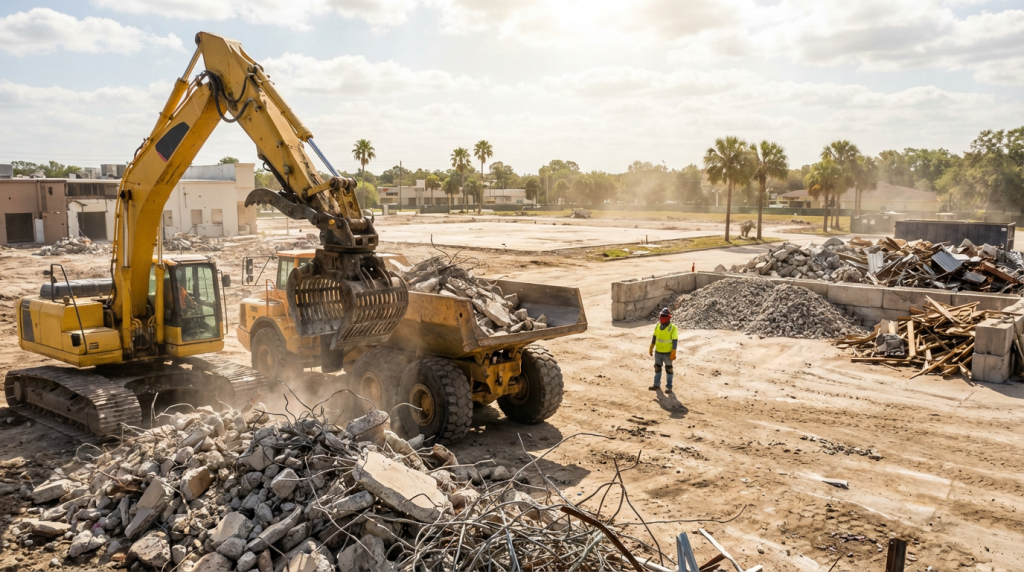
Quick Answer: Demolition debris removal is the controlled process of collecting, separating, hauling, and disposing of materials generated during structural demolition. On large commercial and infrastructure projects, it directly affects site safety, compliance, and how quickly a project can transition into construction.
Key Takeaways
- Demolition debris removal is a critical path function on commercial and infrastructure projects, directly affecting sequencing, access, and overall project delivery—not just site cleanup.
- When not properly planned, debris buildup can quickly disrupt workflow, slow inspections, and force downstream trades to operate out of sequence.
- Effective debris management requires coordinated planning across demolition, hauling, recycling, and documentation to maintain productivity and compliance.
- Cost, schedule, and safety impacts are tightly linked—inefficiencies in debris removal tend to cascade across all three areas.
- The most successful projects integrate debris removal into preconstruction planning rather than treating it as a post-demolition activity.
When you’re managing a large-scale commercial build, bridge teardown, or industrial redevelopment in Central Florida, demolition isn’t the finish line—it’s the start of your biggest logistical challenge. For projects involving complex infrastructure, our experience with bridge and highway demolition shows how quickly debris removal becomes a critical sequencing issue.
Once structures come down, you’re dealing with thousands of tons of concrete, steel, and mixed debris that must be cleared fast, documented properly, and handled in full compliance with local and state regulations. In many cases, this requires coordination across specialized crews and equipment, similar to what we execute on heavy highway and bridge demolition projects. All while keeping your project on schedule, your site accessible, and your team moving.
If debris is not actively managed, it quickly disrupts access, slows inspections, and creates downstream delays across multiple trades. To support this, many contractors align their approach with established safety protocols and field procedures, such as those outlined in our PPE and safety program.
Done right, demolition debris removal keeps your project moving forward—clean, compliant, and ready for the next phase. Done wrong, it becomes a bottleneck that affects every trade behind you.
Scope of Demolition Debris Removal in 2026
On large commercial and infrastructure projects in Central Florida, demolition debris removal is driven by production planning, regulatory requirements, and site logistics—not just disposal.
Project Execution Reality
Bridge, highway, industrial, and redevelopment projects generate high-volume mixed materials that must be separated, staged, and removed in alignment with demolition sequencing and active site operations. In practice, this means coordinating crushing, recycling streams, and haul-off activity while maintaining access for ongoing construction and traffic control requirements.
Compliance & Documentation
For DOT, municipal, and private owners, debris removal also includes required closeout documentation:
- Haul tickets
- Recycling and diversion reports
- Landfill and disposal manifests
These records are now part of project delivery requirements, not just administrative closeout.
Why Effective Debris Removal is Crucial for Your Project
On commercial and infrastructure projects in Central Florida, demolition debris removal is a critical path function, not a cleanup activity. When it is not properly planned and executed, it impacts schedule performance, field productivity, cost control, and overall project delivery.
The impact of ineffective debris removal typically shows up in four areas: schedule performance, field productivity, cost control, and compliance exposure.
Schedule Impact (sequencing disruption)
Debris buildup is often the first point of failure, as it restricts access and forces work out of sequence. Earthwork, utility installation, foundation operations, and phased construction activities can all be delayed when work zones are not cleared in alignment with demolition progress. On DOT and roadway projects, this can also interfere with traffic control staging and planned lane shifts.
Productivity Loss (field inefficiency mechanism)
As sequencing breaks down, field productivity declines. Congested haul routes, limited staging areas, and poorly timed material removal slow down both demolition crews and supporting operations. Equipment and labor may be forced into idle time while waiting for cleared access, and material handling often requires multiple touchpoints instead of a single efficient flow.
Cost Exposure (financial consequence)
Reduced productivity and schedule disruption quickly translate into increased project costs. Common impacts include standby labor and equipment charges, inefficient hauling cycles, and higher disposal costs due to unoptimized load management. On public infrastructure work, these inefficiencies can also contribute to extended general conditions or liquidated damages when milestones are missed.
Compliance & Reputation (external exposure outcome)
Beyond operational impacts, debris management affects how a project is perceived by owners, agencies, and the public. Poor site control or documentation gaps can trigger inspection findings, corrective actions, or audit issues. On visible commercial and infrastructure projects, unmanaged debris can also lead to complaints, increased scrutiny, and reduced confidence in contractor performance during progress reviews or future awards.
Protecting Your Reputation and Investment
On high-visibility commercial and infrastructure projects in Central Florida, site conditions are closely tied to contractor performance. Poorly managed demolition debris removal can create perception and oversight risks that extend beyond the jobsite.
Public & Stakeholder Visibility
Poor site control becomes highly visible on active commercial and infrastructure projects:
- Complaints from adjacent businesses and residents
- Increased scrutiny on municipal and DOT corridors
- Negative perception during active redevelopment or roadway work
Owner and Agency Confidence
Clean, controlled sites reinforce confidence in project execution:
- Demonstrates strong field management and coordination
- Supports positive inspection outcomes and agency relationships
- Reduces questions during progress reviews and walkthroughs
Financial & Contract Risk
Visible site issues can escalate beyond operational concerns:
- Disputes over cleanup responsibility or scope interpretation
- Change order scrutiny tied to site conditions or delays
- Increased oversight on future project phases or awards
Challenges in Demolition Debris Removal
On commercial and infrastructure projects in Central Florida, demolition debris removal is shaped by site constraints, regulatory requirements, and sequencing demands, all occurring within active construction environments.
Many projects operate in highly restricted environments where space is limited and access is tightly controlled. Urban corridors, active commercial districts, and live roadway or bridge environments often leave little room for staging, stockpiling, or efficient truck loading. This makes coordination of material flow just as important as the demolition work itself.
At the same time, debris removal must be carefully aligned with ongoing construction activities. Demolition sequencing is typically tied to structural phases, utility work, and earthwork operations, meaning debris cannot simply be removed at the end—it must move continuously in step with production to avoid restricting access for follow-on trades.
Environmental and regulatory conditions in Central Florida add another layer of complexity. Stormwater protection, erosion control, and work near wetlands or sensitive areas often require additional planning during debris staging and hauling. Disposal and documentation requirements at the county and state level also mean material tracking must be maintained throughout the process, not just at closeout.
Finally, logistics play a major role in overall performance. Haul routes, traffic patterns, load sequencing, and coordination with approved disposal and recycling facilities all directly influence how efficiently debris can be removed from the site. When any of these elements are not properly planned, it can quickly impact productivity and extend overall project duration.
Regulatory Requirements in Central Florida
Demolition debris removal on commercial and infrastructure projects in Central Florida is governed by federal, state, and local regulations that directly impact how materials are handled, transported, and documented.
Regulatory requirements span state, county, and transportation agencies, all of which define how materials are handled, transported, and documented.
When hazardous materials are involved, additional federal and state requirements apply. Materials such as asbestos, lead-based paint, or contaminated soils must be tested, documented, and disposed of through licensed facilities.
Compliance is not just administrative—it directly influences sequencing, scheduling, and overall project risk from demolition through turnover.
Safety and Liability Concerns
Demolition debris handling introduces multiple field-level safety and liability exposures on active projects on commercial and infrastructure projects in Central Florida, especially where multiple crews, equipment, and public interfaces are active.
Key risk areas include:
- Equipment and personnel interaction hazards (struck-by incidents, backing accidents, material handling injuries)
- Uncontrolled haul routes and staging areas leading to congestion and collisions
- Active roadway and bridge work zone exposure, where traffic and construction overlap
- Dust, debris, and containment failures that can trigger inspection issues or complaints
- Regulatory or owner non-compliance findings, including corrective actions or work stoppages
To mitigate these risks, debris removal should be built into site safety planning from the outset. Effective controls typically include defined haul routes, designated loading zones, dust suppression measures, and consistent coordination between demolition crews, trucking operators, and site supervision.
On DOT and public-sector projects, safety performance is closely monitored, making disciplined debris management a key factor in project delivery and contractor evaluation.
The Demolition Debris Removal Process
Efficient demolition debris removal follows a continuous sequence that aligns with demolition production, site logistics, and turnover requirements on commercial and infrastructure projects in Central Florida.
1. Pre-Planning and Setup
The process begins in preconstruction, where material types, estimated volumes, disposal locations, recycling opportunities, haul routes, and staging areas are identified and aligned with the overall project schedule.
2. Phased Demolition and Material Removal
As demolition progresses, debris removal is coordinated in real time to maintain site access and prevent congestion. Material is removed in phases that match structural sequencing, traffic control requirements, and follow-on trade access needs.
3. On-Site Sorting and Material Handling
As materials are generated, they are separated where feasible into distinct streams such as concrete, metals, and mixed debris. This supports recycling opportunities and reduces disposal costs while maintaining cleaner staging conditions on site.
4. Hauling, Transport, and Disposal
Once staged, materials are transported using appropriate equipment such as roll-off trucks or dump trailers. Loads are scheduled around site activity and traffic conditions, and delivered to approved landfills or recycling facilities based on material type and project requirements.
5. Documentation and Final Cleanup
Throughout the process, haul tickets, manifests, and recycling records are maintained for compliance and closeout. At completion, remaining debris is cleared and the site is prepared for the next phase of construction.
How to Choose the Right Demolition Debris Removal Partner
Selecting the right demolition debris removal partner directly affects how efficiently demolition transitions into construction. The wrong fit can quickly create coordination issues that impact demolition sequencing and delay downstream work.
Experience should be your first filter. Contractors with a proven track record on commercial, industrial, or DOT/infrastructure projects are better prepared to manage high production rates, complex phasing, and constrained jobsite conditions without disrupting ongoing operations.
From there, evaluate whether demolition and debris removal are handled as an integrated scope. When these functions are split across multiple vendors, coordination gaps often lead to inefficiencies, missed haul windows, and unnecessary site congestion.
Key capabilities to confirm include:
- Sufficient hauling capacity to match demolition production rates
- Equipment and staffing levels that prevent material bottlenecks
- Ability to maintain continuous site access for follow-on trades
Safety and regulatory compliance should be clearly demonstrated through documented procedures and field practices. This includes familiarity with FDOT requirements, local disposal regulations, and environmental controls that apply to active construction zones.
Strong partners also bring consistency in communication and field coordination. They should work directly with superintendents, project managers, and inspectors to ensure debris removal stays aligned with sequencing, access requirements, and overall project schedule performance.
Ultimately, the right partner functions as an extension of the project team, ensuring debris removal supports—not constrains—project delivery.
Frequently Asked Questions
1. How is demolition debris removal different from standard construction waste hauling?
Demolition debris removal deals with high-volume, mixed structural materials (concrete, steel, asphalt, embedded debris) generated in a short timeframe, often requiring phased removal tied to demolition sequencing. Standard construction hauling is typically lower volume and more predictable in material type and timing.
2. At what stage should debris removal be planned—before or after demolition starts?
It should be planned during preconstruction, not after demolition begins. Early planning allows haul routes, staging areas, recycling streams, and disposal sites to be aligned with sequencing so debris flow does not interrupt active work.
3. What happens to mixed debris that cannot be easily separated on site?
Mixed loads are typically transported to approved facilities where further sorting, processing, or disposal occurs. However, improper on-site separation can increase disposal costs and reduce recycling opportunities, so most large projects prioritize at least basic segregation in the field.
4. How do weather conditions in Central Florida affect debris removal operations?
Heavy rain, storms, and high groundwater conditions can limit access to staging areas, affect soil stability, and delay hauling schedules. Projects often require adaptive sequencing and temporary stabilization measures to maintain safe and continuous debris movement.
5. What type of documentation is typically required for closeout on public infrastructure projects?
Common requirements include haul tickets, landfill receipts, recycling/diversion reports, and sometimes weight tickets from certified scales. DOT and municipal projects may also require more detailed reporting to verify compliance with disposal and environmental standards.