Florida is in the middle of one of the largest infrastructure buildouts in its history. FDOT’s Moving Florida Forward program has committed $7 billion toward highway widening, bridge replacements, and interchange upgrades across the state — and every one of those projects generates demolition work. If you’re a general contractor or prime holding a DOT contract, you already know that the demolition phase is where timelines get made or broken.
Heavy highway demolition is not a side service. It requires specialized equipment, an experienced crew, and a subcontractor who understands how DOT projects actually run — the phased schedules, the traffic control requirements, the coordination with utilities, and the permit approvals that stack up before the first piece of concrete ever comes down. Getting this wrong costs you time you don’t have.
Key Takeaways
- Florida DOT projects require demolition subcontractors to hold applicable Florida specialty contractor licenses, even when working under a prequalified prime.
- Heavy highway demolition scope typically includes bridge deck removal, structural teardown, pavement milling, retaining wall demo, and concrete recycling.
- Phased demolition and live-traffic management are non-negotiable requirements on most FDOT corridor projects.
- A subcontractor’s safety record and equipment availability are the most common make-or-break factors when GCs are vetting for a DOT bid.
- PAW Demolition actively bids heavy highway and bridge projects statewide and brings 43 years of Florida demolition experience to every job.
What Counts as Heavy Highway Demolition
Heavy highway demolition covers the structural and pavement removal work that happens before new construction can begin on DOT corridor projects. This is not the same as routine excavation or site clearing. The scope is more complex, the regulatory environment is tighter, and the consequences of schedule slippage are felt immediately by every other trade on the project.
Common work types in this category include:
- Bridge deck and superstructure removal — full or partial teardown of existing spans, often over live traffic or water
- Retaining wall and sound barrier demolition — removal of aging concrete structures along widening corridors
- Pavement removal and base preparation — milling, breaking, and hauling concrete or asphalt at high volume
- Ramp and interchange teardown — demolition of existing interchange structures during reconfiguration projects
- Culvert and drainage structure removal — clearing aged infrastructure ahead of drainage system upgrades
- Median and barrier removal — clearing concrete barriers and median structures ahead of lane additions
Each of these requires different equipment, different sequencing, and often a different permit approach. A subcontractor who handles only one or two of these tasks is going to create gaps in your schedule.
How FDOT Projects Structure the Demolition Phase
On FDOT-managed contracts, the prime contractor holds the agreement with the Department and takes full responsibility for specification compliance. Subcontractors do not bid directly to FDOT — they work under the prime. That said, subcontractors must still hold the applicable Florida specialty contractor licenses issued by the Department of Business and Professional Regulation (DBPR). Under Florida Statute §337.14 and FDOT Rule 14-22, prime contractors bidding road, bridge, or public transportation construction contracts above $250,000 must be prequalified with FDOT — but subcontractors working under a prequalified prime are not subject to that same requirement. The prime is also required to obtain FDOT written consent before subcontracting more than 50 percent of the original contract value, per FDOT Standard Specification 8-1 (available via the FDOT Standard Specification Library).
On federally funded highway projects, additional layers apply: Buy America provisions for steel and iron materials, Davis-Bacon prevailing wage requirements under 29 CFR Part 5, and FHWA Form 1273 inclusion all overlay the standard FDOT contract structure. Your demolition sub needs to understand these requirements, not just acknowledge them.
Demolition is typically one of the first phases on a corridor project, which means any delay in that phase cascades directly into grading, drainage, and structural work. The pressure to stay on schedule is immediate and real from the first day of demo.
Pro Tip: When evaluating a demolition subcontractor for a DOT project, ask specifically about their experience working within active FDOT corridor projects — not just general demolition. The permitting coordination, phasing requirements, and traffic control protocols on a DOT job are meaningfully different from a standalone commercial teardown.
Equipment and Capacity: What the Work Actually Requires
Heavy highway demolition is equipment-intensive. Projects at this scale move fast, and rental equipment and third-party crews create real scheduling risk. When a machine breaks down on a DOT project and the replacement is three days out, that is your problem as the prime — not just the sub’s.
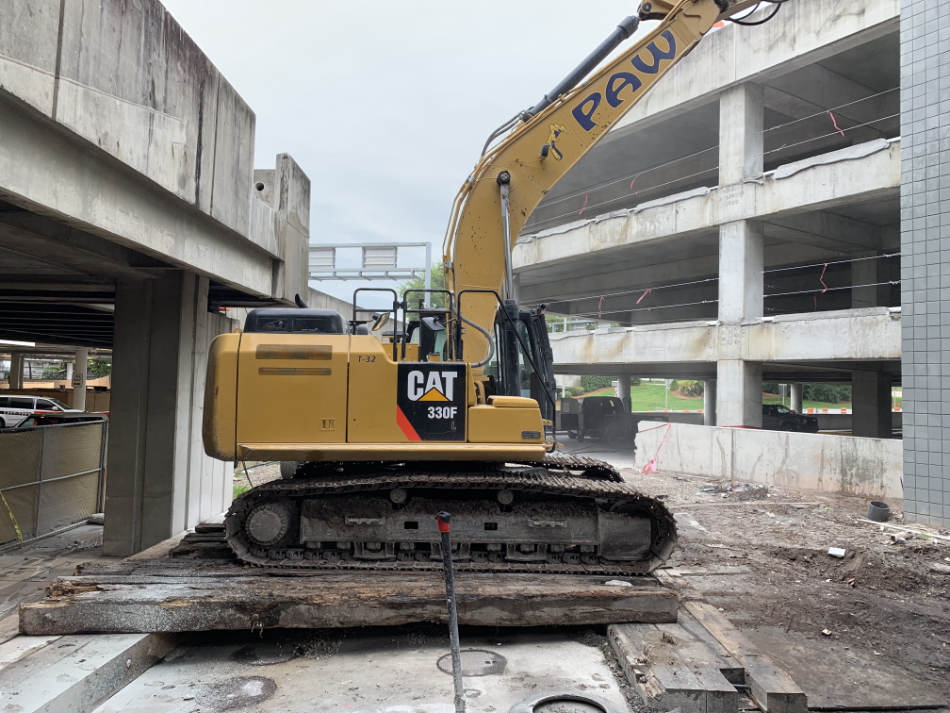
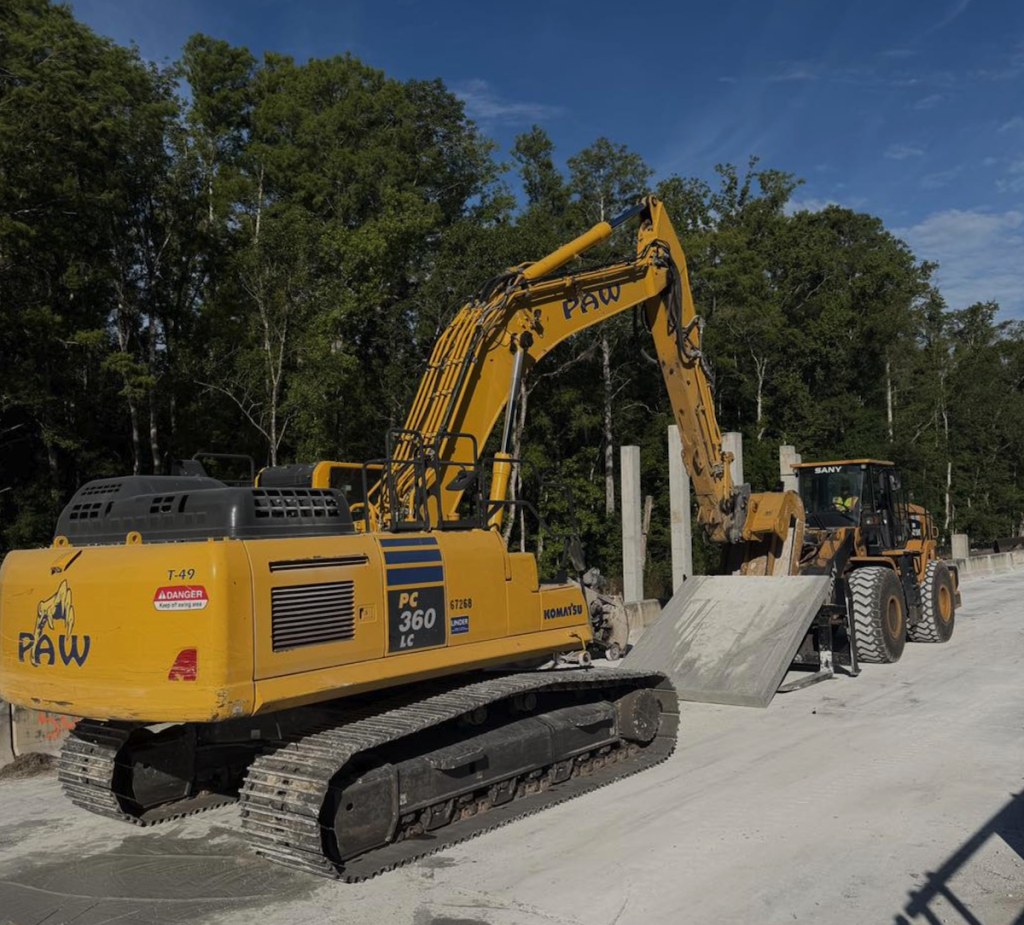
The core equipment for highway demolition typically includes high-reach excavators for elevated structure work, concrete pulverizers and hydraulic shears for structural dismantlement, large-tonnage demolition hammers for bridge deck breaking, and a fleet of dump trucks capable of moving high volumes of concrete debris on a compressed timeline.
In-house equipment ownership matters here. A subcontractor running their own fleet can reposition machines quickly, schedule maintenance on their own timeline, and mobilize without waiting on third-party availability. On a DOT project where the window to close a lane or work over live traffic is measured in hours, that flexibility is not a minor detail.
PAW Demolition operates an owned equipment fleet and staffs every project with direct employees — no outsourced crews. For GCs managing tight DOT schedules, that means one call to one point of contact, with no subcontractor-within-a-subcontractor chain to manage.
Safety Requirements on DOT Demolition Projects
DOT projects carry elevated safety scrutiny. OSHA compliance is the baseline — but on federally funded jobs, the oversight is ongoing and the documentation requirements are substantial. FDOT’s own specifications reference safety management plan requirements, and many primes require their demolition subs to carry specific EMR (experience modification rate) thresholds before they will even consider a bid.
According to the National Council on Compensation Insurance (NCCI), the governing body that calculates experience modification rates for most U.S. states including Florida, an EMR of 1.0 represents the industry average. A rating below 1.0 means a contractor’s claims history is better than average for their classification. Most GCs require subcontractors to carry an EMR below 1.0 for standard commercial and industrial work, with many large infrastructure projects setting thresholds at 0.85 or lower. PAW Demolition carries a 0.72 MOD rate, which reflects a safety record 28 percent better than the industry average. On a DOT project where a recordable incident triggers mandatory reporting and potential stop-work orders, that number carries real weight.
You can review PAW Demolition’s safety procedures and PPE protocols for a detailed look at how safety is managed on active job sites.
Pro Tip: Before awarding demolition work on a DOT project, request the sub’s current EMR certificate directly from their insurance carrier — not just a number from the sub. Also confirm that their certificate of insurance lists your project specifically and includes the state as an additional insured where required by the contract.
Phased Demolition and Live-Traffic Coordination
One of the defining challenges on heavy highway demolition is that the work rarely happens in isolation. On corridor widening projects, you are often tearing down a structure on one side of active lanes while traffic continues moving on the other. On bridge replacement projects, you may need to keep the structure partially open while demo work proceeds on one span.
Phased demolition requires detailed sequencing planning before the first piece of equipment arrives on site. The demolition contractor needs to understand:
- Which sections must remain structurally intact during adjacent demo work
- How debris removal will be staged to avoid lane encroachment
- What night-work or off-peak windows are available for the highest-impact demolition activity
- How temporary shoring or protection will be handled if needed
- What the approved MOT (Maintenance of Traffic) plan requires at each phase
A subcontractor who has only worked on standalone demolition sites will have a learning curve on all of this. Experience on FDOT and DOT projects is not a nice-to-have — it directly affects how smoothly your project runs.
Permitting on Heavy Highway Demolition Projects
Demolition within a state right-of-way or on a DOT-funded project operates under a different permitting structure than standard commercial demolition. The permit process is generally coordinated by the prime contractor and routed through the relevant FDOT district office, though the specific requirements, review timelines, and documentation vary by district and project type. Your demolition sub needs to be prepared to provide documentation quickly and accurately when the permit review process requires it.
On projects that cross county jurisdictions — which is common on highway corridor work — additional local permits may apply at each county line. In-house permitting capability matters here. A demolition contractor who manages permits internally can move faster, respond to permit conditions more efficiently, and avoid the delays that come from routing requests through a third-party permit service.
PAW Demolition handles permitting in-house across the Florida counties we serve. For more detail on how the commercial demolition permit process works across Florida, see our overview of commercial demolition services.
Bidding a DOT Project with a Heavy Demolition Phase?
Talk to a team that has done it. PAW Demolition brings 43 years of Florida demolition experience, an owned equipment fleet, and a 0.72 MOD rate to every project.
Concrete Recycling and Material Handling at Scale
Heavy highway projects generate substantial volumes of broken concrete — pavement, bridge deck, retaining walls, and median barriers. How that material is handled affects both your project cost and your compliance with any recycling requirements in the contract.
A demolition contractor with on-site crushing capability can process concrete debris into usable aggregate on or near the project site. This reduces haul-off volume, lowers disposal costs, and in some cases produces material that can be repurposed within the project itself. Florida DOT projects increasingly reference recycled concrete aggregate in their specifications, which makes this capability a practical advantage.
PAW Demolition’s materials operation provides crushed concrete and aggregate products for construction projects across the Tampa Bay region, which means the recycling infrastructure is already built into how we handle large demolition volumes. Learn more about our recycling and sustainability approach.
Pro Tip: When scoping a highway demolition bid, ask your sub what happens to the concrete debris. A contractor with in-house crushing capability may be able to offset a portion of the demolition cost by processing material into saleable aggregate — a detail that can meaningfully affect the overall project economics.
What to Look for When Qualifying a Highway Demo Sub
If you are a GC or prime contractor evaluating demolition subcontractors for a DOT bid, the checklist is more specific than for a standard commercial project. Here is what matters most:
| Qualification Factor | What to Ask |
|---|---|
| FDOT project experience | Have they completed work on FDOT or DOT-funded corridor projects? Can they name specific projects? |
| Bridge and structure capability | Do they have the equipment and expertise for elevated structure removal, not just ground-level demo? |
| EMR and safety record | What is their current verified EMR? Do they have an active safety management plan? |
| Equipment ownership | Do they own their fleet or rely on rentals? Can they mobilize quickly if the schedule compresses? |
| Crew staffing model | Are they using direct employees or subcontracting the work out again? |
| Permitting capability | Can they handle permit applications in-house, or will permit delays add time to your schedule? |
| Phased demo experience | Have they worked on projects with active traffic, MOT requirements, or partial-use structures? |
| License verification | Are they properly licensed by DBPR for the scope of work required? |
PAW Demolition and Heavy Highway Work in Florida
PAW Demolition has been operating in Florida for 43 years. Our work includes full bridge demolition and heavy highway teardown on projects across the state. We actively bid DOT-related demolition projects throughout Florida and have the equipment, experience, and safety record that serious infrastructure projects require.
We operate a regional service area that covers Pasco, Hillsborough, Pinellas, Hernando, Polk, and surrounding counties, with the ability to mobilize statewide on the right projects. If you are a prime or GC putting together a DOT subcontractor team, learn more about PAW Demolition or get in touch directly.
Frequently Asked Questions
Does a demolition subcontractor need to be FDOT prequalified to work on a DOT project in Florida?
No. Under Florida Statute §337.14 and FDOT Rule 14-22, prime contractors must be FDOT prequalified for road, bridge, or public transportation construction contracts above $250,000 — but subcontractors working under a prequalified prime are not required to hold FDOT prequalification. Subcontractors must hold the applicable Florida specialty contractor licenses issued by DBPR. The prime contractor is responsible for obtaining FDOT written consent before subcontracting more than 50 percent of the contract value.
What types of demolition work are common on FDOT highway projects?
Common demolition scope includes bridge deck and superstructure removal, retaining wall and sound barrier teardown, pavement breaking and removal, ramp and interchange demolition, median barrier removal, and culvert removal. Many corridor projects involve several of these simultaneously across different project phases.
How does phased demolition work on a live-traffic highway project?
Phased demolition means the teardown is sequenced so that portions of the roadway or structure remain usable during demo work. The demolition contractor works within approved lane closure windows — often at night or during off-peak hours — and coordinates debris removal to avoid encroaching on active traffic. The project’s Maintenance of Traffic (MOT) plan governs what work can happen during each phase.
What is a good EMR for a demolition contractor working on DOT projects?
Per NCCI guidance, an EMR of 1.0 represents the industry average. Most GCs require subcontractors to carry an EMR below 1.0 as a baseline for prequalification. On larger infrastructure and government projects, many primes set the threshold at 0.85 or lower. PAW Demolition’s current MOD rate is 0.72, which is 28 percent better than the industry average.
Can concrete from highway demolition be recycled?
Yes. Concrete from pavement, bridge decks, and retaining walls can be crushed into recycled concrete aggregate and repurposed for road base, drainage applications, or construction fill. Some FDOT project specifications call for recycled aggregate use. Working with a demolition contractor who has in-house crushing capability can reduce haul-off costs and simplify material handling at scale.
Does PAW Demolition work on projects outside the Tampa Bay area?
Yes. PAW Demolition bids heavy highway and bridge demolition projects across Florida and has taken select out-of-state projects when the scope and logistics are the right fit. The primary service area covers the Tampa Bay region and surrounding Central Florida counties, but statewide capability is available for the right projects.