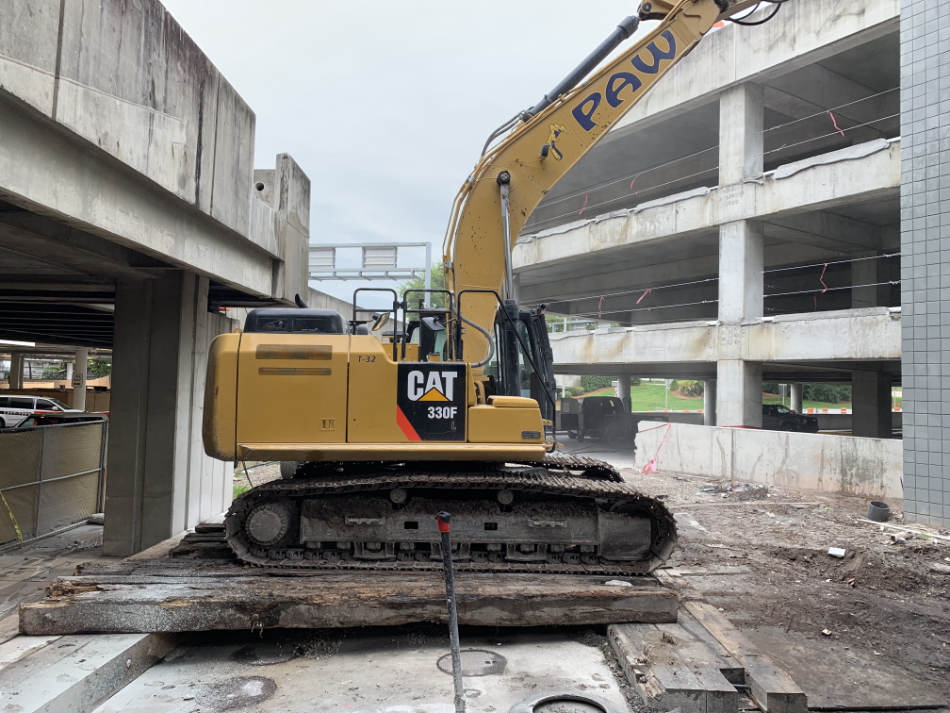
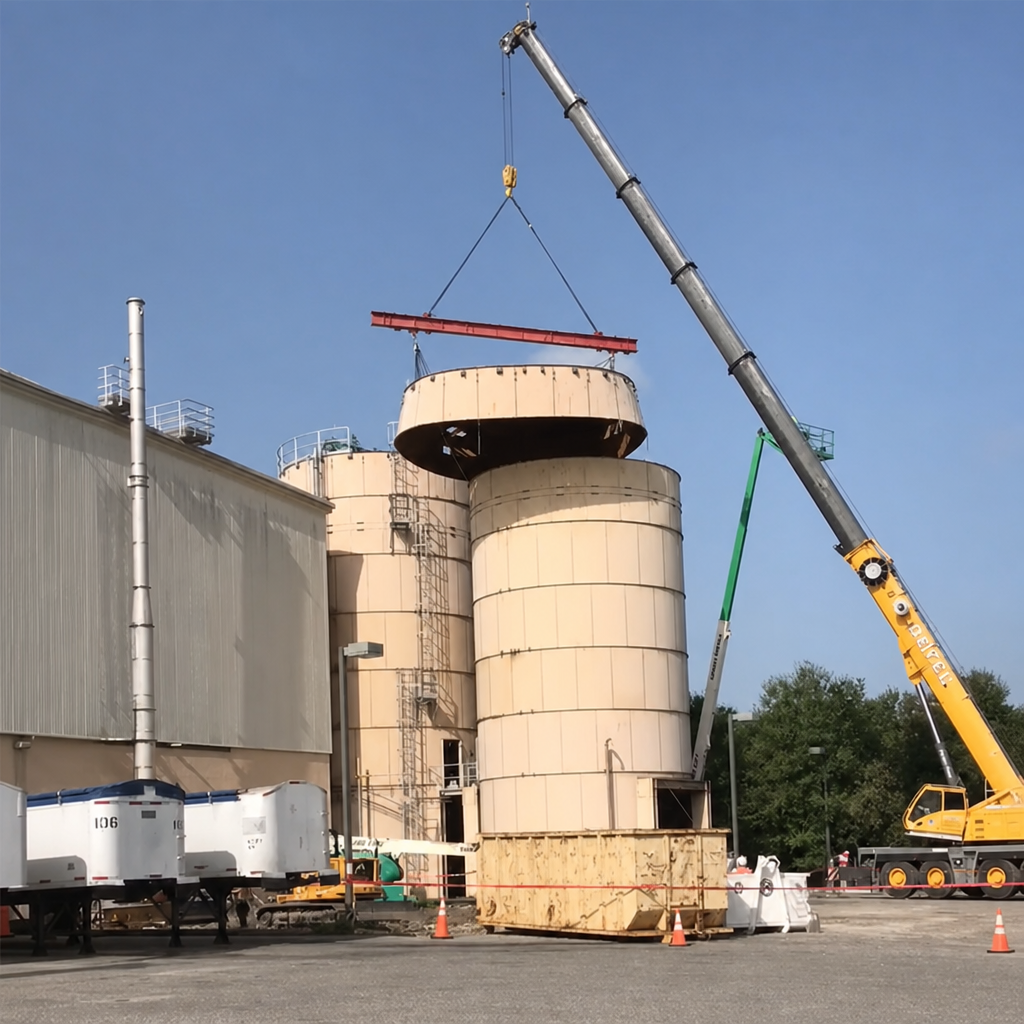
Quick Answer: At wastewater treatment facilities, sludge removal is not a separate pre-demo task. It is the first phase of demolition. A contractor who self-performs sludge extraction, dewatering, structural demolition, hauling, and site restoration under a single contract eliminates the schedule gaps and liability handoffs that split-scope projects introduce. This article explains what full-scope wastewater facility decommissioning actually looks like in the field, what GCs and municipal project managers should require from a subcontractor, and where projects go wrong when the scope is divided.
Key Takeaways
- Sludge removal and dewatering must be completed before structural demolition can begin at water reclamation and wastewater facilities.
- Dewatering sludge on-site before hauling significantly reduces disposal costs. Hauling liquid material is one of the most common and expensive mistakes during facility closures.
- A full-scope contractor who self-performs sludge removal, demolition, hauling, and site restoration reduces schedule risk and coordination overhead for GCs and municipal agencies.
- Concrete recycled from demolished structures can be processed into aggregate on-site, directly supporting sustainable closure requirements in public contracts.
- In Florida, wastewater facility decommissioning involves permit coordination with multiple agencies including Florida DEP district offices, the applicable water management district, and the county building department.
Why Sludge Removal Comes First
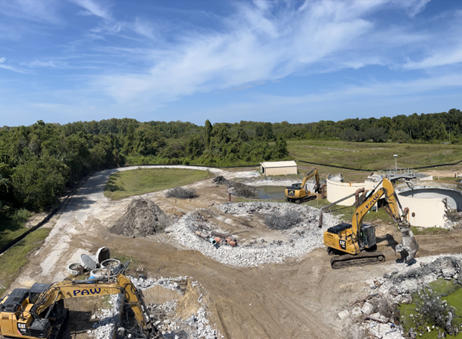
Structural demolition at a wastewater treatment facility cannot begin while tanks and digesters still contain material. Residual biosolids (the semi-solid material remaining after wastewater treatment) create confined space hazards, limit equipment access, and generate environmental liability if disturbed during structural work. Florida DEP regulations require that domestic wastewater facilities obtain permits for construction and decommissioning activities, and those permits routinely require tanks to be emptied and cleaned as a precondition to structural work in Florida-specific projects. Each county and water management district may impose additional requirements.
The sequencing matters to your project schedule. If sludge removal is not integrated into the demolition contractor’s scope from the start, you face the risk of one subcontractor waiting on another. That handoff creates delays, and delays at a decommissioned facility mean extended carrying costs for the owner.
What Full-Scope Sludge and Demolition Work Actually Looks Like
When PAW Demolition completed the Spring Hill Water Reclamation Facility decommissioning for Hernando County, the project scope covered sludge removal, dewatering, demolition, hauling, and full site restoration under a single $646,541 contract. The project commenced in September 2023 and reached final completion in January 2024.
Self-performing the full scope meant no handoffs between contractors, no schedule gaps between phases, and a single point of accountability for the county. PAW’s owned equipment fleet handled sludge extraction and dewatering on-site, then the demolition phase moved forward once the tanks were cleared. All concrete from the demolished structures was hauled to PAW’s own recycling facility and processed into aggregate, keeping material out of the landfill and supporting the project’s environmental closure requirements.
Phase 1: Pre-Demolition Sludge Removal and Dewatering
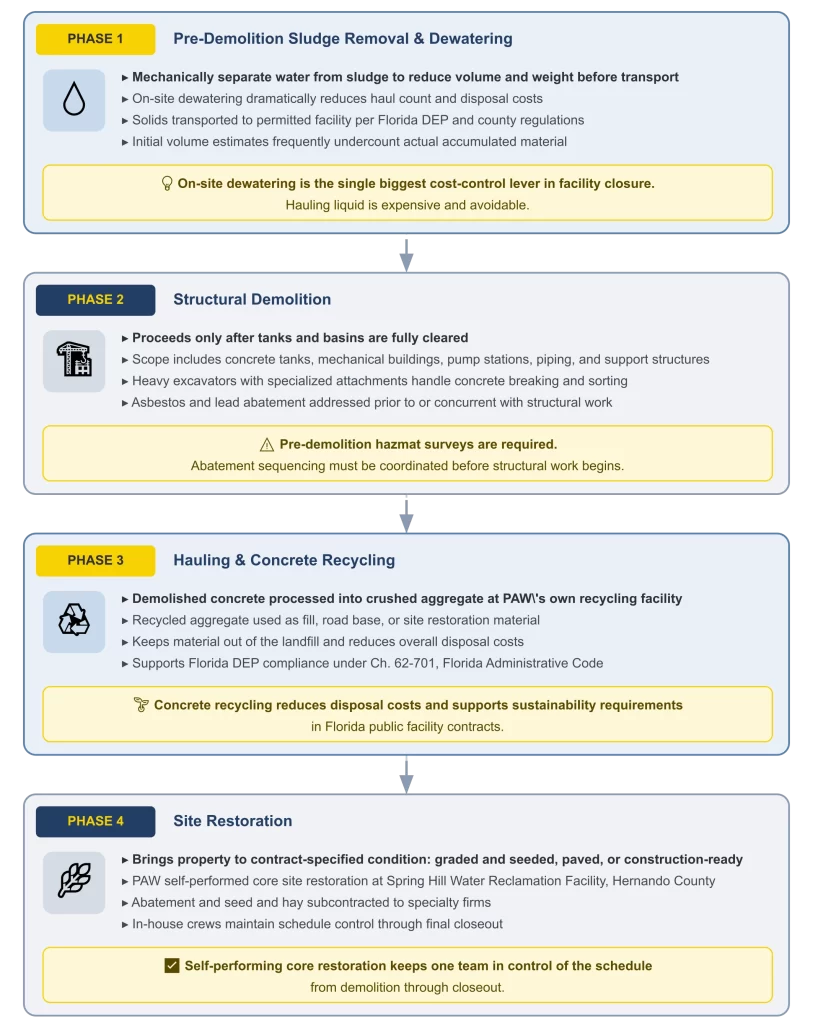
Dewatering is the process of mechanically separating water from sludge to reduce volume and weight before transport. Liquid sludge hauling is one of the most expensive mistakes made during wastewater facility closures. Water adds weight and volume to every load, which drives up transportation costs. Dewatering on-site first, using mechanical separation equipment, dramatically reduces the number of hauls required and lowers overall disposal costs. Once solids reach an appropriate dry content, they are transported to a permitted disposal facility in compliance with Florida DEP and applicable county regulations.
Phase 2: Structural Demolition
After tanks and basins are cleared, structural demolition proceeds. At wastewater facilities, this typically includes concrete tanks, mechanical buildings, pump stations, piping networks, and support structures. Heavy excavators with specialized attachments handle concrete breaking and sorting. Hazardous materials identified during pre-demolition surveys, including asbestos-containing materials or lead-containing components, require abatement prior to or concurrent with structural work depending on the scope and method of demolition.
Phase 3: Hauling and Concrete Recycling
Concrete from demolished structures does not have to go to a landfill. PAW Demolition operates its own concrete recycling facility, processing demolished concrete into crushed aggregate. Recycled aggregate can be used as fill, road base, or site restoration material. On projects where sustainable closure is a contractual requirement common in Florida public facility contracts, this capability directly supports environmental compliance goals and can reduce overall disposal costs. Florida DEP’s solid waste program, governed by Chapter 62-701 of the Florida Administrative Code, sets the permitting framework for construction and demolition debris disposal facilities in the state.
Phase 4: Site Restoration
Final site restoration brings the property to the condition specified in the contract, whether that means graded and seeded, paved, or ready for new construction. At the Spring Hill Water Reclamation Facility, PAW self-performed site restoration after demolition was complete, with abatement and seed and hay subcontracted to specialty firms. Using in-house crews for the core restoration scope keeps the primary contractor in control of the schedule through closeout.
Planning a Wastewater Facility Decommissioning?
PAW Demolition self-performs sludge removal, dewatering, demolition, hauling, and site restoration under a single contract. Talk to our team about your project scope.
How Permitting Works for Wastewater Facility Demolition in Florida
Decommissioning a wastewater treatment facility in Florida involves multiple regulatory touchpoints. The Florida DEP Domestic Wastewater Program requires permits for construction and certain decommissioning activities at regulated facilities. Depending on the project scope and location, additional coordination may be required with the applicable water management district, the county building department, and the Florida Department of Health for facilities with identified hazardous materials. If the facility is connected to a public sewer system, utility disconnection coordination with the relevant utility authority is also required before demolition begins.
PAW Demolition handles permitting in-house. That capability, combined with a GC license (Division I), allows PAW to pull its own permits rather than relying on a GC to manage the permitting process. On the Spring Hill project, PAW used its GC license to pull permits directly, removing a layer of coordination overhead for Hernando County.
What GCs and Municipal Project Managers Should Require in a Subcontractor
When evaluating demolition subcontractors for a wastewater facility decommissioning, the scope of self-performance matters more than on a typical commercial teardown. Look for contractors who can demonstrate:
| Capability | Why It Matters |
|---|---|
| Self-perform sludge removal and dewatering | Eliminates the handoff between sludge and demo contractors; single point of accountability |
| Owned equipment fleet | No dependency on rental availability; equipment arrives when the project requires it |
| In-house hauling | Controls haul scheduling and reduces cost variability on high-volume material removal |
| Concrete recycling capability | Reduces landfill disposal costs; supports sustainability requirements in public contracts |
| In-house permitting experience | Reduces schedule risk on multi-agency permitting scenarios common to public facility work |
| Strong safety record (MOD rate) | Low MOD rates reduce risk exposure for the GC and reflect actual field performance history |
PAW Demolition carries a 0.72 Experience Modification Rate (MOD rate), as calculated by the National Council on Compensation Insurance (NCCI). A MOD rate of 1.0 represents the industry average for a company’s classification; PAW’s 0.72 is 28% below that baseline, reflecting a better-than-average workers’ compensation claims history. GCs can request a copy of a subcontractor’s current NCCI mod worksheet to independently verify this figure. On public facility projects, many municipal agencies and GCs require a MOD rate below a specific threshold, commonly 1.0 or lower, as a condition of bidding. See PAW’s industrial demolition credentials and safety program for more.
Common Challenges on Wastewater Facility Demolition Projects
Underestimating Residual Sludge Volume
This is one of the most common sources of cost and schedule overruns on facility closure projects. Initial estimates based on design capacity rather than actual accumulated volume consistently fall short. A pre-closure assessment that physically measures solids in tanks, digesters, and lagoons gives your team a realistic baseline before contracts are executed. PAW Demolition recommends requesting this assessment as part of any pre-bid site walk on wastewater facility projects.
Abatement Sequencing
Older wastewater facilities frequently contain asbestos-containing materials in pipe insulation, equipment seals, and building components. Abatement must be sequenced correctly relative to demolition activities. On projects where abatement is subcontracted, the demo contractor needs to coordinate that scope closely to avoid delays at structure-specific demolition phases.
Confined Space Entry Requirements
Tanks and digesters at wastewater facilities are classified as permit-required confined spaces under OSHA’s construction standard, 29 CFR 1926 Subpart AA. Sludge extraction from these structures requires a written confined space program, documented entry permits, atmospheric testing, retrieval equipment, trained attendants, and designated entry supervisors per the standard. Contractors without a documented program that satisfies 29 CFR 1926 Subpart AA introduce serious safety and liability risk on these projects.
Why Full Scope Matters More Than Low Bid
Wastewater facility decommissioning is not the project type where splitting the scope saves money. Sludge removal, demolition, hauling, and site restoration are interconnected phases. When performed by separate contractors, each transition point introduces schedule risk. If the sludge removal contractor runs over, the demo contractor’s mobilization is delayed. If demolition falls behind, the site restoration contractor cannot mobilize. Each gap costs time, and time on a decommissioned public facility costs money.
A single contractor who self-performs the full scope absorbs those coordination risks internally. The schedule lives with one team. That is why municipal agencies and GCs managing complex facility closures increasingly look for contractors with demonstrated full-scope capability, not just the lowest line item on a demolition bid.
To review PAW Demolition’s industrial demolition capabilities or discuss a specific project scope, contact our team directly.
The Bottom Line on Wastewater Facility Demolition
- Sludge removal is Phase 1, not a separate pre-demo task. Projects that treat it as an afterthought run over budget and behind schedule.
- Dewatering on-site before hauling is the single biggest cost-control lever available during facility closure. Hauling liquid is expensive and avoidable.
- A full-scope contractor who self-performs sludge removal, demolition, hauling, and site restoration eliminates the handoffs where schedule risk lives.
- Concrete from demolished structures can be recycled into aggregate on-site, reducing disposal costs and supporting sustainability requirements in public contracts.
- In Florida, multi-agency permitting is standard on these projects. A contractor with in-house permitting experience reduces pre-mobilization delays.
- Verify MOD rates independently through NCCI. A contractor’s claimed rate should be backed by a current mod worksheet, not just a marketing number.
- Confined space entry in tanks and digesters requires a documented program under OSHA 29 CFR 1926 Subpart AA. Confirm this before awarding scope.
Frequently Asked Questions
What is sludge removal in the context of wastewater facility demolition?
Sludge removal is the extraction and processing of biosolids (semi-solid material remaining after wastewater treatment) accumulated in tanks, digesters, lagoons, and holding basins. It must be completed before structural demolition begins. The extracted material is dewatered on-site to reduce volume and hauling costs, then transported to a permitted disposal facility. Skipping or underscoping sludge removal is one of the most common causes of budget overruns on facility closure projects.
Why does sludge have to be removed before demolition starts?
Sludge must be removed first because residual material in tanks and basins creates confined space hazards, limits equipment access, and generates environmental liability if disturbed during structural demolition. In Florida, DEP district offices and county building departments typically require tanks to be emptied and cleaned as part of decommissioning permit conditions, though specific requirements vary by jurisdiction and project type.
Can the same contractor handle both sludge removal and demolition?
Yes, and for complex industrial facility closures, a single contractor for both scopes is generally preferable. It eliminates the handoff between separate firms, reduces coordination overhead, and provides the project owner with a single point of accountability for schedule and performance. PAW Demolition self-performed both scopes at the Spring Hill Water Reclamation Facility for Hernando County under a single contract.
How much does wastewater facility decommissioning cost?
Cost varies significantly based on facility size, sludge volume, abatement requirements, structural complexity, and permitting scope. The Spring Hill Water Reclamation Facility decommissioning, covering sludge removal, dewatering, demolition, hauling, and site restoration, came in at $646,541. Smaller standalone facility closures may run lower; larger facilities with complex abatement, multiple structures, or multi-agency permitting will run higher. The most reliable path to an accurate number is a pre-bid site walk with a full-scope contractor who can assess sludge volume, structural scope, and permitting requirements together. Request an estimate here.
How long does it take to decommission a wastewater treatment facility?
Timeline varies based on facility size, sludge volume, abatement requirements, and permitting complexity. The Spring Hill project ran approximately four months from mobilization to final completion. Larger facilities with complex abatement requirements or multi-agency permitting will run longer. Pre-application permit conversations typically need to begin four to six weeks ahead of mobilization on Florida public facility projects, based on PAW Demolition’s experience, though county-specific timelines vary.
What permits are required for wastewater facility demolition in Florida?
Permit requirements vary by project scope and location. In Florida, decommissioning a regulated wastewater facility typically involves the DEP district office (for facility permit modifications or closures), the applicable water management district, and the county building department. Facilities with identified hazardous materials require abatement notifications. The Florida DEP Domestic Wastewater Permitting program provides jurisdiction-specific guidance; PAW Demolition handles permit coordination in-house as part of its project scope.
What happens to the concrete from a demolished wastewater facility?
Demolished concrete can be recycled rather than sent to a landfill. Contractors with concrete recycling capability can process demolished tanks and structures into crushed aggregate for use as fill, road base, or site restoration material. This reduces disposal costs and supports sustainability requirements common in public facility contracts. Florida’s solid waste program (Chapter 62-701, Florida Administrative Code) governs the permitting framework for construction and demolition debris disposal in the state.
What is a MOD rate and why does it matter when hiring a demolition contractor?
A MOD rate (Experience Modification Rate) is a number calculated by NCCI that compares a contractor’s actual workers’ compensation claims history to the expected average for their industry classification. A rate of 1.0 is average; below 1.0 is better than average. PAW Demolition carries a 0.72 MOD rate, meaning its claims history is 28% below the industry baseline. On public facility projects, many municipal agencies and GCs require a MOD rate below a set threshold as a pre-qualification condition. GCs can request a copy of a contractor’s NCCI mod worksheet to verify the figure independently.