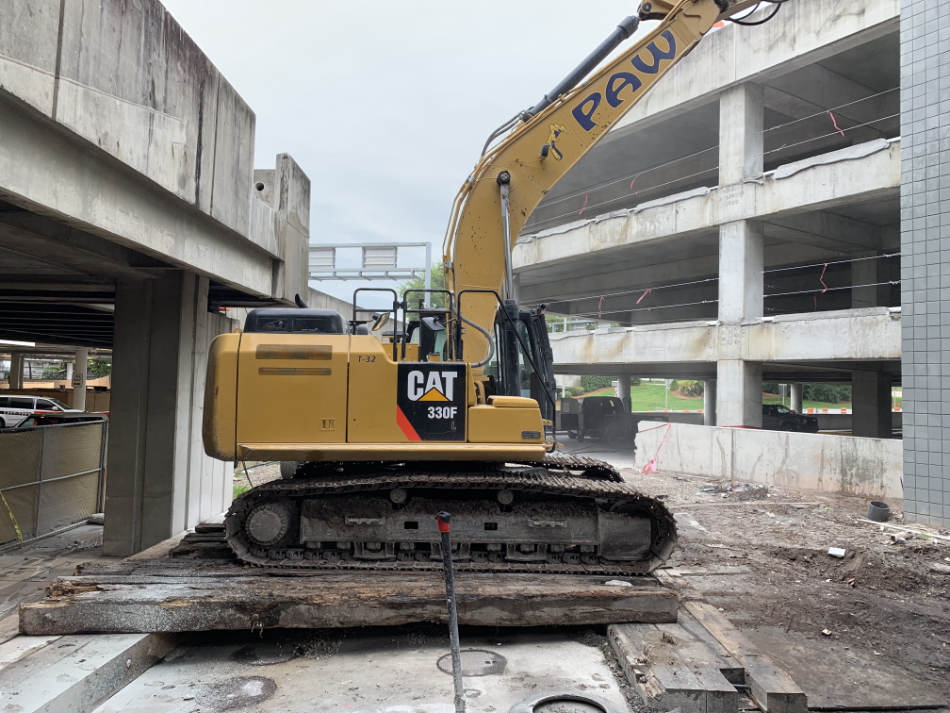
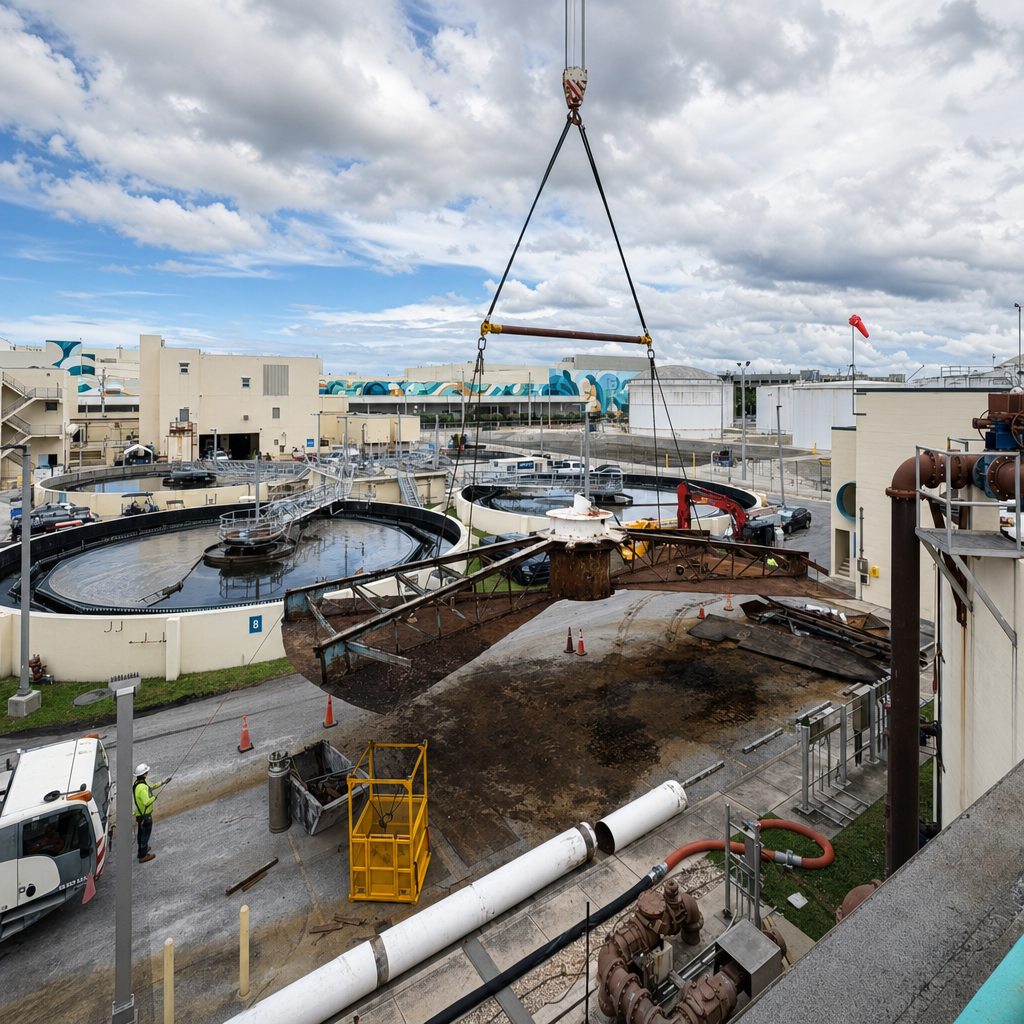
Quick Answer: WRF demolition starts with sludge removal and abatement, not structure. GCs need a demo sub who can sequence, permit, and self-perform all phases through site restoration.
Most GCs have torn down commercial buildings. Fewer have subcontracted the demolition of a wastewater reclamation facility (WRF). The difference goes beyond structural complexity. WRF demolition is a regulated, multi-phase scope that starts well before an excavator ever touches a wall.
Sludge must be removed and tanks dewatered before demolition can mobilize. Abatement must be completed and documented before demo crews set foot on the structure. And the concrete volumes generated by clarifiers, aeration basins, and digesters are among the highest of any industrial scope you will encounter in Florida.
If you are managing a project that includes wastewater facility demolition, this guide covers the phases, the permitting landscape, and exactly what to look for when vetting a demo subcontractor.
Key Takeaways
- Sludge removal and dewatering must be completed before mechanical demolition begins
- Abatement clearance is required before demo NTP; the two scopes cannot run concurrently
- WRF projects generate significant concrete volumes; a demo sub with in-house recycling reduces hauling cost and schedule risk
- Florida FDEP permitting requirements apply to WRF decommissioning; a demo sub with a GC license can self-pull permits and reduce your administrative burden
What’s Actually Inside a Wastewater Reclamation Facility
A wastewater reclamation facility (WRF) is an engineered treatment plant that processes municipal or industrial wastewater through a series of biological, chemical, and mechanical stages before the treated effluent is discharged or reused. Before scoping demo work on one, it helps to understand what you are actually bidding around. These are not simple slab-on-grade industrial buildings. A WRF is a collection of purpose-built concrete treatment structures, each of which requires a specific approach during demolition.
Typical WRF structures include:
- Primary and secondary clarifiers: large circular concrete tanks where solids settle out of wastewater at different treatment stages
- Aeration basins: open concrete tanks where biological treatment occurs; often the largest concrete volumes on site
- Anaerobic or aerobic digesters: enclosed tanks that process biosolids; can retain pressurized gases after decommissioning
- Pump stations: below-grade or at-grade concrete structures housing influent and effluent pumping equipment
- Administration and operations buildings: conventional above-grade structures, often the simplest part of the demo scope
- Underground piping, force mains, and buried infrastructure: these interconnect all structures and must be accounted for in excavation planning
Each structure type carries different residual content, different structural mass, and different sequencing requirements. A demo sub who understands WRF infrastructure can plan the work accordingly. One who does not will create sequencing problems that land back on the GC.
Why WRF Demolition Is Different from Standard Industrial Demo
The core difference is this: standard industrial demolition starts with structure. WRF demolition starts with regulated waste.
Every tank, basin, lagoon, and digester at a wastewater facility holds or has held biological and chemical treatment residuals. Those materials have to be removed, dewatered, and properly disposed of before any mechanical demolition begins. This is not optional and it is not a detail to sort out after NTP is issued.
Florida adds a regulatory layer on top of the operational complexity. The Florida Department of Environmental Protection governs wastewater facility permitting, including decommissioning, under Chapter 62-620 of the Florida Administrative Code. Facilities that discharged to surface waters also have NPDES program obligations that carry through closure. These requirements affect how the project is sequenced and documented, not just how the demo permit is pulled.
Add in multi-subcontractor coordination across sludge and dewatering, licensed abatement, structural demo, hauling, and site restoration, and you have a scope where sequencing mistakes are expensive and where a demo sub who can self-perform multiple phases is a meaningful advantage for the GC.
The four phases below cover how that sequencing works in practice, what each phase requires, and where the coordination risks sit for the GC.
Phase 1: Sludge Removal, Dewatering, and Tank Clearance
Why Sludge Must Be Addressed First
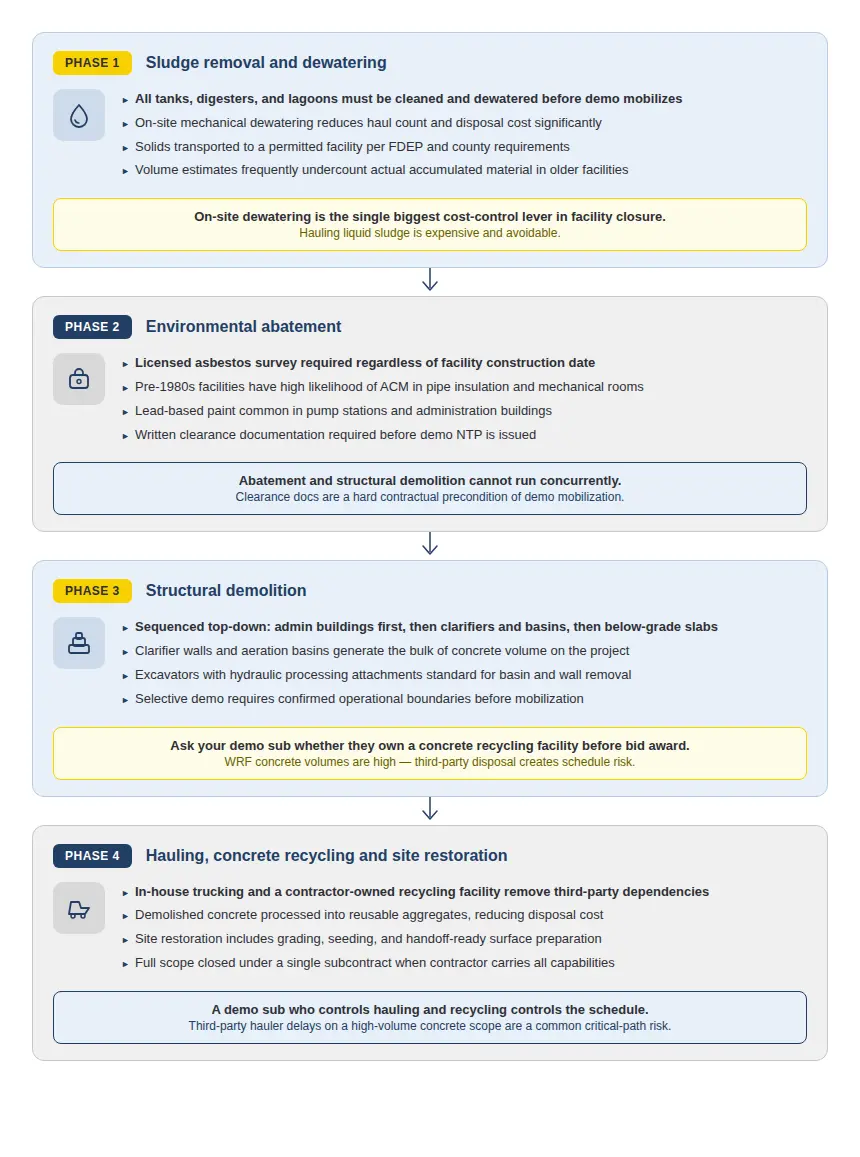
Tanks, digesters, lagoons, and holding structures must be cleaned, dewatered, and emptied before demolition, repurposing, or abandonment can move forward. This is field-tested reality, not a planning nicety. Structural demo crews working adjacent to active sludge conditions face both safety exposure and regulatory risk.
One of the most common mistakes on WRF closures is underestimating how much sludge is actually present. Older facilities often contain decades of accumulated biosolids, thickened material in digesters, inorganic grit in basins, and heavily compacted lagoon sludge. A proper sludge inventory, covering depth measurements, percent solids testing, and dry ton estimates, is what allows accurate hauling forecasts and realistic schedule planning. The sludge removal and wastewater facility demolition process is covered in more detail in a separate guide.
Dewatering Methods and Disposal Cost Comparison
There are two broad approaches to sludge removal: haul it wet, or dewater it on site before hauling. The cost difference is significant. Wet liquid sludge is heavy, and every additional gallon of water in a load is money spent on tipping fees and trucking frequency. On-site mechanical dewatering using centrifuge systems or belt presses reduces volume substantially before the material ever leaves the site. Even a modest increase in cake dryness translates to fewer loads and lower total disposal cost on a project with hundreds of dry tons of material.
The dewatering strategy should be locked in early, not figured out mid-project. It affects equipment mobilization, site logistics, and the timeline for when structural demo can begin.
Spring Hill WRF: PAW Demolition’s Approach
At the Spring Hill Water Reclamation Facility in Hernando County, PAW Demolition self-performed sludge removal and dewatering as part of a full-scope decommissioning and demolition contract. The work was not subcontracted to a separate sludge handler. PAW’s crews managed this phase in-house, which eliminated a coordination layer and kept the sequencing on a single schedule.
Pro Tip: Never issue demo NTP until sludge removal is substantially complete and abatement clearance documentation is in hand. Starting structural demo with residual sludge in tanks or active abatement underway creates compliance exposure for the GC, not just the sub. Make clearance documentation a contractual precondition of demo mobilization.
Phase 2: Environmental Abatement
Wastewater treatment facilities built before the mid-1980s have a high likelihood of containing asbestos-containing materials in pipe insulation, mechanical room ceilings, and equipment housings, given the EPA’s phased asbestos regulations during that period. Lead-based paint is also common in older pump stations and administration buildings. Regardless of construction date, a licensed asbestos survey is required before demolition work begins; the presence of ACM cannot be assumed or ruled out without one. Both asbestos and lead paint must be remediated by a licensed Florida abatement contractor before structural demolition starts.
As a GC, your role in the abatement phase is coordination and documentation. You need to confirm the abatement scope covers the full structure, verify that the contractor holds the appropriate Florida licenses, and hold demo NTP until written clearance is in hand. Abatement and structural demolition are not concurrent scopes. Starting demo while abatement is still active in another part of the structure is a compliance violation and a liability exposure.
Phase 3: Structural Demolition of WRF Components
Once tanks are clear and abatement is documented, structural demolition can begin. The sequencing follows a logical top-down, above-to-below order.
Administration buildings and above-grade equipment housings typically come down first. These are conventional structures and the most straightforward part of the scope. From there, demo moves to the primary treatment structures: clarifier walls and mechanisms, aeration basins, and digester shells. These generate the bulk of the concrete volume on the project. Below-grade slab work and buried tank structures come last, often overlapping with underground piping removal and grading preparation.
Some WRF projects involve selective demolition rather than full clearance. A partial upgrade where one treatment train is being replaced while another remains in service is a common example. In those cases, the demo sub needs to understand the operational boundary clearly before mobilizing. Equipment and structural loadings adjacent to active systems cannot be disturbed without engineering coordination.
Equipment requirements for WRF demo are heavier than standard commercial work. Excavators with hydraulic concrete processing attachments are standard for basin and clarifier wall removal. Dust suppression is necessary for below-grade concrete work in confined basin footprints. If digesters retained any pressurized gas, confined-space protocols apply to the areas immediately adjacent.
Pro Tip: Ask your demo sub whether they own a concrete recycling facility before bid award, not after. Clarifier walls and aeration basin slabs are dense, reinforced concrete and the volumes are high. A contractor who can haul directly to their own recycling yard eliminates a scheduling dependency on third-party disposal and gives you more predictable cost control on a line item that can move significantly on larger WRF scopes.
Phase 4: Hauling, Concrete Recycling, and Site Restoration
In PAW Demolition’s experience on Florida WRF projects, concrete volumes routinely exceed those of comparable commercial and industrial scopes. Clarifiers, aeration basins, and digesters are thick-walled reinforced concrete structures. On a mid-size facility, you can be looking at thousands of tons of concrete debris that needs to leave the site.
How that material is handled has a direct impact on project cost and schedule. A demo sub who relies on third-party haulers and disposal facilities creates a dependency that can stall the project when third-party schedules slip. A demo sub with in-house trucking and their own recycling facility controls both ends of that equation.
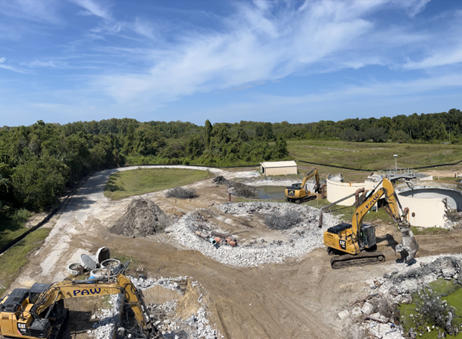
At the Spring Hill WRF, all concrete demolished on site was hauled to PAW Demolition’s own recycling facility and processed into aggregates. PAW’s in-house concrete recycling operation handled the full volume, removing third-party logistics from the critical path and keeping disposal costs predictable.
Site restoration followed demolition: grading, seeding, and a site-ready handoff to Hernando County. The full scope of sludge removal, dewatering, demolition, hauling, and site restoration was completed under a single contract of $646,541, with substantial completion on December 29, 2023, and final completion in January 2024.
Working on a WRF or Industrial Demolition Project in Florida?
PAW Demolition handles full-scope wastewater facility demolition across Florida, including sludge removal, structural demo, concrete recycling, and site restoration.
Florida Permitting for WRF Demolition
 Permitting a wastewater facility demolition in Florida involves more than a standard building demo permit. Here is what GCs need to plan for.
FDEP oversight applies to the decommissioning of wastewater facilities under Chapter 62-620, Florida Administrative Code. If the facility discharged to surface waters, NPDES program requirements, administered in Florida by FDEP since 1995, carry through to facility closure. Permit modifications or closures require coordination with the appropriate FDEP district office, and documentation of final facility status is part of the closeout process.
On the construction side, the demo contractor’s license determines who can pull the demolition and site restoration permits. In Florida, a General Contractor license (Division I) covers rehabilitation work including demolition and site grading. A demo-specific license alone is not sufficient for projects that include site restoration work. This distinction matters when you are awarding a full-scope subcontract and want one sub to carry both the demo permit and the site restoration permit.
At the Spring Hill WRF, permits were self-pulled under a GC license (Division I), covering both the demolition and site restoration scope. Confirming that a demo sub holds the right license class before bid award is the simplest way to avoid a permit coordination gap on a full-scope WRF subcontract.
For county-specific permit requirements in the Tampa Bay area, PAW Demolition’s guides to Hillsborough County demolition permits and Pinellas County demolition permits cover the local process in detail.
How to Vet a Demo Sub for a WRF Scope
Not every industrial demolition contractor in Florida is equipped to handle a water reclamation facility. The capability checklist for a WRF scope is more specific than for standard commercial demo. Here is what to ask before bid award.
| Capability | Why It Matters for a WRF Project |
|---|---|
| Sludge removal and dewatering | Eliminates a separate subcontractor and removes sequencing risk between sludge handling and demo mobilization |
| In-house permitting (GC license, FL Division I) | Allows the sub to self-pull demo and site restoration permits, reducing GC administrative burden and permit cycle time |
| Owned concrete recycling facility | Controls disposal cost and removes a third-party scheduling dependency on a high-volume concrete scope |
| In-house trucking and roll-off | Single-source logistics from demo through haul-off; no third-party hauler delays on the critical path |
| MOD rate below 1.0 | Safety track record indicator; affects your insurer’s assessment and the overall risk profile of the subcontractor relationship |
| Completed WRF or water infrastructure project history | Confirms the sub understands process sequencing, regulated waste handling, and FDEP coordination rather than just structural demolition |
For a deeper look at how to evaluate a demo sub before bid award, see PAW Demolition’s guide to vetting an industrial demolition subcontractor in Florida.
Pro Tip: Request MOD rate documentation in writing before bid award. PAW Demolition holds a 0.72 MOD rate, which is 28% better than the industry average according to NCCI. On a regulated industrial project with significant safety and compliance exposure, that number matters to your insurer and to the risk profile of your overall subcontractor team.
The Bottom Line on Industrial Wastewater Facility Demolition
- WRF demolition is a regulated, multi-phase scope; sludge removal and abatement must be completed and documented before structural demo begins
- Florida FDEP Chapter 62-620 F.A.C. governs WRF decommissioning; NPDES obligations carry through closure for surface-discharge facilities
- A demo sub with a Florida GC license (Division I) can self-pull demo and site restoration permits, reducing GC administrative burden
- In-house sludge removal, concrete recycling, and trucking eliminate coordination dependencies that slow WRF projects down
- MOD rate below 1.0 is a baseline safety qualifier; PAW Demolition’s 0.72 rate reflects a 28% better-than-average safety record per NCCI
- Full-scope capability under one subcontract is the most schedule-reliable approach to WRF demolition
Frequently Asked Questions
What permits are required to demolish a wastewater treatment facility in Florida?
At minimum, a local building demolition permit is required. Beyond that, FDEP coordination under Chapter 62-620 F.A.C. applies to facility decommissioning, and facilities that previously discharged to surface waters carry NPDES obligations through closure. The permitting picture is more layered than a standard commercial demo, which is why licensing matters: a contractor with a Florida GC license (Division I) can self-pull demolition and site restoration permits rather than requiring the GC to manage those separately.
Does sludge need to be removed before demolition can begin?
Yes, and the volume is often larger than expected. Older facilities accumulate biosolids over decades, and underestimating what is in the tanks is one of the most common and costly mistakes on WRF closures. Sludge removal and dewatering need to be substantially complete before structural demo crews mobilize.
What is the difference between wet hauling and on-site dewatering?
Wet hauling moves liquid sludge directly off site, but water weight drives up tipping fees and trucking frequency significantly. On-site mechanical dewatering reduces sludge volume before it leaves the site, lowering both hauling cost and the number of loads. On larger WRF projects with hundreds of dry tons of material, the cost difference between the two approaches is substantial.
What is the role of abatement in a WRF demolition project?
Abatement handles asbestos and lead-based paint before structural demo begins. It must be performed by a licensed Florida abatement contractor, and written clearance documentation is required before demo NTP is issued. Abatement and structural demolition run sequentially, not concurrently. As the GC, your job is to confirm scope coverage, verify contractor licensing, and treat clearance docs as a hard precondition of demo mobilization.
How long does wastewater facility demolition typically take?
Timelines vary by facility size and sludge volume. As a reference point, the Spring Hill WRF in Hernando County, a mid-size municipal facility, ran from mobilization in early September 2023 to substantial completion on December 29, 2023, covering sludge removal, dewatering, full structural demolition, hauling, concrete recycling, and site restoration. For similarly scoped facilities, a three-to-four month window is a reasonable planning benchmark when sequencing is locked in before mobilization. The biggest schedule risk is an undefined sludge management plan, which delays demo NTP and compresses every phase that follows.
Does the demo sub need a GC license to pull permits on a WRF project?
If the scope includes site restoration work such as grading or seeding in addition to demolition, a Florida GC license (Division I) is required to self-pull those permits. A demolition-specific license alone does not cover rehabilitation and site work. This is a practical consideration when awarding a full-scope WRF subcontract and wanting a single sub to carry all permit responsibilities.