
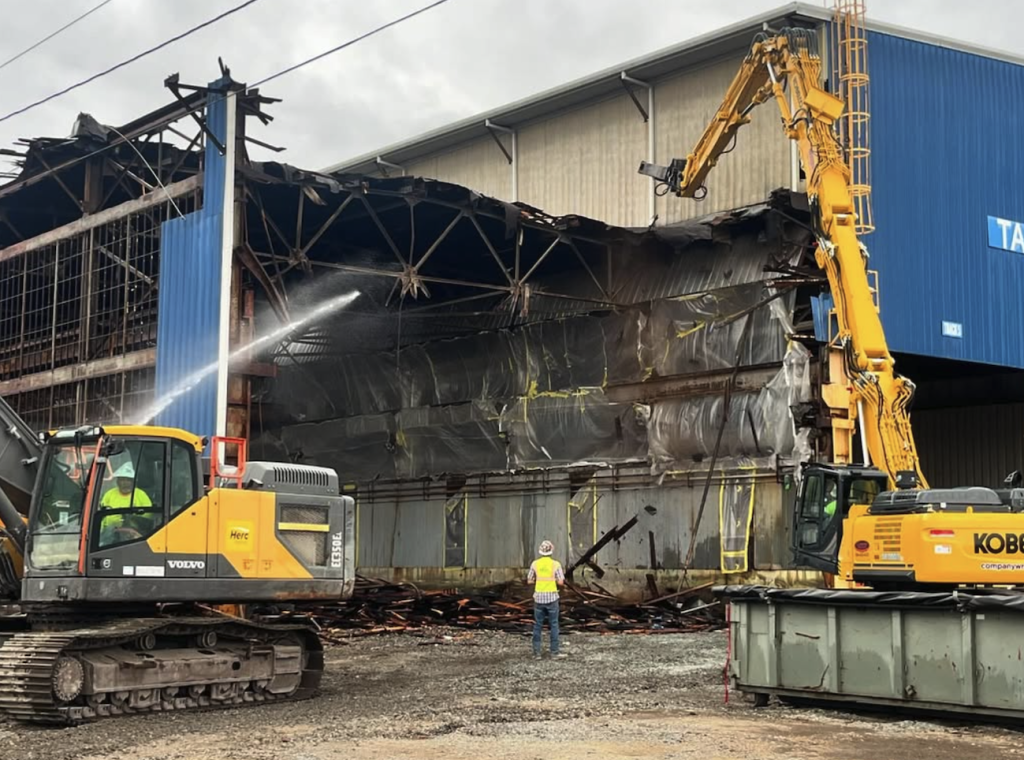
Quick Answer: Selective demolition removes specific structural components, interior systems, or sections of a building while the rest of the structure stays intact. Commercial projects need it when they’re renovating occupied facilities, reconfiguring floor plans, removing hazardous materials from operational buildings, or adapting a structure for a new use without a full teardown.
Key Takeaways
- Selective demolition removes targeted portions of a structure while preserving everything else, including load-bearing elements, facades, and operational systems.
- It applies to tenant improvements, adaptive reuse, industrial reconfiguration, and phased redevelopment where a full teardown is not practical or cost-effective.
- Successful selective demolition requires pre-demolition surveys, structural engineering input, utility isolation, and coordinated sequencing with other trades.
- Florida commercial projects must obtain demolition permits and comply with NESHAP notification requirements when asbestos-containing materials are present.
- The right contractor brings owned equipment, in-house permitting capability, and a track record on complex structural scopes, not just interior strip-outs.
When a general contractor or developer looks at a commercial building and says, “We don’t need to tear it all down,” that’s the moment selective demolition becomes the right conversation to have. Not every project calls for a clean sweep. Sometimes the structure has years of useful life left. Sometimes the timeline won’t allow a full rebuild. Sometimes the budget simply doesn’t support starting from zero.
Selective demolition is the answer to all three. It is a precision-driven approach that removes exactly what needs to go and leaves everything else standing, operational, and protected. On large commercial and industrial projects, that distinction matters as much as any other scope decision a project team makes.
This article explains what selective demolition is, how it differs from full demolition, when commercial projects actually need it, and what it takes to execute it correctly on a job site where the stakes are real.
What Is Selective Demolition?
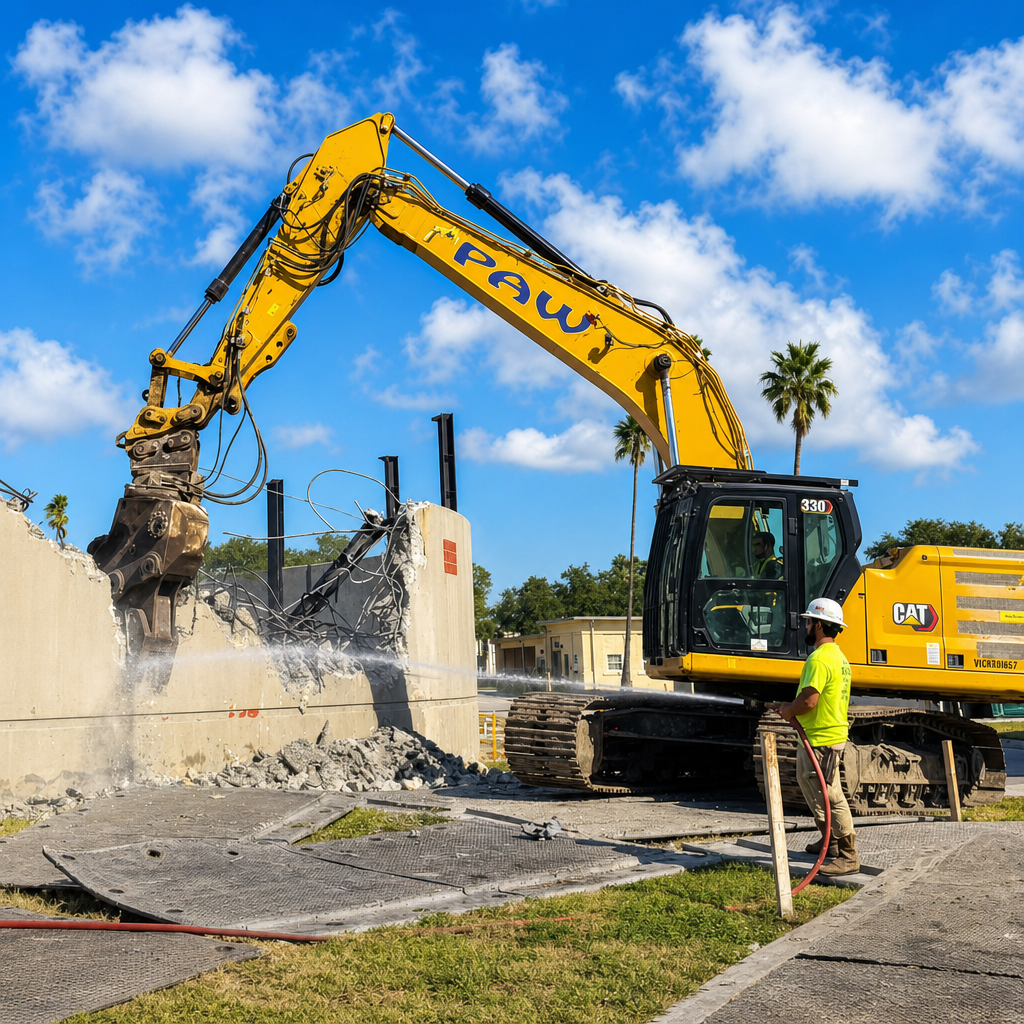 Selective demolition is the controlled removal of specific building components while preserving the surrounding structure. That might mean taking out interior walls and mechanical systems for a tenant improvement, cutting out a deteriorated floor section in a manufacturing facility, removing a building wing that no longer serves its purpose, or stripping out an entire interior fit-out while keeping the shell and foundation intact.
The defining feature is precision. Unlike a full teardown, where the goal is removing everything down to the slab, selective demolition requires crews to work within a live structure and make surgical decisions about what stays and what goes. Every cut affects the building’s remaining load path. Every removed element changes how adjacent components behave. That requires more planning, more sequencing, and more coordination with structural engineers and other trades than most people expect.
Selective demolition is also sometimes called partial demolition, interior demolition, or soft-strip demolition, depending on the scope. The terms overlap significantly, but the underlying principle is the same: remove what you need to remove without compromising what you intend to keep. For a side-by-side comparison of how selective and total demolition differ at the project level, the selective vs. total demolition breakdown covers the key distinctions.
How Selective Demolition Differs from Full Demolition
Full demolition removes an entire structure, including foundations and below-grade elements, and clears the site for new construction. The objective is total removal, and the methods reflect that: high-reach excavators, hydraulic shears, wrecking machinery, and in some cases controlled implosion. The site ends up cleared and ready for a new footprint.
Selective demolition operates under a different set of constraints. The structure is staying. Neighboring systems are live. Occupants may still be present in adjacent spaces. Equipment selection shifts toward precision tools: smaller excavators, demolition robots, concrete saws, core drills, and hand tools for tight or occupied areas. The pace is more methodical, the sequencing more deliberate, and the scope more precisely defined by drawings and engineering review.
The cost model differs as well. Full demolition is often driven by volume and speed. Selective demolition carries a higher unit cost because of the precision, structural coordination, and logistics of working within or adjacent to an active building. PAW Demolition’s published cost guidance reflects ranges of $8–$20 per square foot for selective work versus $4–$10 per square foot for total demolition, depending on scope and project conditions. That higher per-unit figure is offset by what you don’t have to rebuild. A peer-reviewed economic analysis published in Resources, Conservation and Recycling (Elsevier) found that selective demolition unit costs run higher than conventional demolition in most scenarios, but that the gap narrows and can reverse as disposal fees and landfill costs rise, and as salvaged material value is captured. On commercial projects where new construction costs run $150 to $400 per square foot or more, the demolition cost differential is rarely the deciding factor in total project economics.
| Factor | Selective Demolition | Full Demolition |
|---|---|---|
| Scope | Targeted removal of specific components | Complete removal of structure |
| Structure remaining | Yes, partially or fully | No |
| Equipment | Precision tools, smaller equipment, hand demolition | High-reach excavators, shears, heavy machinery |
| Engineering coordination | Required for load path and temporary support | Less intensive; full removal is the endpoint |
| Typical use case | Renovation, adaptive reuse, phased redevelopment | Site clearing, full rebuild, end-of-life structures |
| Permitting complexity | Varies by scope; may require structural review | Standard demolition permit plus utilities disconnect |
When a Commercial Project Needs Selective Demolition
The decision to go selective over full typically comes down to one or more of the following conditions: the structure has remaining value, the budget can’t support a full rebuild, the schedule won’t accommodate it, or the operations happening in or around the building can’t be interrupted at that level of scale. Here are the most common commercial scenarios where selective demolition is the right call.
Tenant Improvements and Interior Reconfiguration
When a new tenant moves into a commercial space, or an existing tenant needs a different layout, interior demolition is almost always part of the scope. Partition walls, drop ceilings, raised flooring, outdated MEP systems, and built-in millwork all need to come out before new construction begins. The exterior envelope, structural frame, and core systems stay; only the fit-out gets removed.
This is one of the highest-volume applications for selective demolition in commercial real estate. Office buildings, retail centers, medical facilities, and mixed-use developments all cycle tenants, and each turnover involves some degree of partial interior removal.
Adaptive Reuse and Redevelopment
Florida has a significant inventory of older commercial and industrial buildings being repositioned for new uses. A warehouse becomes a distribution center with a different internal layout. An older office building gets converted to mixed-use. An industrial facility gets reconfigured to accommodate new equipment and processes.
In these projects, the building envelope and structural frame often remain while everything inside gets gutted and rebuilt. Selective demolition handles the removal phase, clearing out old interior systems, non-structural walls, and obsolete equipment so the new build-out can begin. Paired with on-site concrete recycling, the material recovered from these scopes can be processed and reused directly on or near the project.
Phased Redevelopment
Large commercial and industrial campuses often can’t afford to shut down completely during construction. A phased approach keeps operations running in one section while demolition and construction progress in another. Selective demolition makes that possible by isolating the work area from the occupied portion of the building.
This requires careful sequencing and communication between the demolition contractor, the GC, and the facility owner. Noise, dust, vibration, and access paths all need to be managed so that adjacent operations aren’t compromised. Contractors who work regularly as subcontractors to large GCs understand this coordination model. It’s a different discipline than showing up to a cleared site with a full teardown scope.
Pro Tip: When bidding a phased selective demo scope, ask your demolition contractor how they handle utility isolation in occupied buildings. Identifying and safely isolating only the circuits, plumbing lines, and HVAC zones serving the demo area, without cutting power or water to adjacent tenants, is one of the most technically demanding aspects of the work. A contractor with experience on complex commercial jobs will have a defined protocol for this; one without it will be working it out on the fly.
Hazardous Material Scopes in Operational Buildings
Selective demolition is often sequenced directly after or alongside abatement work on older commercial buildings. Once a licensed abatement contractor removes asbestos-containing materials, lead-based paint, or other regulated substances from the targeted areas, the selective demo contractor clears the remaining structure in those zones. The two scopes are related but distinct, and the contractor managing selective demolition should understand exactly where their work starts relative to the abatement boundary.
On the Spring Hill Water Reclamation Facility project in Hernando County, PAW Demolition self-performed the demolition, hauling, and site restoration work while coordinating directly with a subcontracted abatement team. That kind of division-of-scope management is routine on complex commercial and industrial projects where multiple regulated activities overlap.
Structural Modifications and Additions
Adding square footage to an existing building, cutting new openings for loading docks or storefronts, removing a wing to reconfigure the site footprint, or demolishing a secondary structure while the primary building stays operational all require selective work. The contractor has to understand the structural behavior of what’s being removed and what’s staying, particularly when load-bearing elements are involved.
This is where engineering coordination becomes non-negotiable. Removing columns, beams, or shear walls without temporary support or proper sequencing can compromise the remaining structure. A selective demolition contractor working at this level needs to be able to read structural drawings, communicate with the project engineer, and execute shoring and sequencing plans specific to the building’s actual condition.
What the Selective Demolition Process Looks Like on a Commercial Job
Selective demolition is not a day-one activity. By the time the first wall comes down, a significant amount of planning work has already happened. Here is how the process typically unfolds on a commercial project.
Pre-Demolition Survey and Scope Definition
Before any work begins, the demolition contractor walks the site with the GC, reviews architectural and structural drawings, and identifies exactly what is being removed and what is staying. The scope definition at this stage drives everything that follows: equipment selection, crew size, temporary support requirements, debris management planning, and permit applications.
For buildings of a certain age, a pre-demolition survey also determines whether asbestos-containing materials, lead-based paint, or other regulated substances are present in the targeted areas. Under 40 CFR Part 61, Subpart M, §61.145, written notification to the applicable regulatory authority must be postmarked or delivered at least 10 working days before asbestos stripping, removal, or any site preparation that would disturb asbestos material begins. In Florida, that notification goes to the applicable FDEP district office or delegated local air program. That clock starts before the contractor touches anything.
Utility Isolation
Before selective demolition begins in any area, all utilities serving that zone must be isolated: electrical circuits de-energized, gas lines capped, water and drain lines disconnected. In an occupied building, this means isolating only the services running to the demo area without cutting off adjacent occupied spaces. This requires coordination with utility providers, building engineers, and the facility management team.
Pro Tip: Don’t assume that drawings reflect actual field conditions, especially in older commercial buildings. It is common to find HVAC ducts, electrical conduit, and plumbing lines routed in ways that don’t match the as-built drawings. A selective demo contractor experienced in occupied commercial buildings will walk the site and verify actual routing before committing to a utility isolation plan, not after the demo crew arrives on site.
Temporary Shoring and Structural Protection
When selective demolition involves load-bearing elements, the contractor must install temporary shoring before removal begins. This protects the building’s remaining structure while the targeted element comes down. The shoring plan is typically developed in coordination with the project’s structural engineer of record and reviewed before work begins.
Even when structural elements are not being removed, temporary protection measures are often required: dust barriers, vibration monitoring for sensitive adjacent uses, protection of existing finishes that are staying, and weather protection for exposed sections.
Demolition and Debris Management
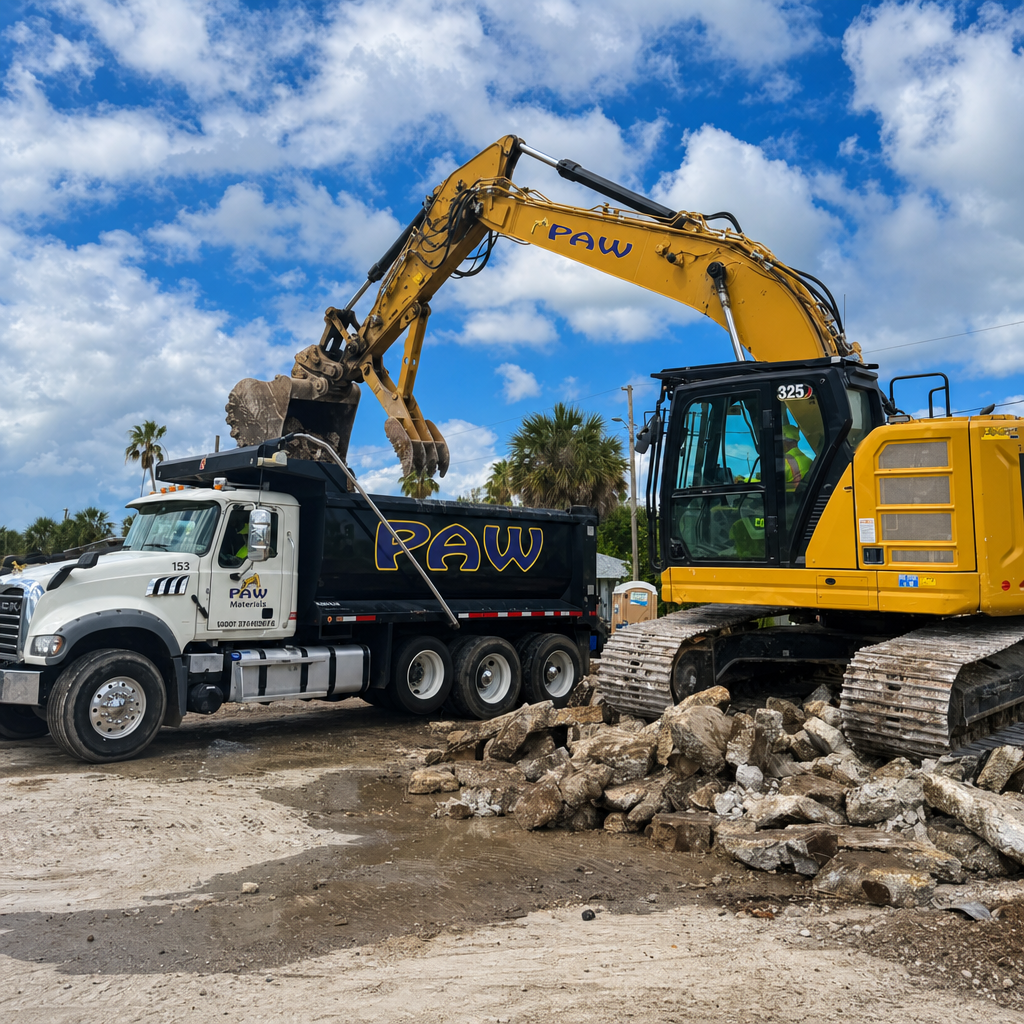 The actual demolition is sequenced to minimize risk to the remaining structure and to workers in adjacent areas. Debris is either chuted out, loaded directly into containers, or hauled through designated paths that keep the work zone separated from occupied or sensitive areas.
On commercial jobs where concrete is a significant component of what’s being removed, on-site or near-site concrete recycling can meaningfully reduce hauling costs and landfill tonnage. Crushed concrete from selective demo work can be reprocessed into reclaimed concrete aggregate (RCA) for use as road base, site fill, or structural subbase. FDOT accepts RCA as base and subbase material under Section 911-2.7 of its Standard Specifications for Road and Bridge Construction, subject to gradation, Limerock Bearing Ratio, and contamination requirements, provided the supplier holds a DEP permit under FAC 62-701.730 or qualifies as a clean debris source. PAW Demolition’s on-site concrete recycling facility gives project teams a direct outlet for this material rather than routing it through third-party disposal.
Site Handoff
When the selective demolition scope is complete, the site gets cleaned, remaining structural edges are addressed, and the area is handed off to the next trade. On interior jobs, that typically means the space is broom-clean and ready for framing, MEP rough-in, or whatever phase follows. On exterior or structural scopes, it means the remaining building is stable, protected, and ready for the next phase of construction.
Scoping a Selective Demolition Project in Florida?
PAW Demolition has 43 years of experience on complex commercial and industrial scopes across Florida. We self-perform with an owned fleet, handle permitting in-house, and work as a proven subcontractor to major GCs statewide.
What Drives Selective Demolition Cost on Commercial Projects
Selective demolition is not meaningfully priced per square foot. The variables that drive cost are more specific than that, and understanding them helps project teams budget accurately and evaluate contractor proposals on equal terms.
Scope complexity. A soft-strip of a standard office space is a different animal from cutting out a deteriorated floor section in an active industrial facility. The more the scope touches structural elements, live utilities, or occupied adjacent spaces, the higher the labor intensity and coordination cost.
Hazardous materials. If asbestos-containing materials or lead-based paint are present in the targeted areas, abatement must be completed before selective demo proceeds. The abatement cost is typically a separate line item from the demo scope, but the sequencing affects the overall project timeline and should be coordinated from the beginning.
Access and logistics. High floors, tight interior corridors, occupied neighboring spaces, and restricted hours all add cost. So does the need to remove debris through a building rather than directly to a container at grade. Contractors who bring the right equipment for confined or elevated work are worth the premium over those who don’t.
Material recovery value. In some selective demo scopes, salvageable materials, including structural steel, copper, brick, or equipment, reduce the net cost. A contractor who can manage material separation and identify what has recovery value brings a real economic benefit to the owner or GC.
Pro Tip: When comparing selective demolition bids, look closely at what each contractor is including in their debris management scope. Some bids assume debris removal in one phase; others account for multiple mobilizations as the project progresses. On phased projects, the number of debris pulls and container exchanges can become a meaningful cost variable. Make sure everyone is bidding the same logistics assumptions before comparing numbers.
Permitting for Selective Demolition in Florida
Selective demolition on commercial projects in Florida requires a permit in virtually all jurisdictions, even when no structural elements are being removed. The specific requirements vary by county and municipality, but the general framework is consistent across the state.
The permit application typically requires a description of the scope, identification of what is being removed and what is staying, confirmation that utilities have been or will be isolated, and in many cases a structural review if load-bearing elements are involved. Some jurisdictions require a signed statement from a licensed structural engineer when selective demolition includes columns, beams, or bearing walls.
NESHAP notification requirements apply when regulated asbestos-containing materials are present in the scope area. Under 40 CFR Part 61, Subpart M, §61.145, written notification must be postmarked or delivered to the applicable FDEP district office or delegated local program at least 10 working days before asbestos stripping, removal, or any site preparation that could disturb asbestos material begins. Threshold quantities that trigger the full notification and removal requirements are 260 linear feet on pipes, 160 square feet on other facility components, or 35 cubic feet off facility components.
For project teams working across multiple Florida counties, the county-by-county demolition permit guide covers the specific requirements and contacts for the major jurisdictions where selective demolition projects are most active. For scopes in Hillsborough and Pinellas, the dedicated permit posts for Hillsborough County demolition permits and Pinellas County demolition permits cover the local process in detail.
The Bottom Line on Selective Demolition for Commercial Projects
- Selective demolition is the right choice when the structure has remaining value, the budget or timeline doesn’t support a full teardown, or operations need to continue in adjacent spaces during construction.
- The scope definition has to happen before pricing. Selective demo bids based on square footage without a detailed walk and drawing review are not reliable. Scope precision drives cost precision.
- Engineering coordination is not optional when structural elements are involved. The demolition contractor and the project’s structural engineer need to be aligned on shoring, sequencing, and load path management before the first cut is made.
- Permitting and NESHAP notification must be built into the project schedule from day one. In Florida, the 10-working-day NESHAP notification clock runs before demolition begins, not before the permit is issued.
- Contractor selection matters more on selective scopes than on full teardowns. A contractor who self-performs with owned equipment, understands structural drawings, and has a track record on complex commercial jobs reduces coordination risk across the entire project team.
Frequently Asked Questions
Is selective demolition more expensive than full demolition per square foot?
On a per-square-foot basis, selective demolition typically costs more than full demolition. PAW Demolition’s published cost ranges reflect $8–$20 per square foot for selective work versus $4–$10 for total demolition, and peer-reviewed research published in Resources, Conservation and Recycling (Elsevier) confirms selective demolition unit costs generally run higher than conventional demolition, though the gap narrows as disposal fees and landfill costs increase. What changes the equation on commercial projects is new construction cost, which typically runs $150 to $400 per square foot or more. At that scale, paying a premium on the demolition line to preserve a functional structure almost always produces a lower total project cost.
Can selective demolition happen while a building is occupied?
Yes, and it frequently does. Projects involving tenant improvements, phased renovations, and industrial reconfigurations often require demolition work while other parts of the building remain operational. This requires careful utility isolation, dust and noise control, defined access paths, and close coordination with the facility team and other trades on site.
What happens to concrete and debris removed during selective demolition?
Debris is hauled off-site and either recycled or disposed of, depending on the material type and local processing options. Concrete removed during selective demolition can be crushed and reprocessed into aggregate base material, reducing landfill tonnage and providing a usable material for site restoration or future construction phases. Contractors with on-site recycling capability can process this material more efficiently than those who rely entirely on third-party disposal.
Does selective demolition require a licensed contractor in Florida?
Yes. In Florida, commercial demolition work, including selective scopes, must be performed by or under a licensed contractor. Projects involving structural elements or work within a commercial building typically require a General Contractor license or a licensed demolition contractor. Working with an unlicensed contractor on a permitted commercial project creates liability exposure for the GC and the owner.
How far in advance should we engage a selective demolition contractor for a commercial project?
Based on PAW Demolition’s experience across Florida commercial projects, straightforward interior scopes typically need two to four weeks of lead time to review drawings, complete the site walk, and secure the permit. Complex structural scopes, phased projects, or jobs requiring NESHAP notification typically need six weeks or more. Permit timelines vary by jurisdiction and can extend the schedule further. Projects with hazardous material abatement requirements should build in additional lead time to coordinate the abatement scope before the selective demo work begins.