
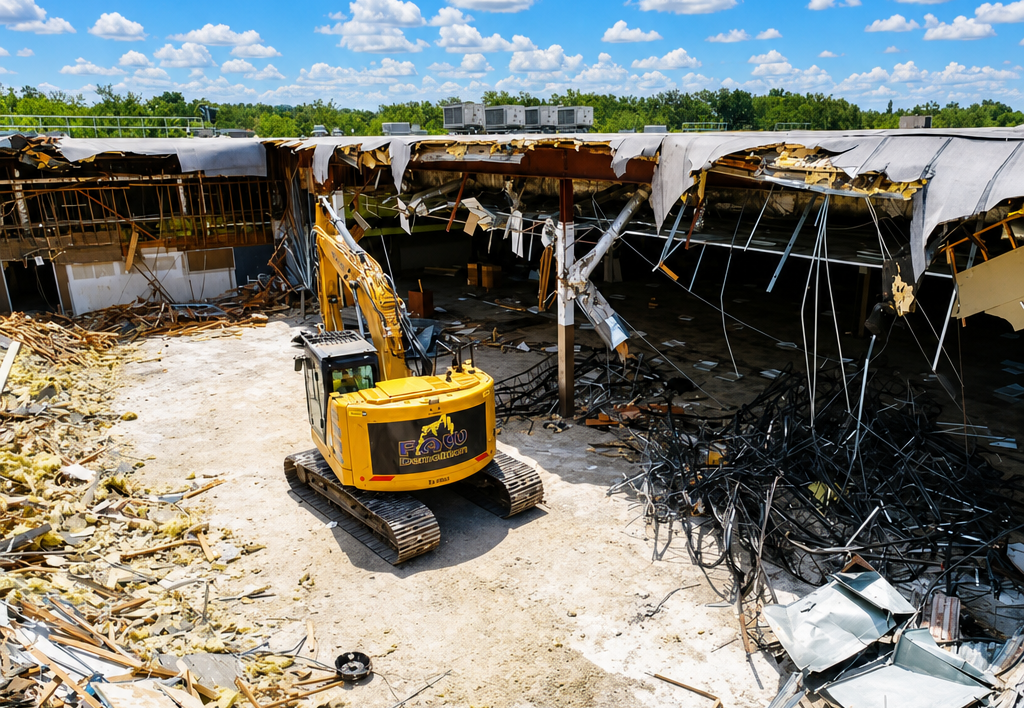
Quick Answer: Warehouse demolition cost in Florida typically runs between $4 and $12 per square foot, though steel-frame buildings often land at the lower end while concrete tilt-wall structures push costs higher. Industrial building demolition cost depends on material, size, site access, asbestos abatement, permitting, and how much of the structure can be recycled instead of hauled to a landfill.
Key Takeaways
- Warehouse demolition costs in Florida generally range from $4 to $12 per square foot depending on structural material and site conditions.
- Steel-frame warehouses often cost less to demolish than concrete tilt-wall or masonry buildings because structural steel has salvage value.
- Asbestos abatement, county permitting, and utility disconnection are line items that can add thousands of dollars if not scoped upfront.
- Concrete recycling can meaningfully reduce disposal costs compared to standard landfill hauling.
- An accurate quote requires a site walk, not just a square footage number over the phone.
If you own or manage industrial property in Central Florida, chances are your warehouse has outlived its usefulness, sustained storm damage, or no longer fits the site plan for redevelopment. Before a general contractor, developer, or municipal buyer can move forward, they need a realistic warehouse teardown price for what it costs to bring the structure down. This guide breaks down the specific factors that drive warehouse demolition cost in Florida, so you can budget accurately and evaluate contractor quotes with confidence.
What Warehouse Demolition Cost Actually Covers
Warehouse demolition cost and industrial building demolition cost refer to the removal of large-footprint commercial structures, typically single-story steel, concrete, or masonry buildings used for storage, manufacturing, or distribution. This is distinct from residential demolition pricing, which is driven by different factors such as smaller square footage, wood-frame construction, and simpler permitting. Warehouse and industrial projects involve heavier equipment, larger debris volumes, and additional regulatory steps such as asbestos NESHAP notification, which is why the cost structure and per-square-foot ranges differ substantially from a house or garage teardown.
Average Warehouse Demolition Cost in Florida
Most warehouse demolition projects in Florida fall between $4 and $12 per square foot, with larger and simpler steel-frame buildings often landing at the lower end of that range. A 40,000-square-foot metal warehouse with a straightforward layout might come in closer to $4 to $6 per square foot, while a concrete tilt-wall building of the same size with asbestos-containing materials or a congested urban site could reach $10 to $12 per square foot or more. Industrial building demolition cost follows the same pattern across manufacturing facilities, distribution centers, and cold storage buildings. These ranges reflect PAW Demolition’s completed industrial and commercial projects across Central Florida and are reviewed periodically as material, labor, and disposal costs shift.
These figures are a starting point, not a quote. The only way to get an accurate number is a site assessment that accounts for the specific variables below.
| Building Type | Typical Cost Per Square Foot | Why |
|---|---|---|
| Steel-frame warehouse | $4 – $6 | Structural steel has recycling value that offsets demolition cost |
| Concrete tilt-wall warehouse | $7 – $10 | Heavier equipment and more processing time to break down panels |
| Masonry or block warehouse | $8 – $12 | Denser material, slower demolition, higher disposal weight |
| Any building with asbestos abatement | +$2 – $3 | Specialized removal and disposal required before demolition begins |
Structural Material Is the Biggest Cost Driver
Florida warehouses are typically built one of three ways: pre-engineered steel frame, concrete tilt-wall, or concrete masonry unit (CMU) block. Each behaves differently once a crew starts taking it apart, and that difference shows up directly in the price.
Steel-frame warehouses are usually the most cost-efficient to demolish. Once the structure comes down, the steel goes to a recycler, and that salvage value helps offset the cost of the project. Concrete tilt-wall and masonry buildings require heavier equipment, more time to break material down to a haulable size, and a larger volume of debris by weight. That added labor and disposal weight is why concrete and masonry structures consistently price higher per square foot than steel buildings of the same footprint.
Building Size and Site Access
Total square footage drives the overall cost of a project, but larger warehouses often see a lower cost per square foot than small buildings of the same construction type. Mobilizing excavators, shears, and haul trucks for one 60,000-square-foot warehouse is more efficient than running the same equipment across several smaller sites.
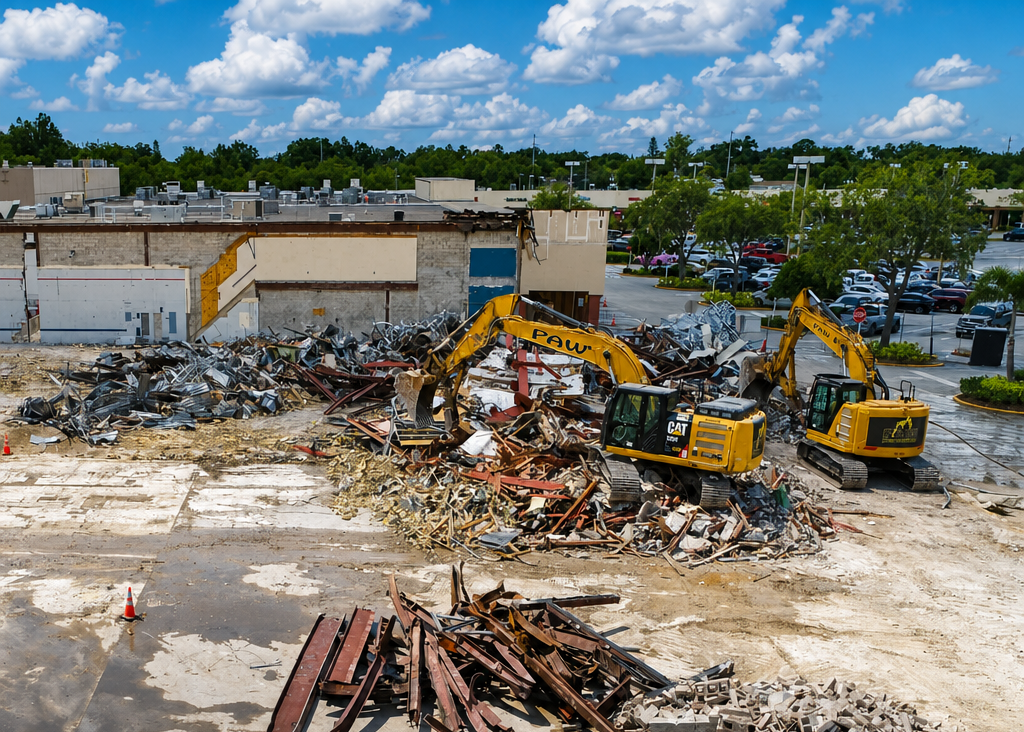
Site access matters just as much as size. A warehouse set back on an open industrial parcel with wide clearance for excavators and dump trucks costs less to demolish than one wedged between active neighboring tenants, close to power lines, or accessible only through a narrow loading corridor. Tight sites slow production, require more careful (and more expensive) equipment maneuvering, and sometimes call for hand demolition in areas machines cannot safely reach.
Asbestos and Hazardous Material Abatement
Many Florida warehouses built before the 1980s contain asbestos-containing materials in roofing, floor tile, insulation, or pipe wrap. Under the federal Asbestos NESHAP (40 CFR Part 61, Subpart M), a thorough inspection is required before any commercial or industrial demolition, and a written notification must be filed with the Florida Department of Environmental Protection at least 10 working days before work begins, regardless of whether asbestos is found on-site.
If asbestos is present above the regulated threshold, abatement typically adds $2 to $3 per square foot to the project based on PAW Demolition’s completed abatement work, though the exact figure varies with contamination level and the amount of material requiring removal. Skipping this step is not an option: it is a federal requirement enforced at the state level, and violations carry real financial and legal exposure for the property owner.
Permitting and Regulatory Compliance
Demolition permit requirements vary by county in Florida, and the fees, timelines, and documentation requirements are not identical across Hillsborough, Pasco, Pinellas, and surrounding jurisdictions. Beyond the local demolition permit, industrial and commercial projects typically require utility disconnection confirmation, stormwater and erosion control measures, and the asbestos NESHAP notification described above.
Contractors who pull their own permits and handle notifications in-house tend to keep projects on schedule more reliably than those who subcontract this step out. For a full county-by-county breakdown, see our guide to Florida demolition permits by county.
Get an Accurate Warehouse Demolition Quote
Every warehouse site is different, and a real number requires a walk-through, not a phone estimate. Talk with our team about your project’s structure, site conditions, and timeline.
Debris Removal and Disposal
Landfill tipping fees are rising nationally, and disposal weight is a major line item on any warehouse demolition budget. The national average landfill tipping fee reached $62.28 per ton in 2024, up 10% from the prior year, according to the Environmental Research and Education Foundation. The South Central region, which includes Florida, has historically tracked below that national average, but rates are climbing here as well, and concrete and masonry debris weighs significantly more per cubic yard than the materials in a wood-frame structure, so underestimating debris volume is one of the most common ways a bid comes in low.
Recycling reduces this cost wherever possible. Steel gets sold to scrap recyclers. Concrete can be crushed and reused as aggregate rather than trucked to a landfill. A contractor that handles both demolition and material processing in-house, rather than subcontracting hauling and recycling to separate vendors, typically passes some of that savings back into the total project cost.
Utility Disconnection and Site Restoration
Before demolition begins, electric, gas, water, and sewer connections must be properly disconnected and capped, which requires coordination with utility providers and can affect project timelines if not scheduled early. After the structure comes down, site restoration such as grading, fill, and erosion control is often part of the scope, particularly when the site is being prepared for redevelopment rather than left as a vacant lot.
The Warehouse Demolition Process, Step by Step
- Asbestos survey. A licensed consultant inspects the building and documents any regulated materials before a bid is finalized.
- Permitting and NESHAP notification. The demolition permit is pulled and, if required, the asbestos notification is filed at least 10 working days ahead of work.
- Utility disconnection. Electric, gas, water, and sewer connections are confirmed disconnected and capped by the applicable utility providers.
- Mechanical demolition. Excavators and shears bring down the structure, separating steel, concrete, and other materials as the building comes apart.
- Debris processing and hauling. Steel is set aside for scrap recycling, concrete is crushed for aggregate reuse where possible, and remaining debris is hauled off-site.
- Site restoration. Grading, fill, and erosion control bring the site to its finished condition, ready for the next phase of development.
Why Contractor Experience Affects the Final Number
General contractors and developers evaluating demolition bids should look past the per-square-foot number and ask what is actually included. A quote that bundles permitting, asbestos coordination, debris hauling, and recycling into one scope is easier to hold a contractor accountable to than one where those items are handled by separate vendors with separate change orders.
PAW Demolition’s $646,541 project at the Spring Hill Water Reclamation Facility in Hernando County, completed in January 2024, is a representative example. The scope included self-performed sludge removal, dewatering, demolition, hauling, and site restoration, with all concrete hauled to PAW’s own recycling facility and processed into aggregate. Only abatement and seed and hay work were subcontracted. That kind of in-house scope, rather than coordinating multiple vendors, is what keeps a project’s actual cost close to its original bid.
The Bottom Line on Warehouse Demolition Cost
- Confirm your warehouse’s structural material first. Steel-frame buildings generally cost less to demolish than concrete tilt-wall or masonry structures.
- Order an asbestos survey before requesting bids so contractors can quote against confirmed conditions instead of a worst-case range.
- Ask whether a quote includes concrete recycling. Processing debris on-site into aggregate can lower your total cost versus standard landfill hauling.
- Confirm your contractor handles permitting, NESHAP notification, and utility disconnection in-house rather than passing those steps to subcontractors.
- Request a site walk-through before you finalize a budget. Square footage alone cannot produce an accurate number.
- Request a quote to get pricing specific to your building.
Frequently Asked Questions
does a partial teardown cost less than full warehouse demolition?
Partial teardowns are not automatically cheaper. Selective demolition that preserves the slab or structural frame for reuse can lower material and disposal costs, but it requires more careful sequencing and additional labor hours than a full teardown, which can offset the savings depending on the scope.
can warehouse demolition proceed while an adjacent building stays occupied?
Yes, demolition can proceed safely next to an occupied building with the right site controls. Dust barriers, vibration monitoring, and coordinated equipment staging allow work to continue near active tenants or neighboring operations without disrupting them.
does insurance typically cover storm-damaged warehouse demolition?
Coverage is not automatic and depends on the specific policy and cause of damage. Property owners should confirm with their carrier that demolition and debris removal are included before assuming insurance will offset the cost.
what should a warehouse demolition bid itemize beyond the square footage price?
A complete bid should separate permitting, asbestos survey and abatement, debris hauling, recycling credits, and site restoration into distinct line items. Bids that combine everything into one number make it difficult to compare contractors or identify where costs can be reduced.
is it worth demolishing a warehouse before a property sale instead of after?
Clearing the structure before a sale can widen the buyer pool to include developers seeking a shovel-ready site. The tradeoff is that the seller absorbs the demolition cost upfront instead of passing that cost to the buyer through a lower sale price.