
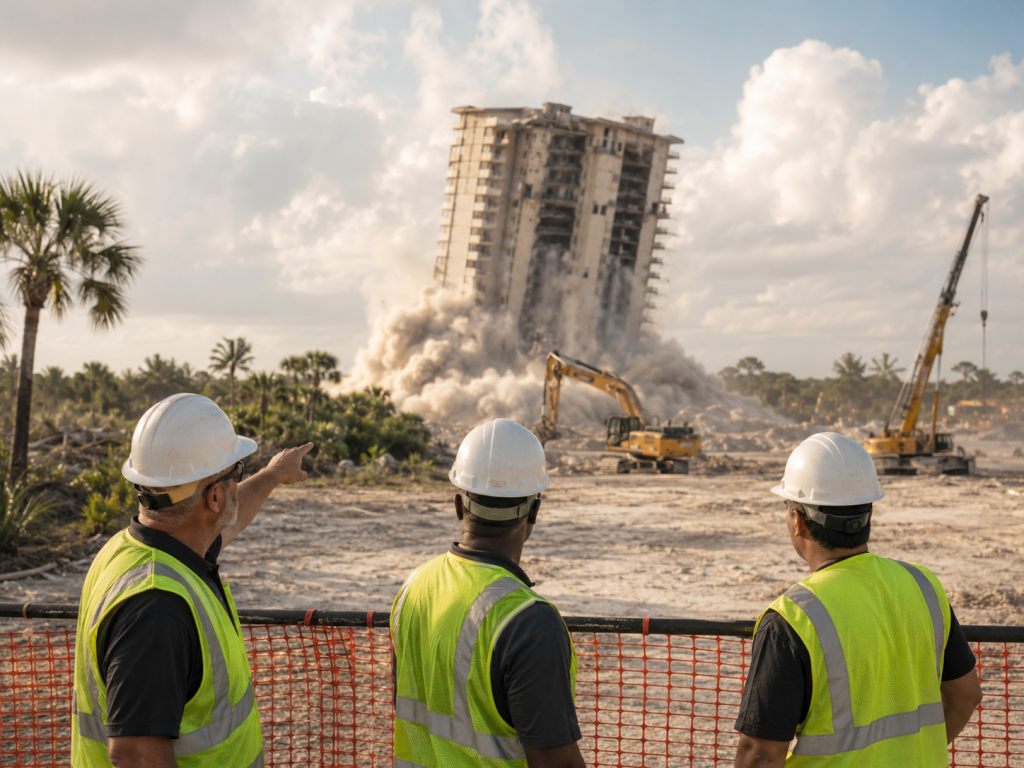
Quick Answer: Mechanical demolition is the standard method for most commercial and industrial projects, using excavators and specialized attachments to bring structures down with precision. Building implosion is reserved for large, tall structures in constrained sites where mechanical access is impractical. The decision comes down to structure type, site constraints, timeline, and budget.
Two structures sit side by side on a redevelopment site. One is a five-story concrete parking garage in the middle of an active airport campus. The other is a three-story warehouse on an open industrial lot with room to maneuver. Both need to come down. Both are the same contractor’s problem. But the method for each will be completely different.
That gap between what you see on television and what actually happens on most demolition sites is where contractors earn their fee. Building implosion is real, it is spectacular, and it is sometimes the right call. But it is also rare, expensive, and technically demanding. Mechanical demolition handles the overwhelming majority of commercial and industrial work, and for good reason.
Understanding the difference between building implosion vs mechanical demolition is one of the more practical things a GC or developer can know before a large project goes to bid. Here is how experienced contractors actually think through that decision.
Key Takeaways
- Mechanical demolition uses hydraulic excavators with purpose-built attachments and is the default method for most commercial and industrial projects.
- Building implosion uses strategically placed and sequenced explosives to collapse a structure inward under its own weight. It is technically a controlled use of explosives, not a true implosion in the physics sense.
- Pre-implosion preparation can take three to six months and adds significant cost beyond the implosion event itself.
- PAW Demolition has executed both methods at the commercial scale, including the $3.6 million Tampa International Airport Red Side Garage implosion.
- You will learn the specific site and structure conditions that make implosion worth considering and when mechanical methods are sufficient.
- You will learn how permitting, safety requirements, and material recovery differ between the two methods.
What Mechanical Demolition Actually Means
Mechanical demolition is the use of heavy equipment to dismantle or destroy a structure. The core machine in commercial and industrial work is the hydraulic excavator fitted with purpose-built attachments.
The Equipment: Attachments That Do the Work
- Hydraulic shears cut through structural steel columns and beams cleanly.
- Concrete pulverizers and crushers break reinforced concrete into manageable pieces without relying on impact.
- Hydraulic breakers fracture thick slabs and foundations where controlled cracking is needed.
- Grapples sort and load debris, separate recyclable material, and handle bulk material movement.
- High-reach booms extend a standard excavator’s reach to safely engage upper floors of taller structures from the outside, top-down.
The versatility of mechanical demolition is why it dominates the industry. A single experienced crew with the right equipment can handle a concrete block warehouse, a steel-framed distribution center, a wastewater treatment building, or an above-grade parking structure. PAW Demolition’s industrial demolition work illustrates how mechanical methods scale across complex structure types.
Why Mechanical Demolition Is the Default
Mechanical methods give the contractor direct control throughout the job.
- Crews can pause, reassess, and adjust as conditions change.
- Material segregation happens in real time, which matters for on-site concrete recycling or structured debris removal.
- No permitting complexities unique to explosives.
- No blast radius coordination with adjacent tenants.
- No spectator management challenges.
For projects where material recovery is part of the scope, mechanical demolition is the more precise choice. Concrete can be sorted and crushed on site for reuse as aggregate. Steel can be separated and loaded for recycling. That capability integrates directly with downstream hauling and materials work, which is a meaningful project efficiency when the contractor controls all three functions.
Pro Tip: When reviewing a demolition bid, ask specifically what equipment will be on site and which attachments the contractor owns versus rents. Owned equipment means faster mobilization, no third-party scheduling conflicts, and a crew that operates the same machines every day. PAW Demolition runs an owned equipment fleet, which is a scheduling and performance advantage on time-sensitive commercial jobs.
What Building Implosion Actually Means
Building implosion is the strategic placement of explosives at critical structural support points, detonated in a precise sequence, to cause a structure to collapse inward under its own weight. The term “implosion” is technically a misnomer. The building is not subjected to external pressure. Instead, explosives weaken or remove key supports so the structure can no longer carry its own gravity loads and fails progressively from the bottom up.
What You See vs. What You Don’t See
The collapse event: A few seconds. Visually dramatic. The part everyone remembers.
The preparation timeline: Three to six months for a complex structure (industry standard; actual timeline varies by project complexity and regulatory requirements). Structural analysis, demolition sequencing engineering, drilling and charging thousands of connection points, wrapping structural elements, coordinating with authorities on blast radius, road closures, and site security. This is where the real work happens.
A Real Example: Tampa International Airport
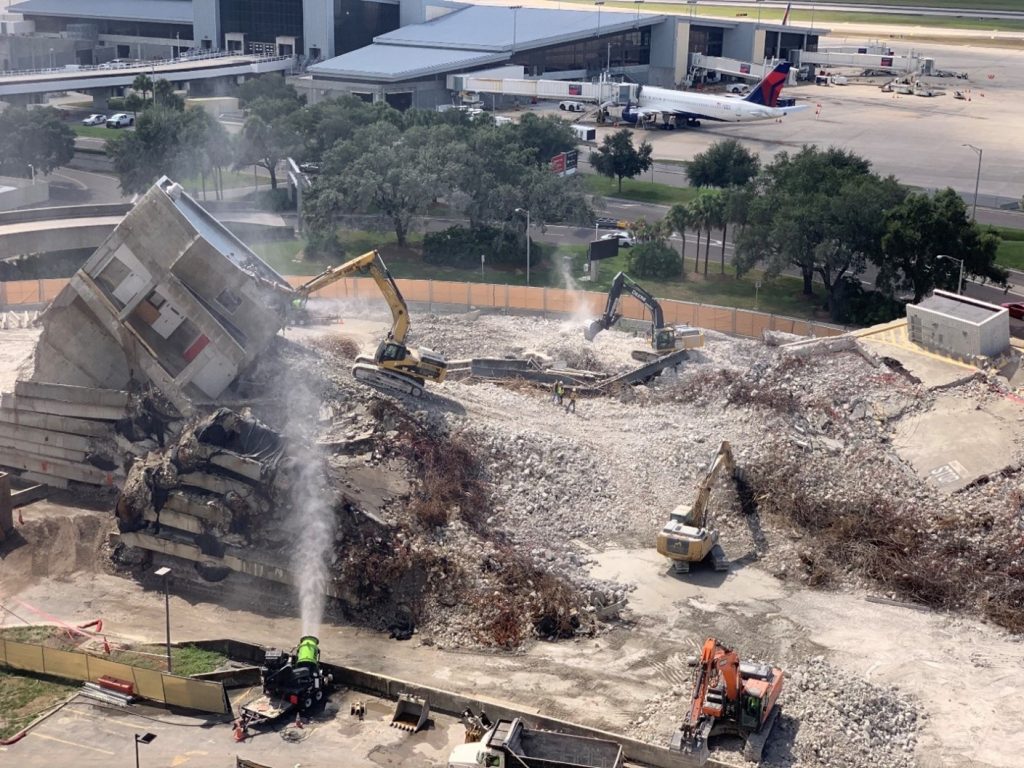 PAW Demolition completed the demolition of the seven-story Red Side Rental Car Garage at Tampa International Airport.
- Contract value (verified project data): $3,655,246
- Scope: Pre-implosion structural engineering, the implosion event, full debris removal, concrete processing
- The implosion: Airport closed 1 to 2:30 a.m. to protect guests and employees. Collapse lasted seconds.
- Full timeline (verified project data): January 2019 to February 2020
When Implosion Is the Right Call
Implosion is not simply a faster or cheaper alternative to mechanical work. It is a solution for situations where mechanical demolition either cannot reach the structure safely or would require so much time and staging that the implosion timeline becomes competitive.
Typical triggers:
- Structures too tall for high-reach excavators to work safely from the perimeter
- Urban sites where surrounding occupied buildings prevent large-scale mechanical equipment use
- Project timelines requiring the structure to come down in a single event rather than over weeks or months
- Airport and infrastructure settings with extended site access restrictions
- Structures with configurations that would be hazardous to approach floor by floor
Pro Tip: An implosion is not a cost shortcut. Factor in engineering fees, explosives permitting, months of pre-implosion mechanical preparation work (interior stripping, abatement, drilling, wrapping), post-implosion debris removal, and site restoration. The total project cost often exceeds what a disciplined mechanical demolition would cost. Implosion buys a specific kind of site clearance speed in a specific kind of constrained environment.
The Decision Framework Contractors Use
Experienced demolition contractors do not start with a preferred method and back-fit it to the project. They start with the project conditions and let those conditions determine the method. The decision is rarely binary, and most large projects involve both approaches at different phases.
| Factor | Points Toward Mechanical | Points Toward Implosion |
|---|---|---|
| Structure height | Under 10 to 12 stories; high-reach excavator can work safely | Tall enough that top-down mechanical work becomes unsafe or impractical |
| Site access | Open footprint; equipment can stage and maneuver around structure | Surrounded by occupied buildings or active infrastructure |
| Timeline | Weeks to months of scheduled demolition work are acceptable | Collapse event needs to happen in a compressed window (e.g., airport closure) |
| Budget | Lower total project cost for most structure types | Higher total cost; months of prep work plus post-implosion debris removal |
| Material recovery | Real-time segregation; concrete recycling integrated into workflow | Mixed debris post-collapse requires sorting before processing |
| Regulatory complexity | Standard demolition permitting applies | Explosives permits, blast radius coordination, local authority approval required |
| Structural condition | Stable enough for top-down mechanical approach | Severely compromised structures that cannot support workers or equipment safely |
The Role of Pre-Demolition Assessment
Before either method begins, a qualified contractor completes a structural assessment:
- Review original building plans where available
- Walk the structure floor by floor to document condition
- Identify hazardous materials requiring abatement
- Map utilities for disconnection
For implosion candidates, the assessment also drives the structural engineering analysis that determines where charges must be placed and in what detonation sequence.
Skipping this phase is where demolition projects go wrong. A structural element that looks sound can be compromised in ways that change sequencing or cause unpredictable behavior. The criteria for vetting an industrial demolition subcontractor include exactly this kind of planning transparency.
Need to Decide Which Method Is Right for Your Project?
PAW Demolition has executed both mechanical and implosion work at the commercial and industrial scale across Florida. We can walk you through a site assessment, explain what your project actually requires, and give you a clear picture of cost, timeline, and method before you commit to anything.
How Mechanical and Implosion Work Together on Complex Projects
The Tampa International Airport garage project shows how both methods operate within a single scope. An implosion does not eliminate mechanical demolition work. It replaces one phase of it, specifically the structural collapse phase, while mechanical methods handle everything before and after.
Before the Implosion
PAW crews performed mechanical pre-demolition work:
- Stripping interior non-structural elements
- Coordinating abatement
- Drilling column and beam connection points
- Prepping the structure for charges
After the Implosion
Mechanical equipment returned to:
- Process 32,000 tons of concrete
- Separate recyclable material
- Restore the site
- Recycle concrete for road base aggregate
That integrated model, where demolition, hauling, and materials processing are controlled by the same contractor, eliminates the coordination friction that slows projects when multiple subcontractors hand off work. It also gives the GC or owner a single point of accountability.
High-Reach Demolition as a Middle Ground
For structures in the eight to fifteen story range that are not good implosion candidates, high-reach demolition is often the right answer. Long-boom hydraulic excavators can safely engage upper floors from ground level, working top-down without requiring workers to operate at dangerous heights inside the structure. Equipment reach capacity varies significantly by model, ranging from approximately 65 feet (20 meters) for standard long-reach configurations to 161 feet (49 meters) for specialized high-reach units, per National Demolition Association equipment guidance and manufacturer specifications.
This method is slower than implosion but faster than traditional floor-by-floor mechanical work, and it preserves the material segregation and recycling advantages of a fully mechanical approach.
Permitting and Regulatory Requirements by Method
Both methods require permits, but the permitting complexity for controlled implosion is substantially higher. Choosing the right demolition method Florida contractors recommend also carries specific regulatory implications that vary by jurisdiction.
Mechanical Demolition Permits
Mechanical demolition in Florida requires a demolition permit issued by the applicable local building department before work begins.
- Structural plans review
- Utility disconnection confirmation
- Asbestos survey documentation (where applicable)
- County-by-county variations (Hillsborough, Pinellas, Pasco, and Hernando counties each have specific requirements)
PAW Demolition handles permitting in-house across its service area, which eliminates a common project delay point.
Implosion Permits: The Additional Layer
Implosion adds significant permitting complexity:
- Federal explosives licensing through the Bureau of Alcohol, Tobacco, Firearms and Explosives (ATF)
- State-level explosives permits
- Local fire and emergency management authority coordination
- Formal blast radius analysis submitted to local officials
- For projects near active infrastructure or occupied structures: additional lead time before any site work begins
Pro Tip: If you are a GC planning a project that might involve implosion, begin the permitting coordination process earlier than you think you need to. Explosives permits and blast radius approvals involve multiple agencies, and the timeline is not flexible once you have committed to an implosion date. Build the permit lead time into your master schedule, not your contingency buffer.
Safety Considerations for Each Method
Both mechanical demolition and implosion are safe when executed by qualified, experienced crews. The safety risks associated with each method are different in character.
Mechanical Demolition Safety
Safety centers on controlled sequential execution. Workers and equipment operators are present throughout, which means the risk exposure is continuous but manageable through proper sequencing, structural monitoring, and site control.
A contractor with a proven safety record and a low experience modification rate demonstrates this capability concretely. PAW Demolition carries a 0.72 experience modification rate (calculated per NCCI (National Council on Compensation Insurance) Experience Modification methodology as detailed in NCCI’s Experience Rating Plan Manual), 28 percent below the industry average, reflecting the discipline of daily site management across complex projects.
Implosion Safety
Implosion safety concentrates risk into a shorter window but with a larger blast perimeter footprint. The implosion event requires:
- Evacuating and securing a defined blast radius
- Temporarily closing adjacent roadways or infrastructure
- Coordinating with local authorities on spectator control
Once the charges are set and the sequence initiates, the outcome is determined by the engineering and preparation work that preceded it. There is no in-the-moment adjustment available. This is why the months of pre-implosion preparation are not optional overhead; they are where the safety work actually happens.
Hazardous Materials: Non-Negotiable for Both Methods
The pre-demolition hazardous materials survey is a non-negotiable first step for both methods. Asbestos, lead paint, and other regulated materials must be identified and abated before any structural demolition begins.
Florida’s NESHAP notification requirements mandate advance notice to the applicable FDEP district office at least 10 working days before demolition begins on structures that meet regulated asbestos-containing material thresholds. Regulatory guidance is available from the Florida Department of Environmental Protection (FDEP) and the EPA National Emissions Standard for Hazardous Air Pollutants (NESHAP) under 40 CFR Part 61, Subpart M. These requirements apply equally to mechanical and implosion projects.
The Bottom Line on Implosion vs. Mechanical Demolition
- Start every project evaluation with a pre-demolition structural assessment before committing to any method or accepting any bid.
- If your structure is under ten to twelve stories with adequate site access, specify mechanical demolition and require the contractor to document their equipment and sequencing plan.
- Do not treat implosion as a budget lever. Require a full-scope cost comparison that includes prep work, permitting, debris removal, and site restoration before drawing any cost conclusions.
- For implosion projects, add explosives permit lead time to your master schedule before you finalize a demolition date with any stakeholder.
- Require proof of in-house permitting capability, an owned equipment fleet, and a current experience modification rate below 1.0 from any demolition contractor you are evaluating for a complex project.
- Look for a contractor who has executed both methods at scale. That experience shapes better method recommendations and fewer surprises once work begins.
Plan Your Tear Down
Fast, reliable demolition services from licensed pros with decades of field experience.
Frequently Asked Questions
What is the difference between implosion and controlled demolition?
All building implosions are a form of controlled demolition, but not all controlled demolition involves implosion. Controlled demolition refers to any demolition process engineered to produce a predictable, bounded outcome, including mechanical demolition, high-reach work, and explosive methods. Implosion specifically means using sequenced explosives to collapse a structure inward under its own weight, while mechanical controlled demolition uses equipment rather than explosives to achieve the same outcome.
How long does it take to prepare a building for implosion?
Pre-implosion preparation for a large commercial or multi-story structure typically takes three to six months. This phase includes structural engineering, abatement, interior stripping, drilling and charging structural elements, wrapping columns and beams to contain debris, and coordinating all permits and authority approvals. The implosion event itself may last only seconds.
What does building implosion cost compared to mechanical demolition?
Building implosion typically costs more in total project terms than mechanical demolition for the same structure. Engineering fees, explosives permitting, months of pre-implosion preparation work, post-implosion debris removal, and site restoration all add to the total before the implosion event itself is counted. Implosion is chosen for site constraint and timeline reasons, not to reduce cost. For structures where mechanical demolition is feasible, it is generally the more cost-effective path.
Can a building next to occupied structures be imploded safely?
Implosion adjacent to occupied structures is technically feasible but requires more engineering and coordination than open-site implosions. Engineers design the detonation sequence to direct the collapse away from adjacent structures and to minimize blast radius and debris projection. The closer the surrounding occupancies, the more constrained the viable implosion window and collapse direction become, and the more preparation work is required to protect neighboring properties.
What happens to the concrete after an implosion?
Post-implosion concrete debris is processed through mechanical methods: excavators with grapples and pulverizers sort and break the collapsed material, which is then hauled off site or processed at a concrete recycling facility. On-site recycling reduces haul costs and diverts recyclable material from landfills.
How do I know if my project needs an implosion specialist?
A project warrants an implosion evaluation when the structure’s height, location, or site constraints make mechanical demolition impractical or unsafe. Specific triggers include structures taller than ten to twelve stories, buildings surrounded by active infrastructure with limited equipment access, or timelines that require the structural mass to come down in a single compressed event. A qualified demolition contractor can assess whether implosion is warranted during the pre-demolition site evaluation.