
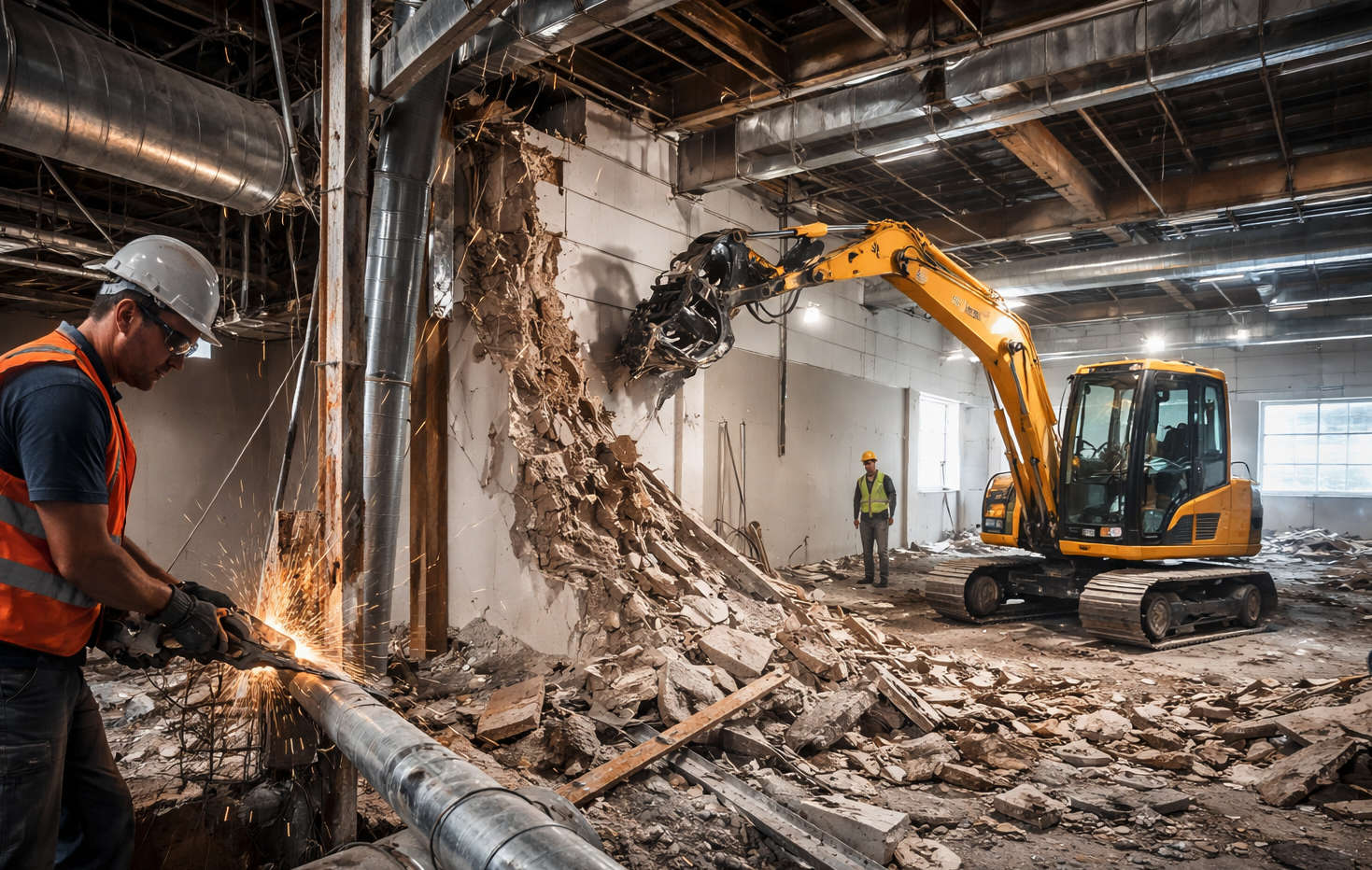
Selective demolition is becoming an essential strategy for commercial and industrial projects in Pasco County. Unlike traditional demolition, which often involves tearing down entire structures, selective demolition targets specific parts of a building.
This approach is not only more cost-effective but also offers greater precision and sustainability. As businesses increasingly prioritize environmental responsibility and operational efficiency, selective demolition stands out as a smart, strategic choice for modern renovation and construction projects.
With its focus on careful dismantling and material reuse, selective demolition supports sustainable demolition practices and minimizes waste, making it a popular option for commercial renovations and industrial upgrades alike.
Industry professionals often hold certifications such as OSHA 30-Hour Construction Safety, and many reputable contractors are members of the National Demolition Association (NDA), ensuring adherence to best practices and safety standards.
| Feature | Selective Demolition | Traditional Demolition |
|---|---|---|
| Scope | Targets specific sections or components | Removes entire structure |
| Precision | High; preserves surrounding areas | Low; less control over adjacent areas |
| Material Reuse | Maximizes salvage and recycling | Limited; most materials become waste |
| Disruption | Minimal; allows ongoing operations | Significant; often requires full shutdown |
| Environmental Impact | Lower; supports sustainability | Higher; generates more landfill waste |
| Cost Efficiency | Potential for cost savings | May incur higher disposal and repair costs |
Quick Answer
Quick Answer: Selective demolition focuses on removing specific sections of a structure, offering cost savings, safety, environmental benefits, precision, and minimal disruption, making it ideal for commercial and industrial projects.
What is Selective Demolition?
Selective demolition is the careful removal of specific parts of a building while preserving the rest.
Selective demolition is especially useful in commercial and industrial projects where retaining portions of the building is necessary for operational continuity or structural reasons.
Many projects require compliance with EPA regulations for hazardous material abatement, and may involve certified asbestos abatement contractors or lead-safe certified firms to ensure regulatory compliance and safety.
How Selective Demolition Works
The process starts with a detailed assessment of the building to identify which parts need removal and which should remain intact. Skilled demolition teams then use specialized tools and techniques to dismantle targeted sections carefully.
This often involves soft stripping, removal of interior components, or extraction of hazardous materials without disturbing the overall structure. The focus is on precision to protect adjacent areas and maintain the integrity of the remaining building.
Applications in Commercial and Industrial Projects
Selective demolition is widely used in:
- Office renovations where part of the workspace is updated without affecting the entire facility.
- Factory upgrades, allowing machinery areas to be dismantled while production continues elsewhere.
- Retail space reconfigurations, where sections are remodeled to accommodate new layouts.
These applications highlight the flexibility and control selective demolition offers in complex environments.
5 Key Benefits of Selective Demolition
- Cost Savings: By focusing only on specific areas, projects avoid the expenses associated with full-scale demolition and reduce waste disposal fees.
- Precision and Control: Contractors can target only the necessary parts of a building, preserving structural integrity and minimizing risk to surrounding systems.
- Enhanced Safety: Focused demolition reduces hazards like falling debris and uncontrolled collapses, protecting workers and the community.
- Environmental Sustainability: Less waste is sent to landfills, and more materials are recycled, supporting green building initiatives.
- Minimal Disruption to Ongoing Operations: Businesses can often continue operating during selective demolition, limiting downtime and interruptions.
1. Cost Savings
One of the primary advantages of partial demolition is significant cost savings. By focusing only on specific areas, projects avoid the expenses associated with full-scale demolition.
Selective demolition reduces waste disposal fees since less debris is generated, and the ability to salvage materials further decreases overall costs.
Reusing and Recycling Materials
Materials like steel beams, wood, and concrete can often be reclaimed and reused or recycled. This not only cuts down on material costs but also aligns with eco-friendly demolition benefits by reducing demand for new resources. Many businesses in Pasco County find that reusing materials helps stretch their budgets while contributing to sustainable construction practices.
2. Precision and Control
Selective demolition offers unmatched precision by allowing contractors to target only the necessary parts of a building. This control is vital in projects that involve high-value assets or require maintaining structural integrity.
It ensures that surrounding systems such as electrical wiring, plumbing, and HVAC remain undisturbed, which is critical in modern commercial and industrial environments. Many selective demolition contractors are certified in confined space entry and utilize advanced equipment such as robotic demolition machines and high-reach excavators for increased accuracy and safety.
Protecting Adjacent Structures
By carefully dismantling only selected areas, selective demolition reduces the risk of accidental damage to nearby buildings or infrastructure. This is especially important in dense commercial zones or industrial parks where many structures are close together. Contractors often coordinate with building managers to ensure safety and prevent costly repairs.
3. Enhanced Safety
Safety is a top priority in any demolition project, and selective demolition helps minimize risks for workers and the surrounding community. By working in a focused and controlled manner, hazards like falling debris or uncontrolled collapses are significantly reduced.
Modern equipment and well-trained teams further ensure that safety protocols are strictly followed throughout the demolition process. Many teams are trained in HAZWOPER (Hazardous Waste Operations and Emergency Response) standards and follow ANSI A10.6 safety guidelines for demolition operations.
Minimizing Hazards in Populated Areas
Selective demolition is ideal for urban or industrial zones in Pasco County where people work or live nearby. The approach controls dust, noise, and debris, reducing exposure to harmful conditions. This makes it a preferred method for projects where safety and environmental concerns are paramount, as detailed in resources like industrial demolition company safety standards.
4. Environmental Sustainability
Selective demolition supports sustainable demolition practices by reducing the volume of waste sent to landfills and maximizing material recycling. This approach aligns well with green building initiatives and can contribute to certifications such as LEED.
Many Pasco County businesses are adopting selective demolition as part of their commitment to reducing environmental impact in construction projects.
Reducing Landfill Contributions
Because only targeted parts of a structure are removed, the amount of debris collected is much smaller. Salvaged materials are sorted and recycled, significantly lowering landfill contributions. These eco-conscious benefits make selective demolition an attractive option for companies focused on environmental responsibility, as explored in going green and recycling strategies.
5. Minimal Disruption to Ongoing Operations
One of the key commercial renovation benefits of selective demolition is its ability to allow businesses to continue operations during construction. This is crucial for industries where downtime can be costly or disruptive.
Selective demolition helps maintain productivity by limiting noise, dust, and interruptions to specific areas rather than shutting down entire buildings.
Maintaining Productivity During Projects
In manufacturing plants or retail environments, selective demolition enables partial renovations without halting normal activities. Contractors use techniques to isolate work zones and control environmental factors, ensuring employees and customers are unaffected.
This approach is often recommended when planning projects involving ongoing operations, as discussed in technology in commercial demolition.
Is Selective Demolition Right for Your Project?
Selective demolition offers a range of benefits including cost savings, precise targeting, enhanced safety, environmental sustainability, and minimal disruption. These advantages make it a compelling option for many commercial and industrial projects in Pasco County.
To determine if selective demolition fits your needs, consider the scope of your project, the condition of the building, and your sustainability goals. Consulting with experienced demolition professionals can provide tailored advice and help you choose the best approach.
For those interested in exploring options further, contacting a local expert like the best demolition contractor Pasco County can be the next step toward a successful project.
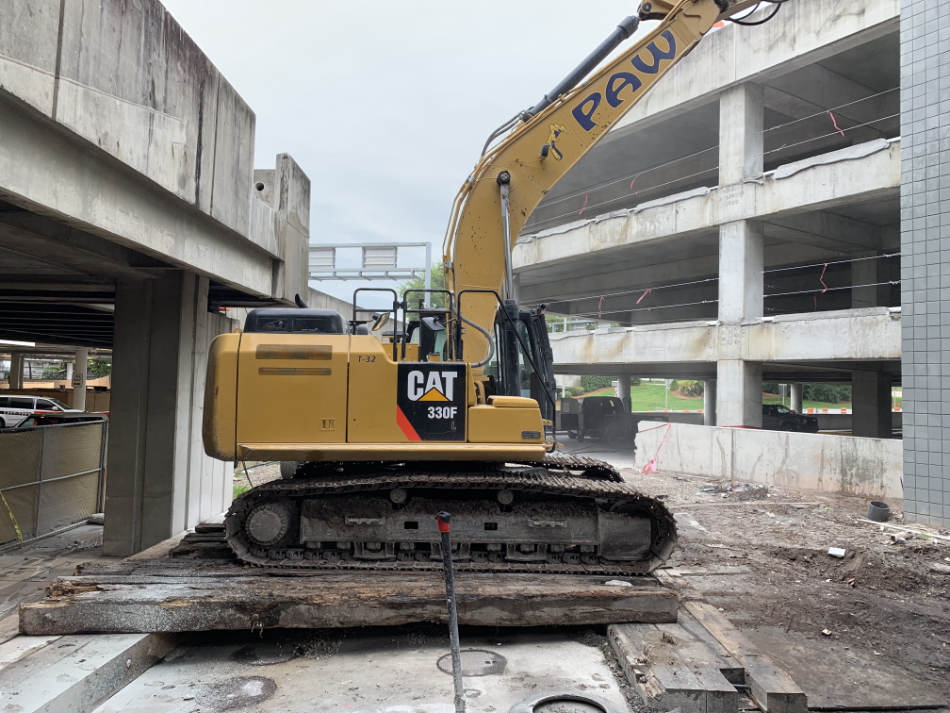
Fast, reliable demolition services from licensed pros with decades of field experience.
Frequently Asked Questions
What is the difference between selective demolition and traditional demolition?
Selective demolition focuses on removing specific parts of a structure, preserving the rest. Traditional demolition involves completely tearing down an entire building or structure.
Is selective demolition more expensive than traditional demolition?
While initial costs may be similar, selective demolition often saves money by reducing waste disposal fees and enabling material reuse. It also prevents costly damage to surrounding structures, lowering overall expenses.
Can selective demolition be performed in occupied buildings?
Yes, selective demolition is designed to minimize disruption, making it suitable for occupied spaces. Techniques are used to control noise, dust, and safety hazards, allowing businesses to continue operating.
How does selective demolition contribute to sustainability?
It reduces construction waste by salvaging and recycling materials. Additionally, selective demolition supports green building certifications like LEED by promoting eco-friendly demolition practices.
What types of projects benefit most from selective demolition?
Projects involving partial renovations, retrofits, or expansions benefit greatly. Industries such as retail, manufacturing, healthcare, and office spaces often rely on selective demolition for efficient upgrades.