
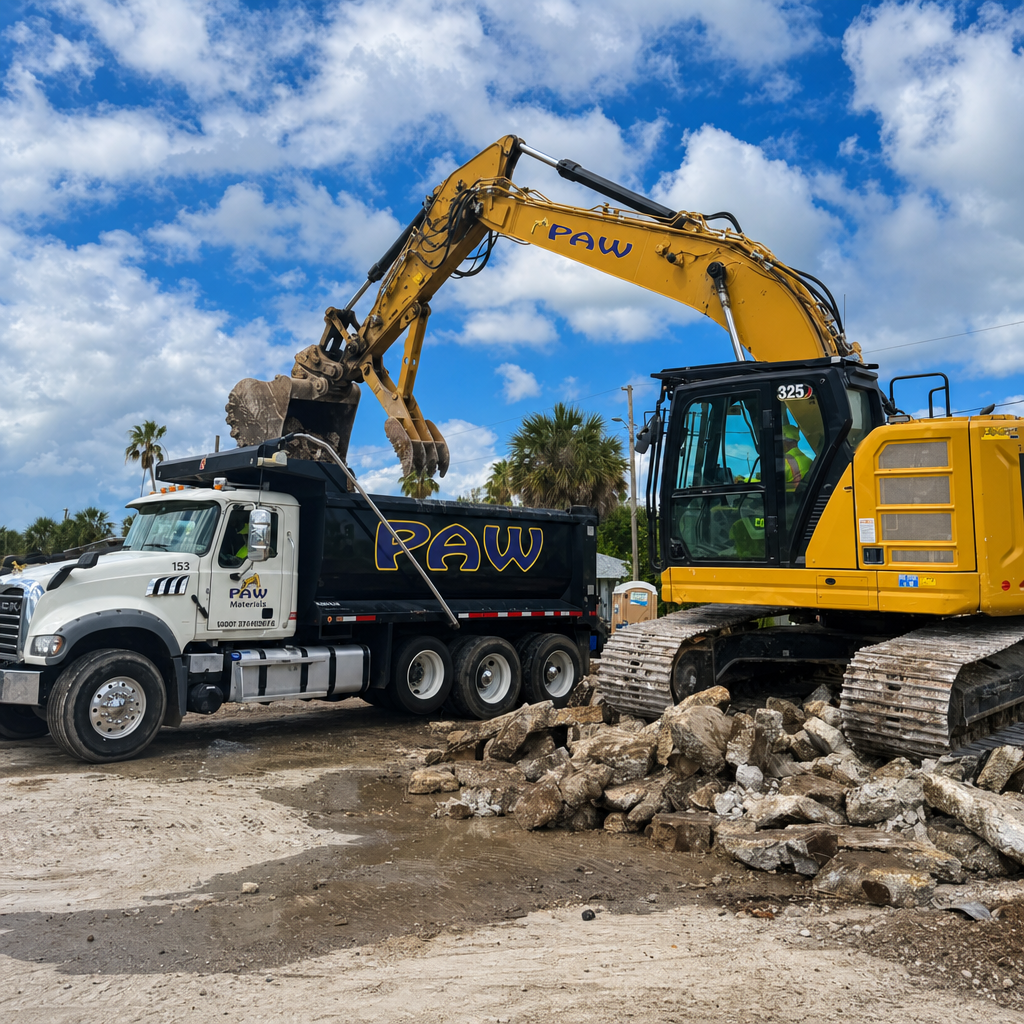
Quick Answer: Commercial site clearing in Florida is a seven-phase process covering hazardous materials surveys, permitting, utility disconnections, structural demolition, debris processing, land clearing, and grading. Each phase has its own regulatory triggers and scheduling dependencies. Missing one step delays everything that follows.
You have a site. You have a development plan. You have a GC lined up. What you may not have is a clear picture of what actually happens between “we own the property” and “we’re ready to build.” That gap is where commercial site clearing lives, and it is more involved than most developers expect the first time through it.
Site clearing for a commercial development is not a single task. It is a sequence of interdependent steps, each with its own permitting requirements, regulatory triggers, and scheduling dependencies. Miss one, and the rest of your timeline moves with it. This article walks through the full process as a Florida commercial contractor experiences it, from initial site assessment through final grading, so you know what to plan for and what to ask your contractor before the project kicks off.
Key Takeaways
- Commercial site clearing begins well before any equipment touches the ground, starting with hazardous materials surveys, permitting, and abatement.
- NESHAP notification to the appropriate FDEP district office is required at least 10 working days before demolition begins, whether or not asbestos is present. Where asbestos is found, that clock starts before removal work, not before structural demo.
- Demolition and land clearing permits are issued separately by different county departments and must often be applied for concurrently to avoid timeline gaps.
- Demolished concrete can be recycled into usable aggregate, reducing disposal costs and potentially supplying base material back to your project.
- A full-scope contractor who handles demolition, hauling, and materials processing under one contract eliminates the coordination friction that causes budget overruns and schedule slippage.
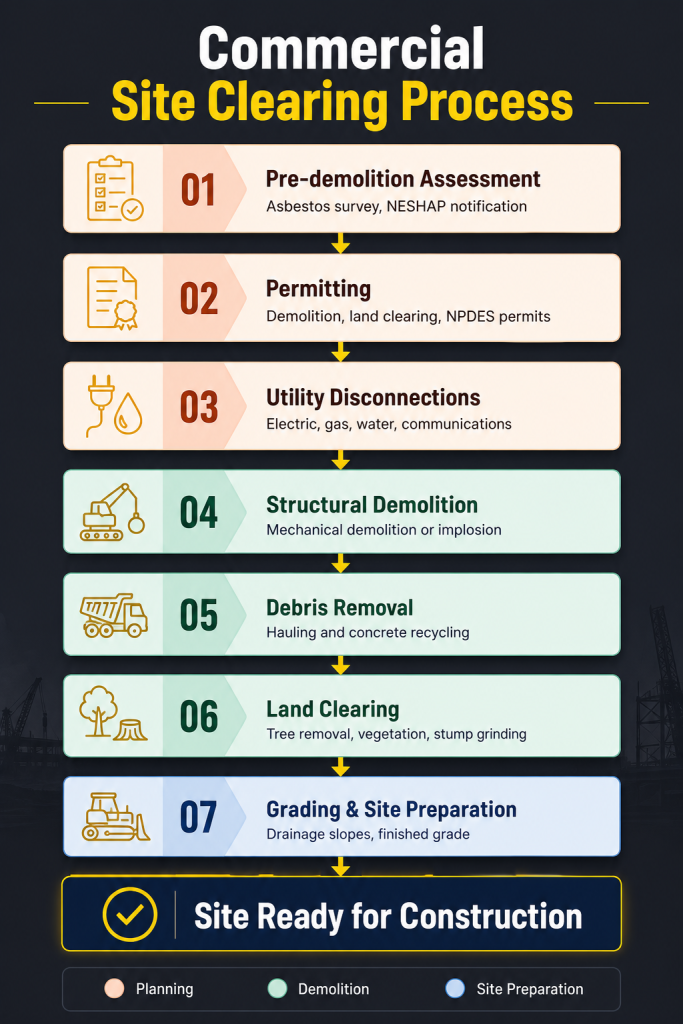
Phase 1: Pre-Demolition Assessment and Hazardous Materials Survey
Before any structure on your site comes down, federal law requires a thorough inspection for asbestos-containing materials (ACMs). Under the EPA’s National Emission Standards for Hazardous Air Pollutants (NESHAP), any institutional, commercial, or industrial building subject to demolition must be inspected by a certified asbestos consultant prior to the start of work. This applies to every commercial demolition, regardless of the building’s age or apparent condition.
NESHAP Notification Requirements
In Florida, written notification must be submitted to the appropriate FDEP district office or local delegated program at least 10 working days before demolition begins (40 CFR Part 61, Subpart M, §61.145). Where asbestos is present, the 10-working-day clock starts before stripping or removal work begins, not before structural demolition. Where no asbestos is found, notification is still required before demolition commences. That notice must include:
- Scheduled start and completion dates
- Site location and contractor information
- Removal methods to be used
- Asbestos quantities, if applicable
What the Survey Covers
Beyond asbestos, a thorough pre-demolition survey flags additional hazards that must be addressed before structural work begins:
- Lead-based paint, common in structures built before 1978
- Mercury-containing equipment, including fluorescent lighting and switches
- Underground storage tanks (USTs), which trigger separate closure permitting
- PCBs and other regulated substances depending on prior site use
The scope of these surveys depends on the structure’s age, prior use, and site history. An industrial site that formerly housed manufacturing operations may carry a more complex environmental baseline than a retail strip center. On sites where asbestos or lead is identified, a licensed abatement contractor must complete remediation before mechanical demolition proceeds.
At PAW Demolition, we coordinate directly with abatement subcontractors to keep the handoff clean and the schedule intact, as we did on the Spring Hill Water Reclamation Facility project in Hernando County, where abatement was subcontracted while PAW self-performed all structural demolition, hauling, and site restoration.
Phase 2: Permitting and Regulatory Coordination
There is no single permit that covers commercial site clearing in Florida. Demolition, land clearing, and tree removal are processed by different departments, often on different timelines, and the requirements vary by county. A developer breaking ground in Hillsborough County is operating under different rules than one working in Pasco or Hernando, even on adjacent parcels.
Permits Typically Required
| Permit Type | Issuing Authority | Key Requirements |
|---|---|---|
| Demolition permit | County building department | Site plans, contractor licensure, utility disconnection documentation |
| Land clearing / tree removal permit | Development services or environmental review | Clearing plan, tree survey, mitigation plan if required |
| NPDES stormwater permit | FDEP or water management district | SWPPP with erosion and sediment controls in place before clearing begins; required when land disturbance reaches one acre or more (40 CFR §122.26(b)(14)(x) and (b)(15)(i)) |
| Environmental resource permit | Water management district or FDEP | Required for sites that include or abut wetlands, floodplains, or regulated water features |
On projects where demolition and clearing overlap, many counties allow concurrent review when both applications are submitted together with a full site plan. That concurrent submission is worth asking about early, since sequential review can add weeks to the permitting window.
PAW Demolition holds a General Contractor license and pulls permits in-house on applicable projects, which removes a layer of coordination cost for GCs and developers who would otherwise manage that process separately.
Phase 3: Utility Disconnections
All active utility services must be formally disconnected and confirmed in writing before demolition crews can safely proceed. This step is non-negotiable and affects your permit timeline, since most building departments require documentation of disconnections as a condition of permit issuance.
Utilities That Must Be Disconnected
- Electric service, coordinated with the local utility provider and confirmed with a written disconnection notice
- Natural gas, requiring the utility to physically cap the service at the meter or main
- Water and sewer, including any on-site irrigation systems or fire suppression connections
- Communications lines, including telephone, cable, and fiber
- On-site fuel or propane systems, which may require tank removal or decommissioning before demo can proceed
These are the responsibility of the property owner or developer, coordinated directly with the respective utility companies. Utility relocations, where existing service lines must be moved or capped rather than simply terminated, require separate sequencing to avoid holding up the demolition start. The utility disconnection requirements before demolition vary by provider and must be confirmed in writing before permits clear.
Phase 4: Structural Demolition
With abatement complete, permits in hand, and utilities confirmed off, structural demolition can begin. The method your contractor uses depends on the structure type, site constraints, adjacency to active operations or neighboring properties, and schedule pressure.
Common Demolition Methods for Commercial Sites
- Mechanical demolition using excavators with demolition attachments is the standard approach for most commercial structures
- High-reach excavators and hydraulic breakers for taller structures or heavy concrete construction
- Selective interior demolition where only specific structural elements are removed while the shell is retained
- Controlled implosion for larger structures where footprint, height, or adjacency constraints make mechanical demolition impractical
Concrete structures, steel-framed buildings, masonry, and wood-frame construction all require different sequencing and equipment selections. PAW Demolition has performed implosion work at scale, including the seven-story parking garage at the Tampa International Airport, a $3,655,246 contract that required precise sequencing to protect active airport infrastructure during the demolition sequence.
On projects involving existing concrete slabs, foundations, and flatwork, the demolition contractor’s ability to process that material efficiently has a meaningful impact on cost. A contractor who can crush and recycle material on-site or haul it to their own processing facility changes the math on debris removal. PAW Demolition operates its own on-site concrete recycling facility, where demolished concrete is processed into usable aggregate. Whether that aggregate qualifies for reuse as road base or fill on your specific project depends on application and jurisdiction: FDOT-approved use as base material under Section 911-2.7 of the Standard Specifications for Road and Bridge Construction requires source approval, a DEP permit or clean debris qualification, and testing for gradation, Limerock Bearing Ratio, and contamination. For private site applications not governed by FDOT specs, local engineer approval and project specifications control. Confirm with your contractor and civil engineer which uses apply to your scope before relying on recycled aggregate as a cost offset.
Planning a Commercial Site Clearing Project in Florida?
PAW Demolition self-performs demolition, hauling, permitting support, and concrete recycling under one scope. If you are scoping a commercial redevelopment and want to understand what the full process looks like for your specific site, our team can walk you through it.
Phase 5: Debris Removal and Material Processing
Once a structure is down, the debris removal and material processing phase begins. This is where many developers encounter unexpected cost exposure if they have not thought through the debris management plan during bid development.
Common Debris Streams and Disposal Paths
| Material | Disposal Path | Cost Implication |
|---|---|---|
| Concrete and masonry | On-site crushing or recycling facility | Recyclable; can offset disposal cost or supply aggregate back to project |
| Structural steel | Scrap metal recycling | Carries scrap value; reduces net disposal cost |
| Wood framing and lumber | C&D landfill or mulching | Standard tipping fees apply |
| Drywall and roofing | C&D landfill | Standard tipping fees; some materials may be segregated for recycling |
| Mixed or contaminated waste | Permitted disposal facility | Premium disposal rates; must be segregated from clean C&D debris |
A contractor with in-house hauling, roll-off logistics, and a processing facility can significantly reduce the total cost of debris removal compared to a contractor who subcontracts hauling and pays third-party tipping fees. PAW Demolition operates its own trucking fleet and roll-off equipment, giving us direct control over material routing and cost on projects where debris volume is substantial.
On the Bear Creek seawall project in St. Petersburg, PAW used rip-rap aggregate sourced from its own processing to create a seawall buffer after structural demolition was complete, reducing both disposal cost and material procurement cost for the project owner.
Phase 6: Land Clearing and Vegetation Removal
For sites with existing vegetation, land clearing runs either concurrently with or immediately following structural demolition, depending on site layout and the clearing plan approved as part of the permit. This phase covers:
- Tree removal, including protected species coordination where required
- Stump grinding to below grade
- Brush and undergrowth clearing
- Ground-level vegetation removal that would interfere with grading and foundation work
Florida-Specific Considerations
Florida’s tree ordinances vary significantly by county and municipality. In Hillsborough, Pasco, and Hernando counties, protected tree species and canopy coverage requirements can directly affect how much vegetation can be removed and what replanting or mitigation may be required. Some jurisdictions require a tree survey and mitigation plan before the clearing permit is issued.
Florida’s wet season, which runs June through September, adds another variable. Erosion controls must be installed and functional before clearing begins per NPDES permit requirements. If wet season clearing is unavoidable, your contractor should have a documented wet weather protocol and robust SWPPP controls in place before the first piece of equipment rolls onto the site.
Phase 7: Grading and Site Preparation
Once demolition and clearing are complete, the site is graded to the elevations required by the civil engineering plan. This phase establishes the conditions your GC and trade contractors need to begin vertical construction.
What Grading Accomplishes
- Creates positive drainage slopes that direct stormwater away from future foundations
- Establishes rough finished grade for parking, paving, and landscaping areas
- Prepares the surface for sub-base compaction ahead of concrete or asphalt placement
- Identifies soft spots, fill inconsistencies, or soil issues before construction begins
Grading requires precision equipment and experienced operators who can read and execute civil drawings accurately. A grade error at this stage creates compounding problems, including drainage failures, foundation bearing issues, and rework costs that almost always exceed what precision grading would have cost to begin with.
Soil conditions in central Florida vary considerably. Sites with expansive soils, high water tables, or previously disturbed fill areas may require soil stabilization or sub-base preparation before paving or structural work can begin. Soil testing at this phase, if not already conducted during the environmental assessment, can prevent costly surprises once construction starts.
How a Full-Scope Contractor Changes the Equation for Developers
Most commercial site clearing projects touch at least four or five separate contractors or vendors: the demolition contractor, the hauler, the abatement contractor, the clearing crew, and the grading contractor. Every handoff is a coordination risk. Every subcontract is a markup layer. Every separate scope is a gap where schedule slippage can hide.
A contractor who self-performs demolition, hauling, and concrete processing while coordinating abatement and clearing as a bundled scope compresses those handoffs and removes markup layers from the cost structure. It also creates a single point of accountability, which matters considerably when a project is running against a development deadline.
PAW Demolition has been operating in Florida for over 43 years with a 0.72 MOD rate, which is 28% better than the industry average. Our owned equipment fleet means we are not dependent on equipment rental availability or subcontract labor for core scope items. For developers managing complex redevelopment timelines, that operational depth translates directly into schedule predictability and cost control. Our scope runs from pre-demolition planning through graded, construction-ready site delivery.
The Bottom Line on Commercial Site Clearing for Developers
- Start your asbestos survey and engage your demolition contractor at the same time, not sequentially. The NESHAP clock and lab turnaround add weeks you cannot get back if you treat them as afterthoughts.
- Request concurrent permit review wherever your county allows it. Sequential demolition and clearing permit review is a common and avoidable source of schedule delay.
- Build six to eight weeks of preconstruction lead time into your development schedule before a shovel touches the ground. Projects with wetlands, protected trees, or USTs need more.
- Treat debris management as a cost lever during bid development, not a line item to negotiate later. A contractor with in-house hauling and a concrete recycling facility changes the disposal cost equation.
- Fewer vendors means fewer handoffs. A contractor who can self-perform demolition, hauling, and grading coordination under one scope is a schedule and accountability advantage, not just a convenience.
Frequently Asked Questions
Do I need separate permits for demolition and land clearing on the same commercial site in Florida?
In most Florida counties, yes. A demolition permit is issued by the county building department, while a land clearing or tree removal permit is processed through development services or environmental review. Some counties allow concurrent review when both applications are submitted together with a full site plan, which can reduce the overall permitting timeline.
Can my demolition contractor pull the NESHAP notification, or is that my responsibility as the developer?
Under the NESHAP for asbestos, the notification responsibility falls on the owner or operator of the facility being demolished, or the owner or operator of the demolition operation itself. In practice, many demolition contractors handle this as a service to the project owner, but responsibility for compliance is joint. Confirm with your contractor specifically who is filing the notification and who is maintaining the documentation on-site.
What happens to the concrete from demolished structures on my site?
Demolished concrete can be crushed and recycled into usable aggregate products, including recycled concrete aggregate for base material and larger fraction sizes used for erosion control and drainage applications. Whether your contractor can process material on-site or haul it to a processing facility affects both disposal cost and whether any of that material value flows back to the project.
How much lead time should I build into my development schedule for the pre-demolition phase?
Plan for six to eight weeks of preconstruction lead time to cover the asbestos survey, NESHAP notification filing, demolition permit application, and utility disconnection coordination. Projects with environmental complications, wetland adjacency, or protected tree requirements will need additional time. Engaging your demolition contractor early in this window, rather than after permits are filed, is the most effective way to compress the timeline.
What is an SWPPP and when is it required for a commercial site clearing project?
A Stormwater Pollution Prevention Plan (SWPPP) is required under the NPDES Construction General Permit when a clearing or grading project disturbs one acre or more of land (40 CFR §122.26(b)(14)(x) and (b)(15)(i)). The SWPPP documents the erosion and sediment controls your contractor will install and maintain throughout the project. Required controls must be in place before clearing begins.