
Quick Answer: Decommissioning is the process of safely shutting down a facility, removing hazardous materials, and disconnecting systems before the structure can be repurposed or demolished. Demolition is the physical teardown of the structure itself. Many industrial projects in Florida require both, performed in sequence, but they are distinct scopes with different regulatory requirements, timelines, and contractor qualifications.
Key Takeaways
- Decommissioning prepares a facility for its next phase, whether that is demolition, redevelopment, or long-term closure.
- Demolition is the structural removal of a building or facility and typically cannot begin until decommissioning is complete.
- Florida industrial projects often require both scopes, and skipping or rushing decommissioning creates serious regulatory and safety risks.
- Choosing a contractor who can self-perform both decommissioning and demolition reduces coordination gaps, scheduling delays, and overall project risk.
- Environmental compliance requirements in Florida differ significantly between the two scopes, and each carries its own permitting obligations.
What Is Decommissioning?
Decommissioning is the controlled shutdown and cleanup of an operational or formerly operational facility. It covers everything that needs to happen before a structure can be safely demolished, repurposed, or permanently closed. Think of it as the transition between “active facility” and “ready for whatever comes next.”
Typical decommissioning activities
- Disconnecting and capping utilities (electrical, gas, water, sewer)
- Draining tanks, pipes, and process vessels
- Removing hazardous materials such as asbestos, lead paint, PCBs, and chemical residues
- Cleaning and decontaminating process equipment
- Removing or remediating contaminated soils and sludge
- Conducting environmental assessments (Phase I and Phase II ESAs)
- Documenting regulatory compliance for closure
In Florida, decommissioning is especially common at wastewater treatment plants, chemical processing facilities, power generation sites, and port infrastructure. These facilities often contain regulated substances that must be removed under strict state and federal guidelines before any physical demolition work can begin.
Who regulates decommissioning in Florida?
Depending on the facility type and the materials involved, decommissioning may fall under the jurisdiction of the Florida Department of Environmental Protection (FDEP), the U.S. Environmental Protection Agency (EPA), and OSHA. Wastewater facilities, for example, require specific closure procedures governed by FDEP permits. Asbestos-containing materials must be handled according to both FDEP and EPA National Emission Standards for Hazardous Air Pollutants (NESHAP) requirements.
Pro Tip: If your facility ever stored, processed, or generated hazardous materials, assume decommissioning will be required before demolition. Starting with a thorough site assessment saves time, money, and regulatory headaches.
What Is Demolition?
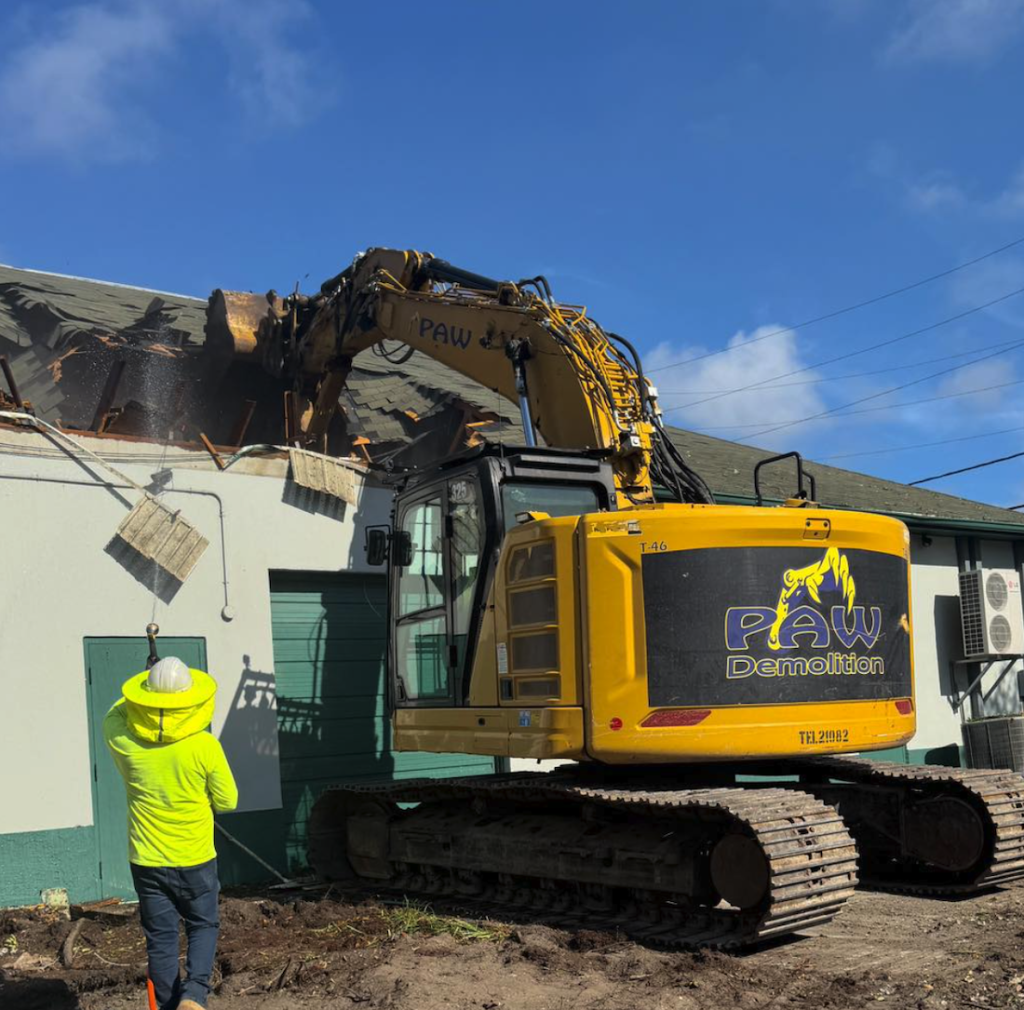
Demolition is the physical teardown and removal of a structure. It is the scope most people picture when they hear the word “demo”: excavators pulling apart walls, concrete being crushed, debris being hauled off site. But demolition on an industrial or commercial project is far more controlled and methodical than it appears.
Common demolition methods for industrial and commercial projects
- Mechanical demolition: Using hydraulic excavators, shears, crushers, and other heavy equipment to systematically dismantle structures
- Selective demolition: Removing specific components while preserving the rest of the structure for renovation or partial redevelopment
- Total demolition: Complete removal of all above-grade and below-grade structures, including foundations
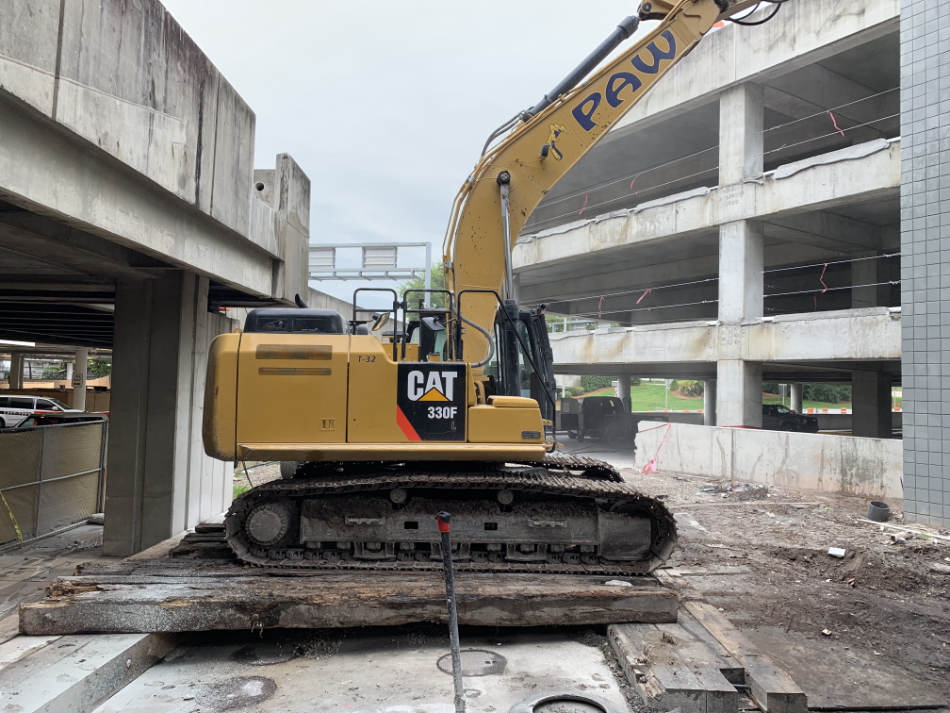
For large-scale projects, PAW Demolition uses a fleet of owned heavy equipment to handle industrial demolition across Florida. Owning equipment rather than renting it means fewer delays and greater control over scheduling, which matters when your project has tight timelines or phased milestones.
What happens after demolition?
Demolition does not end when the last wall comes down. Post-demolition site preparation includes grading, soil compaction, debris removal, and final environmental clearance. On many redevelopment projects, concrete and steel are recycled on site or processed at a nearby facility, diverting material from landfills and reducing hauling costs.
Decommissioning vs. Demolition: Side-by-Side Comparison
The two scopes overlap in timing and sometimes in personnel, but they serve different purposes and follow different rules.
| Factor | Decommissioning | Demolition |
|---|---|---|
| Primary purpose | Safe shutdown, hazardous material removal, regulatory closure | Physical removal of structures |
| When it happens | Before demolition or repurposing | After decommissioning is complete |
| Key regulations | FDEP, EPA (NESHAP, RCRA), OSHA | Local building/demolition permits, OSHA, FDEP (if abatement applies) |
| Typical activities | Utility disconnect, tank draining, asbestos/lead abatement, sludge removal, environmental assessment | Structural teardown, concrete crushing, debris hauling, site grading |
| Environmental risk | High (hazardous materials, contaminated soils, regulated waste) | Moderate (dust, noise, stormwater, debris management) |
| Timeline drivers | Regulatory approvals, lab results, abatement scope | Structure size, equipment availability, permit conditions |
| Contractor qualifications | Licensed abatement contractors, environmental specialists, industrial experience | Licensed demolition contractors, heavy equipment operators, safety certifications |
Why the Distinction Matters for Florida Projects
Treating decommissioning and demolition as one undifferentiated scope is one of the most common and costly mistakes on industrial projects in Florida. Here is why the distinction matters.
Regulatory exposure
If a demolition contractor begins structural teardown before hazardous materials are properly identified and removed, the project owner, general contractor, and demolition contractor can all face enforcement action. In Florida, FDEP can issue Notices of Violation and assess penalties for improper handling of asbestos, contaminated soils, or regulated waste. Federal enforcement through the EPA adds another layer of liability.
Scheduling and sequencing
Decommissioning timelines are often unpredictable. Lab results for soil or material sampling can take weeks. Abatement work may uncover additional contamination that was not identified in the initial assessment. If your project schedule does not account for decommissioning as a distinct phase, demolition will be delayed, and those delays cascade into every downstream trade.
Cost implications
Decommissioning and demolition carry different cost structures. Decommissioning costs are driven by the type and volume of hazardous materials, regulatory requirements, and disposal fees. Demolition costs are driven by structure size, material type, equipment needs, and hauling distances. Bundling both into a single line item on an estimate obscures the true cost drivers and makes it harder to manage change orders when conditions shift.
Understanding the cost factors for industrial demolition in Florida separately from decommissioning helps project owners and GCs build more accurate budgets and reduce financial surprises.
Not Sure Whether Your Project Needs Decommissioning, Demolition, or Both?
PAW Demolition works with general contractors, developers, and facility owners across Florida to scope and execute complex industrial projects from start to finish.
When Your Project Needs Both
Most industrial and infrastructure projects in Florida require both decommissioning and demolition, performed in sequence. Wastewater treatment plants, fuel storage facilities, manufacturing plants, and port infrastructure almost always involve hazardous materials or regulated waste that must be addressed before structural removal can begin.
The advantage of a single contractor for both scopes
When one contractor handles both decommissioning-related activities (such as sludge removal, tank cleaning, and material hauling) and the demolition itself, the project benefits from:
- Fewer coordination gaps: No handoff delays between a decommissioning subcontractor and a demolition subcontractor
- Consistent safety standards: One safety program, one crew culture, one point of accountability
- Integrated logistics: Trucking, recycling, and material supply handled by the same team
- Simplified communication: One project manager, one schedule, one chain of command for the GC to manage
PAW Demolition regularly self-performs sludge removal at wastewater facilities, structural demolition, concrete recycling, trucking, and aggregate supply on the same project. That operational depth is what separates a full-service industrial demolition contractor from a company that only tears things down.
Pro Tip: During the bidding phase, ask prospective contractors which decommissioning tasks they can self-perform versus subcontract out. The fewer handoffs in the field, the lower your project risk.
How to Determine Which Scope Your Project Requires
The answer depends on the facility’s history, current condition, and what you plan to do with the site afterward. Here is a practical framework.
Start with a site assessment
Before any work begins, conduct a Phase I Environmental Site Assessment (ESA). If the Phase I identifies recognized environmental conditions, follow up with a Phase II ESA that includes soil, groundwater, and material sampling. These assessments reveal whether decommissioning is required and define its scope.
Ask these questions
- Has the facility ever stored, processed, or generated hazardous materials?
- Are there underground storage tanks, process piping, or chemical containment systems on site?
- Does the facility have active utility connections that need to be properly disconnected?
- Are there known or suspected asbestos-containing materials or lead-based paint?
- Does the site require environmental closure or regulatory sign-off before demolition can proceed?
If the answer to any of these is yes, decommissioning is part of your project. The scope may be limited (utility disconnects and minor abatement) or extensive (full environmental remediation and regulated waste disposal), but it cannot be skipped.
Match the scope to the contractor
Not every demolition contractor is equipped to handle decommissioning work, and not every environmental contractor can execute a large-scale demolition. For complex industrial projects, you want a contractor with demonstrated experience in both. Review their safety record, their MOD rate, their equipment fleet, and their track record on similar facilities.
PAW Demolition maintains a 0.72 MOD rate and a documented safety program built for high-risk industrial environments. That safety infrastructure is not optional on projects where decommissioning and demolition overlap.
Pro Tip: Request project references that specifically include both decommissioning and demolition on the same site. Past performance on combined-scope projects is the strongest indicator of a contractor’s ability to manage the complexity.
Common Mistakes That Blur the Line Between Decommissioning and Demolition
These missteps show up repeatedly on industrial projects in Florida, and every one of them is avoidable.
- Skipping the environmental assessment: Assuming a facility is “clean” because it looks clean leads to mid-project shutdowns when contamination is discovered during demolition.
- Combining scopes in a single bid line: This hides the true cost of each phase and makes it nearly impossible to manage scope changes without disputes.
- Hiring separate, uncoordinated contractors: When the decommissioning contractor and the demolition contractor do not share a schedule or communicate directly, gaps and overlaps create delays and safety risks.
- Underestimating decommissioning timelines: Environmental lab work, abatement permitting, and regulatory reviews take time. Building demolition-ready dates around optimistic decommissioning estimates sets the entire project up for failure.
- Ignoring below-grade contamination: Decommissioning sometimes reveals contaminated soils or groundwater that were not visible during initial assessments. Budget and schedule contingencies should account for this possibility.
Bottom Line on Decommissioning vs. Demolition in Florida
- Treat decommissioning and demolition as separate scopes with distinct budgets, timelines, and compliance requirements, even when one contractor performs both.
- Start every industrial project with an environmental site assessment to define whether decommissioning is required and how extensive it will be.
- Prioritize contractors who can self-perform both phases to reduce handoff risk, scheduling gaps, and communication breakdowns.
- Verify contractor qualifications independently by reviewing MOD rates, safety programs, equipment ownership, and references from similar combined-scope projects.
- Build schedule contingency into the decommissioning phase because environmental findings and regulatory approvals rarely follow optimistic timelines.
Plan Your Tear Down
Fast, reliable demolition services from licensed pros with decades of field experience.
Frequently Asked Questions
Can a building be demolished without decommissioning first?
Only if the building has no hazardous materials, regulated waste, or active utility connections. Most industrial and many commercial facilities in Florida require at least some level of decommissioning before demolition can legally and safely proceed. Skipping this step risks regulatory penalties and worker safety incidents.
How long does decommissioning take compared to demolition?
Decommissioning often takes longer than the demolition itself, particularly on facilities with extensive hazardous material contamination or complex regulatory closure requirements. A decommissioning phase on a mid-size industrial facility in Florida can range from several weeks to several months, while the demolition phase for the same facility might take two to four weeks.
Who is liable if contamination is found during demolition?
Liability typically falls on the property owner, though general contractors and demolition contractors can also face enforcement action if contamination is disturbed without proper controls. In Florida, FDEP and EPA both have authority to pursue responsible parties. A thorough pre-demolition environmental assessment is the primary tool for identifying and managing this risk before work begins.
Does decommissioning always require environmental remediation?
Not always. Decommissioning may involve straightforward tasks like utility disconnection, equipment removal, and minor cleaning. Environmental remediation becomes necessary when site assessments identify contaminated soils, groundwater, or regulated materials that exceed allowable thresholds. The scope depends entirely on the facility’s history and current conditions.
What certifications should a decommissioning contractor hold in Florida?
At minimum, contractors performing decommissioning work involving hazardous materials should hold relevant state and federal certifications for asbestos abatement, lead abatement, and hazardous waste handling. They should also carry appropriate insurance coverage and demonstrate documented safety programs that meet or exceed OSHA standards for the specific hazards present on site.
Is decommissioning required for commercial buildings or only industrial facilities?
Commercial buildings can also require decommissioning, particularly older structures that contain asbestos, lead-based paint, or legacy environmental contamination from previous tenants. The requirement is driven by what is in or around the building, not by how the building is classified. A Phase I ESA is the standard tool for making that determination.