
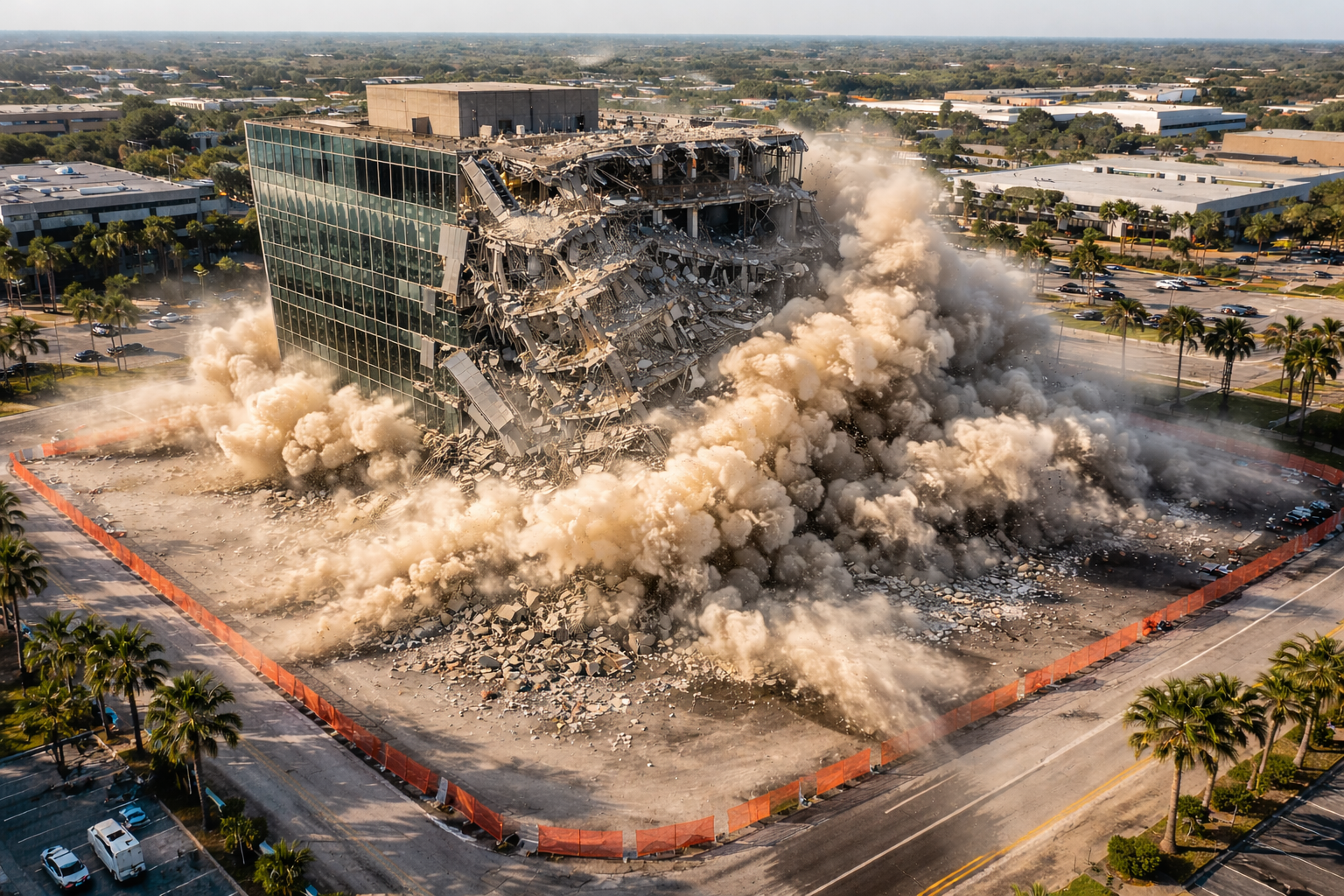
Quick Answer: Office building demolition in Central Florida uses mechanical, implosion, or selective methods depending on the structure type and site conditions. Costs vary based on size, materials, and environmental factors. A licensed commercial demolition contractor manages permitting, environmental compliance, and site safety so your project stays on schedule and within budget.
Why This Phase Determines Your Entire Project Schedule
When a lender draw is tied to site clearance, when follow-on trades are scheduled to mobilize, or when a DOT milestone is fixed in a grant agreement, the demolition phase is not a background task. It is the trigger for everything that follows.
For commercial developers, general contractors, and public infrastructure buyers in Central Florida, a poorly planned demolition phase creates a specific and predictable set of problems: delayed construction starts, unexpected abatement costs that strain the pro forma, change orders from conditions that were not identified before the first wall came down, and liability exposure when safety or compliance gaps show up mid-project.
Most of these problems are avoidable. They trace back to one of three root causes: the wrong contractor, inadequate pre-demolition assessment, or a permitting and environmental process that was not started early enough. This article walks through how to avoid all three.
How Office Building Demolition Supports Central Florida’s Redevelopment in 2026
Central Florida’s population and job growth in 2026 are creating consistent pressure to reposition older commercial sites. Office buildings from the 1970s through the 1990s frequently no longer meet current energy, accessibility, or floor-plate standards. For many owners, demolition and rebuild is more efficient than a heavy renovation that still leaves you with an outdated structure.
Common redevelopment scenarios where demolition is the right first move:
- Converting obsolete single-tenant office parks into mixed-use projects with residential, retail, and structured parking
- Clearing aging municipal office and admin buildings for facilities aligned to current operational needs
- Removing commercial structures that encroach on roadway widenings, FDOT corridor realignments, or transit expansion zones
- Repositioning underperforming suburban office campuses in Hillsborough, Pinellas, Pasco, Polk, and Osceola counties for higher-density uses
Scenario: A developer acquires a 6-story office building along a major corridor in Hillsborough County. The structure is functionally obsolete and parking is constrained. A planned commercial demolition phase clears and re-plats the site for a mixed-use project with ground-floor retail, structured parking, and mid-rise residential. Both the land value and the tax base increase.
In more built-out areas of Central Florida, demolition is often the only path to add capacity. That makes the coordination skills of your demolition contractor, particularly around traffic maintenance, utility sequencing, and close-quarters work near active businesses, as important as their equipment capacity.
Demolition Methods: Choosing the Right Approach for Your Project
Office building demolition in Central Florida typically uses one of three structural methods, and most projects combine more than one. Understanding how each works helps you evaluate contractor proposals and sequence your schedule accurately.
Mechanical Demolition
Mechanical demolition uses heavy equipment to take down a structure in a controlled sequence. It is the most common method for mid-sized office buildings in Central Florida and is well-suited to the range of building types found across the region.
Common equipment used:
- High-reach excavators for taller structures (typically above 4 stories)
- Hydraulic excavators fitted with concrete processors, shears, or grapples
- Loaders and skid steers for debris movement and site management
- Roll-off containers and hauling equipment for waste removal
Best suited for:
- Office buildings from 2 to 10 stories
- Low-rise office parks and suburban campuses with an adequate staging area
- Projects that require phased demolition while adjacent structures remain occupied
Mechanical methods give your contractor a high level of control over the removal sequence, which matters when you are working near active utilities, adjacent tenants, or public roads. Equipment selection directly affects safety and schedule outcomes. For a detailed look at how contractors match machinery to project conditions, see this guide on heavy equipment selection for complex demolition projects.
Implosion Demolition
Implosion uses precisely placed explosive charges to bring a structurally sound building down within a controlled footprint. It is a specialized method used for a specific category of projects, not a shortcut.
When implosion is appropriate:
- Tall office towers in dense urban cores where mechanical top-down work would require extended time at height
- Sites where minimizing time on-site is a primary project requirement
- Structurally sound buildings with predictable load-bearing behavior that allows reliable charge placement and engineered collapse sequencing
Important clarification: Implosion is most effective for structurally sound buildings where engineers can confidently model the collapse sequence. It is not the preferred method for severely degraded structures, where unpredictable load paths make charge placement less reliable. If your building has significant structural deterioration, mechanical demolition typically provides better control.
What implosion requires: Substantially more up-front engineering and coordination than mechanical methods. Expect engagement with structural engineers, licensed blasting specialists, local fire and building officials, law enforcement for traffic and perimeter control, and neighboring property owners. Budget adequate lead time for this process before scheduling a demolition date.
Selective Demolition
Selective demolition, also called soft strip or interior demolition, removes specific building components rather than the entire structure. It almost always precedes full structural demolition and is also used for partial office renovations where portions of the building are retained.
What selective demolition accomplishes:
- Removes interior non-structural elements: ceilings, partitions, flooring, fixtures, MEP systems
- Separates waste streams to support material recycling and salvage
- Reduces total landfill disposal costs through concrete recycling and metal recovery
- Addresses hazardous materials (asbestos, lead-based paint, PCB-containing equipment) before structural work begins
For projects with sustainability reporting requirements, selective demolition supports LEED Materials and Resources credit categories, specifically Construction and Demolition Waste Management (MRc5). It also strengthens your ESG reporting to lenders and institutional investors. For more on sustainable demolition practices, see eco-friendly demolition benefits.
Phased and partial demolition: Many Central Florida redevelopment projects require demolishing one building or wing while adjacent structures remain occupied and operational. This is common in office park conversions, hospital campus expansions, and municipal facility replacements. It requires detailed sequencing plans, temporary utility provisions, and clear communication protocols with tenants and neighbors. Address this in your RFP and contractor interviews, not after award.
What Drives Commercial Building Demolition Costs in 2026
Commercial building demolition costs for office properties in Central Florida respond to a consistent set of variables. Understanding these early lets you build a realistic budget and reduces the likelihood of change orders once work begins.
Primary Cost Drivers
Structure size and type
Total square footage and story count drive baseline cost. Reinforced concrete frames, post-tension slabs, and structural steel cost more to process than light steel or tilt-wall construction. Curtain wall systems and atriums add complexity.
Site access and location
Downtown and CBD sites with limited staging area cost more to operate than suburban office parks. Proximity to hospitals, schools, or active transit routes adds requirements for traffic management, noise control, and public protection measures.
Environmental and hazardous materials
Buildings constructed before 1980 commonly contain asbestos-containing materials and lead-based paint. Pre-1990 buildings may have PCB-containing electrical equipment. Survey, abatement, and regulated disposal costs vary significantly depending on what is found and how much is present. This is one of the most common sources of budget surprises on older office buildings.
Waste handling and disposal
Hauling distance to landfills and recycling facilities, concrete processing on-site vs. off-site, and metal recycling all affect the final cost. Markets for recycled concrete and steel fluctuate and can offset some disposal costs.
Scope of selective demolition
If your project requires an extensive interior soft strip before structural work, budget for that separately. Per-square-foot rates for selective work may be higher than full structural demolition because mobilization costs are spread across a more labor-intensive scope.
How to Protect Your Budget
The most reliable way to control costs is to reduce unknowns before demolition begins. Projects that experience significant cost overruns almost always trace the problem back to a surprise: an abatement condition that was not surveyed, a utility that was not properly disconnected, or a structural condition that was not identified in the assessment.
Steps that reduce budget risk:
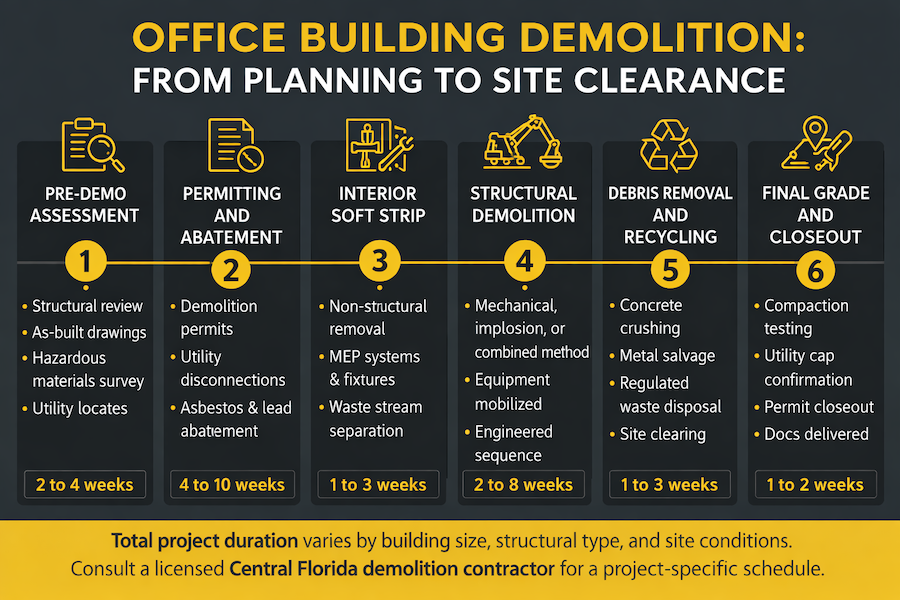
- Commission a pre-demolition assessment before finalizing your budget. This includes structural review, as-built drawing analysis, hazardous materials surveys, and utility verification.
- Require an itemized proposal from your contractor. Clarify exactly what is included: permits, traffic control, utility coordination, backfill, compaction, and final grade. Clarify what is excluded or treated as an allowance.
- Involve your demolition contractor during planning, not after design is complete. Their input on staging, phasing, and access will reduce conflicts with other trades and improve schedule accuracy.
For a detailed look at how to build a demolition budget that holds up through execution, see this guide on how to budget for a demolition project. For Central Florida-specific cost context, commercial demolition cost breakdowns can help you set early estimates.
Permitting, Environmental Compliance, and Regulations in 2026
Regulatory requirements for commercial demolition in 2026 are more detailed than they were a decade ago. For developers, GCs, and public agencies, non-compliance affects schedule, budget, and in some cases, professional liability.
Permitting and Zoning
Every county and municipality in Central Florida has its own demolition permit process and documentation requirements. What is standard in Orange County may differ meaningfully from Hillsborough, Polk, or Osceola. Common requirements across jurisdictions include:
- Proof of utility disconnection (electric, gas, water, sewer, telecom)
- Rodent control certification prior to demolition
- Waste handling and recycling plans
- Site plan showing equipment staging and access routes
In Hillsborough County, for example, demolition permits for commercial structures require coordination with Hillsborough County Environmental Protection Commission in addition to the Building Services division when regulated materials are present. In Orange County, projects touching FDOT right-of-way or state routes require a separate review and approval process that can add weeks to the permitting timeline if not initiated early.
Zoning and land use approvals are a separate track. If your planned future use requires rezoning or a special exception, that process needs to begin well before demolition, since permit issuance may depend on having an approved land use in place. For a county-by-county overview of Florida permitting requirements, see this Florida demolition permits by county guide.
Environmental Compliance
Hazardous materials: Any building built before 1980 requires a pre-demolition asbestos survey under NESHAP (National Emission Standards for Hazardous Air Pollutants) regulations. If asbestos-containing materials are found, licensed abatement must be completed before mechanical demolition begins. Lead-based paint requires separate handling and disposal protocols. PCB-containing equipment (common in older fluorescent lighting ballasts and electrical transformers) requires disposal through a licensed PCB waste hauler.
Waste management: Proper manifests are required for regulated waste. Concrete from slab and structural demolition can typically be crushed and recycled on-site or hauled to a regional recycling facility, reducing disposal costs. Metal salvage from structural steel and MEP systems has established recycling markets. For projects with sustainability reporting requirements, tracking diversion rates from the outset is easier than reconstructing records after the fact. See efficient concrete removal in Central Florida for how recycling and productivity work together on larger projects.
Stormwater and dust control: Demolition sites are subject to NPDES stormwater permit requirements. Silt fencing, inlet protection, and stabilized construction entrances are standard. Dust suppression through water application is required on most Central Florida sites, particularly during dry season, and becomes a neighbor relations issue as much as a compliance one in urban settings.
Safety Requirements and Liability
OSHA’s Construction Standards (29 CFR 1926 Subpart T) govern demolition operations. Key requirements include written engineering surveys before demolition begins, specific fall protection measures, machine guarding, and confined space protocols for below-grade work.
From an owner and GC perspective, your liability exposure is directly connected to your contractor’s safety culture and documentation. Look for:
- A written, site-specific safety plan submitted before mobilization
- Documented daily toolbox talks and job hazard analyses (JHAs)
- Designated competent person on-site during all demolition operations
- Formal PPE program with documented training
Review safety programs and PPE procedures as part of your contractor qualification process. A contractor whose safety and PPE procedures are documented and consistently followed reduces your risk profile across the board.
How to Select the Right Commercial Demolition Contractor
For office building demolition, the contractor selection process deserves the same rigor you apply to structural steel or MEP subcontractors. The lowest bid rarely represents the lowest total project cost when you account for schedule risk, change orders, and liability exposure.
Experience and Project Portfolio
Look for contractors who can demonstrate completed projects that are comparable in size and structural complexity to your own. For office buildings, that means multi-story structures with reinforced concrete or structural steel frames, not light commercial or residential work.
Contractors with experience in bridge, heavy highway, and infrastructure demolition bring skills that are directly relevant to complex office projects: working adjacent to active facilities, managing traffic and pedestrian control plans, sequencing around live utilities, and coordinating with public agencies. For projects near active roadways or public infrastructure, review the contractor’s bridge and heavy highway demolition portfolio as part of your evaluation.
Ask for:
- Minimum three references from comparable office or institutional demolition projects in Central Florida
- Photos or documented case studies showing structural complexity similar to your project
- Names and contact information for the project manager and superintendent on each reference project
Safety Record and Insurance
Experience Modification Rate (EMR): Request the contractor’s current EMR from their workers’ compensation carrier. An EMR below 1.0 indicates safety performance at or better than the industry average. Top-performing commercial demolition contractors typically carry EMRs below 0.8. An EMR above 1.2 should prompt additional questions about recent incident history and current safety programs.
Recordable incident rate: Ask for the contractor’s OSHA recordable incident rate for the past three years. Compare against the Bureau of Labor Statistics annual rate for NAICS 238910 (Site Preparation Contractors).
Insurance requirements for large commercial projects:
- General liability: $2M per occurrence / $4M aggregate minimum for most office demolition scopes
- Workers’ compensation: statutory limits, policy in good standing
- Umbrella/excess liability: $5M or higher for complex urban projects
- Pollution liability: required when regulated materials (asbestos, lead, PCBs) are present
Require certificates of insurance and additional insured endorsements before mobilization. Confirm that coverage applies to the specific scope of work, including any blasting or explosive operations if implosion is part of the scope.
Equipment Capacity and Workforce
A contractor’s ability to meet your schedule depends on what they own and who they employ, not just what they can rent or subcontract on short notice.
Questions to ask during contractor interviews:
- What high-reach excavators do you own, and what is the maximum reach?
- What concrete processing attachments and shears are in your fleet?
- Do you self-perform structural demolition, or do you subcontract it?
- What is your current backlog, and can you commit the crew and equipment your project requires on our mobilization date?
- How do you staff night and weekend shifts if the schedule requires it?
Self-performance of structural demolition work generally improves schedule control and accountability. Strategic subcontractors for abatement, blasting, or specialized utility work are reasonable and common, but the structural demolition scope should be managed directly.
Scenario: A GC is awarded a downtown office tower redevelopment linked to a federal transit funding milestone. The schedule is compressed and non-negotiable. Selecting a contractor with documented experience on similarly sized urban projects, an owned equipment fleet that does not depend on rental availability, and the supervisory depth to run phased operations is the difference between hitting the milestone and paying liquidated damages.
What to Expect at Project Closeout
The demolition phase does not end when the last wall comes down. For developers, GCs, and public owners, the contractor’s closeout deliverables directly affect your ability to start the next phase.
Standard closeout documentation should include:
- Final grading to the specified subgrade elevation with compaction reports
- Utility disconnection confirmations from all applicable utilities
- Waste manifests and recycling documentation (required for LEED and sustainability reporting)
- As-demolished survey if the site will be replatted or if utilities were relocated
- Hazardous materials abatement certificates and disposal manifests
- Permit closeout from all applicable jurisdictions
Clarify these deliverables in your contract before award. A contractor who understands what you need at closeout will plan for it from day one rather than scrambling to produce documentation after the fact.
Fast, reliable demolition services from licensed pros with decades of field experience.
Frequently Asked Questions
What is the typical timeline for office building demolition in Central Florida?
Timeline depends on building size, structural type, and site conditions. A 2 to 4-story low-rise office building with straightforward access typically takes 4 to 8 weeks from mobilization to final grade. A 6 to 10-story reinforced concrete structure in an urban setting, with interior soft strip and abatement preceding structural demolition, more commonly runs 10 to 16 weeks. Permitting and abatement add time before structural work begins, so total project duration from notice to proceed to site clearance is often longer than the structural demolition phase alone suggests. Ask your contractor to provide a detailed schedule broken down by phase during the proposal process.
What happens if hazardous materials are found during demolition?
If asbestos, lead-based paint, or PCBs are found during demolition that were not identified in the pre-demolition survey, work in the affected area must stop until the material is assessed and abated by a licensed contractor. This is one of the most common causes of cost overruns and schedule delays on older office buildings. The best protection is a thorough hazardous materials survey before demolition begins, conducted by a licensed industrial hygienist, covering the full scope of the structure, including below-grade areas and utility tunnels.
What permits are required for commercial building demolition in Central Florida?
Requirements vary by county and municipality, but most Central Florida jurisdictions require a demolition permit from the local building department, utility disconnection verification, a rodent control letter, and for structures built before 1980, a pre-demolition asbestos notification submitted to the Florida Department of Environmental Protection. Projects that affect public roads, stormwater systems, or FDOT right-of-way require additional agency approvals. Starting the permitting process 6 to 10 weeks before your target mobilization date is a reasonable baseline for most office projects.
How do I evaluate whether a demolition contractor is qualified for a large office project?
Start with comparable project references: ask for at least three projects of similar size and structural complexity completed in Central Florida within the past five years. Request the contractor’s current EMR (below 1.0 is acceptable, below 0.8 is strong). Review their equipment list and confirm they own the high-reach and concrete processing equipment your project requires. Ask who will serve as project manager and superintendent, and verify their direct experience on comparable projects.
Can office building demolition be phased while adjacent buildings stay operational?
Yes, and it is common in Central Florida office park conversions, medical campus expansions, and municipal facility replacements. Phased demolition requires detailed sequencing plans, temporary utility provisions, vibration and dust monitoring, and clear communication protocols with remaining tenants. It also affects your contractor’s production rate and may increase cost per square foot compared to full-site clearance. Raise phasing requirements in your RFP so contractors can price and plan for them accurately.
What does the site look like when demolition is complete?
A complete demolition scope typically delivers the site graded to a specified subgrade elevation with compaction tested to meet your geotechnical engineer’s requirements. All above-grade structures are removed, visible slab and foundation elements are broken and removed to the depth specified in the contract, and the site is cleared of debris. Utilities are disconnected and capped at the property line or at the depth specified by the utility provider. If your contract does not specify final subgrade elevation, grading depth, or utility disposition, add that language before award.
Planning for a Successful Project in 2026
Successful office building demolition in Central Florida is the result of early planning, accurate site assessment, and selecting a contractor whose experience, safety record, and equipment capacity match your project’s requirements.
The projects that go smoothly share a few consistent characteristics: the hazardous materials survey was completed before budget finalization, the permitting process was started before design was complete, the contractor was selected on qualifications rather than price alone, and the closeout deliverables were defined in the contract before mobilization.
The projects that experience overruns and delays almost always skipped at least one of those steps.
If you are in the planning phase for an office building demolition in Hillsborough, Orange, Osceola, Polk, Pinellas, Pasco, or any surrounding county, start with a thorough pre-demolition assessment and involve a qualified contractor early. The cost of that investment is small relative to what it protects.