
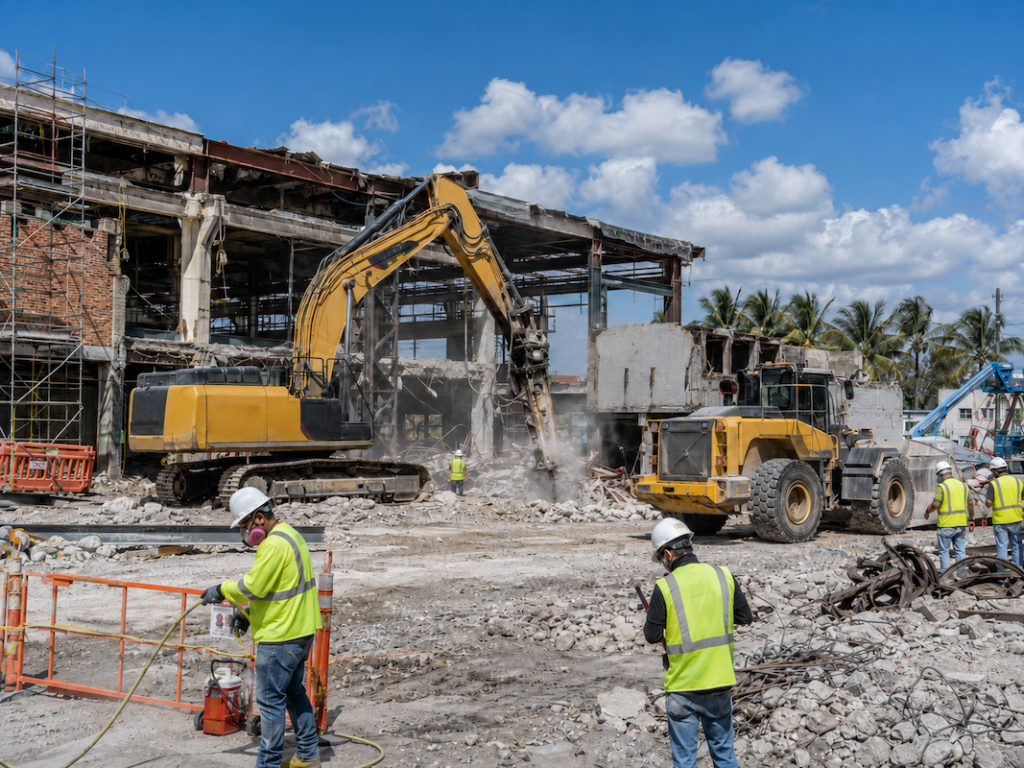
Quick Answer: Commercial demolition in Florida requires a pre-demolition hazardous materials survey, FDEP notification at least 10 working days before work begins, asbestos abatement by a licensed contractor before structural demolition, and OSHA-compliant lead exposure controls. Skipping any step exposes the owner, GC, and demolition contractor to stop-work orders, civil penalties, and criminal liability.
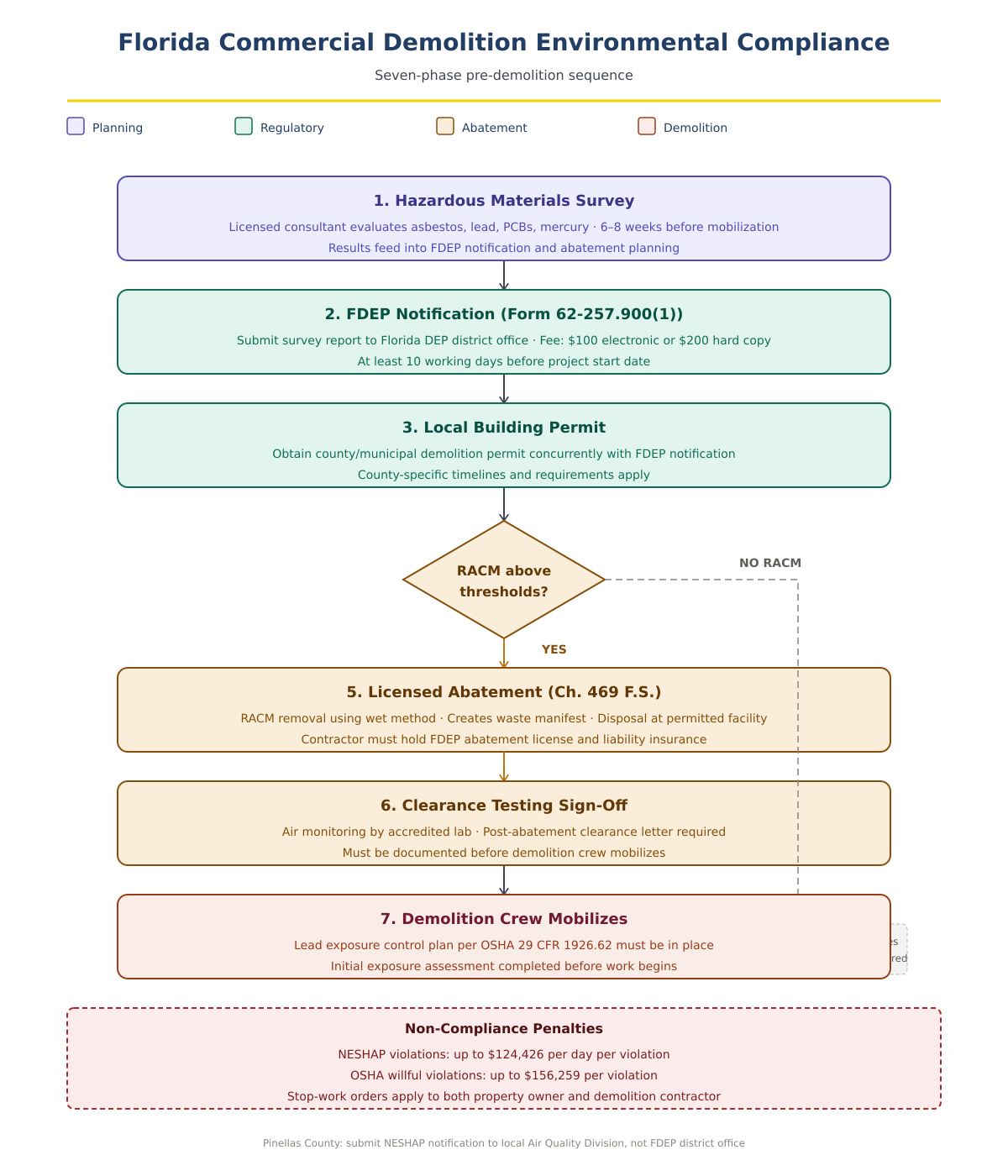
Environmental compliance in commercial demolition is not optional. It begins weeks before mobilization and follows a legally mandated sequence: survey, notification, abatement (if triggered), then crew mobilization with lead controls in place.
Two hazardous materials dominate: asbestos and lead-based paint. Both are governed by overlapping federal and Florida rules, with obligations falling on the property owner, GC, and demolition contractor simultaneously.
Key Takeaways
- Every commercial demolition in Florida requires a hazardous materials survey by a licensed consultant before any structural work begins, regardless of building age.
- FDEP must receive a Notice of Renovation or Demolition at least 10 working days before the project start date, separate from and in addition to the local building permit.
- Asbestos-containing material (ACM) above NESHAP thresholds must be removed by a licensed abatement contractor before the demolition crew mobilizes.
- OSHA’s Lead in Construction standard (29 CFR 1926.62) applies to any demolition crew disturbing surfaces that may contain lead-based paint, with no minimum quantity threshold.
- Non-compliance exposes both the property owner and the contractor to civil penalties, stop-work orders, and criminal referral under the Clean Air Act.
- Demolition contractors with in-house permitting capability help GCs keep the regulatory sequence on schedule and close the gaps between abatement and structural demolition.
Why Environmental Compliance Starts Before Demolition, Not During
The single most common mistake on commercial demolition projects is treating hazardous material management as a parallel task rather than a prerequisite. Asbestos abatement and lead controls cannot happen alongside structural demolition. They must be completed in a specific order, and that order is legally mandated.
The regulatory framework
Florida’s demolition rules follow the federal Asbestos National Emission Standards for Hazardous Air Pollutants (NESHAP), codified in 40 CFR Part 61, Subpart M. Florida implements and enforces NESHAP under Chapter 62-257, F.A.C., through the Florida Department of Environmental Protection (FDEP).
Worker safety during lead disturbance falls under OSHA’s Lead in Construction standard at 29 CFR 1926.62.
Compliance applies to all projects
Both frameworks apply to commercial, industrial, and institutional facilities. Neither waits for hazardous materials to be confirmed present. The obligation to inspect, assess, and notify begins the moment a demolition project is planned. Neither applies only to buildings of a certain age or apparent condition.
Asbestos in Commercial Demolition in Florida: The NESHAP Framework
 Who must comply with asbestos rules
The Asbestos NESHAP applies to all commercial, industrial, and institutional demolition projects. There are no size or age exemptions. A 2001-built building incorporating pre-1980 salvaged materials, vermiculite insulation, or certain cladding products may still contain regulated asbestos-containing material (RACM). Age is a risk indicator, not a legal threshold.
The residential exemption (rarely applies)
A structure qualifies for the residential exemption only if all four of these are true:
- Four or fewer dwelling units
- Not part of a larger multi-building project
- Never been used commercially
- Not being cleared for commercial redevelopment
For mixed-use or urban redevelopment projects, confirm exemption status with the applicable FDEP district office before proceeding.
Pre-demolition survey requirements
Before any demolition activity begins, conduct a thorough asbestos inspection. Florida requires this to be performed by a state-licensed asbestos consultant. Visual inspection alone is insufficient. Bulk samples of suspected materials must be analyzed using polarized light microscopy (PLM) by an accredited laboratory.
The survey report:
- Becomes the basis for FDEP notification (must accompany it)
- Documents location, type, quantity, and condition of any ACM found
- Identifies both friable material and non-friable material that may become friable during demolition
Pro Tip: Commission the asbestos survey immediately after a demolition contract is awarded, not after permit submission. Survey turnaround plus FDEP’s 10-working-day notification window can add three to four weeks to your pre-mobilization schedule. GCs who build this into their critical path avoid the most common cause of demolition schedule slippage on older commercial buildings.
NESHAP thresholds and what they trigger
The level of regulated asbestos-containing material found in the survey determines which compliance steps apply:
| RACM Quantity Found | Notification Required | Abatement Required Before Demolition |
|---|---|---|
| Any amount (even zero) | Yes. All demolitions must notify FDEP. | Only if above thresholds below |
| 260+ linear feet on pipes | Yes | Yes |
| 160+ square feet on other components | Yes | Yes |
| 35+ cubic feet off components | Yes | Yes |
| Below all three thresholds | Yes. Reduced notification still required. | No mandatory abatement, but safe work practices still apply |
One detail that consistently trips up project teams: even a building where no asbestos is found requires demolition notification to FDEP. The notification requirement for demolitions is universal. Only renovation projects below the thresholds are exempt from notification.
How to submit FDEP notification
Florida has EPA-delegated authority to administer NESHAP under Chapter 62-257, F.A.C. Submit the Notice of Renovation or Demolition (FDEP Form 62-257.900(1)) to the FDEP district office with jurisdiction over the project site, not EPA Region 4 directly.
Timing: Notification must be postmarked or received at least 10 working days before the project start date. The 10-working-day clock does not start until FDEP receives a complete notification, including the asbestos survey report. Incomplete submissions reset the clock.
Fees (as of March 2025):
- $100 for electronic submission through the DEP Business Portal with same-day payment
- $200 for hard copy or “Pay Later” invoices
Special note on Pinellas County: The local Air Quality Division administers its own asbestos program and receives notifications separately from FDEP. Confirm jurisdiction for your project location before submitting. Our county-by-county demolition permit guide details jurisdiction-specific requirements across Florida.
Pro Tip: Batch FDEP notification with the local building permit application. Many county building departments will not issue a demolition permit until the FDEP notification is confirmed received. Submitting both simultaneously accelerates the approval sequence.
Lead-Based Paint in Commercial Demolition: OSHA’s Role
Why lead is a different compliance problem than asbestos
Asbestos compliance is primarily an environmental regulation administered by EPA and FDEP. Lead-based paint compliance in demolition is primarily a worker safety regulation administered by OSHA. The two regulatory frameworks operate in parallel, and a demolition project must satisfy both independently.
OSHA’s Lead in Construction standard at 29 CFR 1926.62 applies to all construction work where employees may be occupationally exposed to lead. That definition expressly includes demolition and salvage of structures where lead or lead-containing materials are present. There is no minimum quantity threshold. If a crew is disturbing surfaces that may contain lead paint in a structure where lead is present, the standard applies.
Commercial buildings constructed before 1978 have the highest probability of containing lead-based paint. Lead can also be present in structural steel coatings, bridge components, industrial equipment coatings, and certain plumbing materials in buildings of any age. The obligation to assess begins with the pre-demolition planning phase, not after demolition starts.
Exposure assessment requirements
Before employees begin any work that may involve lead exposure, the demolition contractor must conduct an initial lead exposure assessment. The assessment determines whether any employee may be exposed at or above the action level of 30 µg/m³ of lead per cubic meter of air (measured as an 8-hour time-weighted average).
Until the assessment is complete, the contractor must assume exposures exceed the permissible exposure limit (PEL) of 50 µg/m³ and implement required control measures immediately. For commercial demolition involving lead paint, this means respiratory protection, protective clothing, and hygiene controls from the first day of work. For detailed requirements, see our guide to OSHA compliance in industrial demolition.
Key OSHA 29 CFR 1926.62 requirements for demolition contractors
| Requirement | Trigger | Details |
|---|---|---|
| Initial exposure assessment | Any work potentially disturbing lead | Air monitoring or objective data demonstrating exposure levels |
| Engineering and work practice controls | Exposure at or above action level | Wet methods, HEPA vacuums, local exhaust ventilation |
| Respiratory protection | Exposures above PEL or during interim period | Minimum half-mask with P100 filters; supplied-air for high-exposure tasks |
| Protective clothing | Exposure above PEL | Coveralls, head and foot covering; change area required |
| Hygiene facilities | Any lead exposure | Handwashing before eating, drinking, or leaving work area |
| Medical surveillance | Exposure above action level for 30+ days per year | Blood lead testing; medical removal if blood lead level reaches 50 µg/dL |
| Worker training | Any potential lead exposure | Health effects, controls, PPE, hygiene, medical surveillance requirements |
| Recordkeeping | All covered activities | Exposure records and medical records retained for 30 years minimum |
Who bears responsibility for lead compliance
Lead compliance under 29 CFR 1926.62 falls on the employer whose workers are exposed: the demolition contractor. Unlike NESHAP, where owner and contractor share notification obligations, lead safety is the contractor’s responsibility.
When vetting a demolition subcontractor, require documentation of:
- Lead compliance program and written exposure control plan
- Evidence of worker training (OSHA-compliant)
- Prior exposure assessments on similar project types
- Medical surveillance records (if applicable)
A contractor who cannot produce these is not equipped to manage lead risk.
Pro Tip: Florida and federal law do not require a pre-demolition lead paint survey for commercial buildings the way the NESHAP requires an asbestos inspection. Commissioning one anyway is standard practice among experienced GCs. A pre-demolition lead assessment gives the demolition contractor the data to set up proper controls before mobilization rather than discovering an issue after work begins and air monitoring flags an exceedance.
Other Regulated Hazardous Materials on Commercial Demolition Sites
PCBs in caulking and electrical equipment
Polychlorinated biphenyls (PCBs) were used in caulking compounds in commercial buildings built between 1950-1980, and in electrical transformers, capacitors, and light ballasts. PCBs are regulated under TSCA (EPA). Buildings with confirmed PCB caulking require a TSCA-compliant remediation plan before structural demolition.
Mercury-containing equipment
Thermostats, fluorescent lamps, switches, and HVAC components in older buildings may contain mercury. These must be segregated and handled as universal waste under Chapter 62-737, F.A.C. (Florida’s equivalent of EPA’s Universal Waste Rule). Send to a permitted recycler or disposal facility. Mercury cannot be co-mingled with general demolition debris.
Mold and water-damaged materials
Florida’s humidity makes mold a near-certain finding in buildings with roof damage, plumbing failures, or deferred maintenance. While no federal standard governs mold remediation on demolition projects, OSHA’s general duty clause and EPA mold guidelines apply. Remediate visible mold before demolition to protect workers and prevent spore dispersal to adjacent occupied structures.
How the Compliance Sequence Works on a Real Project
The following timeline reflects a realistic compliance sequence for a mid-size commercial building demolition in the Tampa Bay area. Actual durations vary based on building size, ACM quantity, and county jurisdiction.
| Phase | Activity | Typical Timing Before Demolition |
|---|---|---|
| Planning | Commission hazardous materials survey (asbestos, lead, PCBs, mercury) | 6–8 weeks out |
| Planning | Receive survey report from accredited lab | 4–6 weeks out |
| Regulatory | Submit FDEP Notice of Renovation or Demolition with survey report | Minimum 10 working days before start |
| Regulatory | Submit local building demolition permit application | Concurrent with FDEP notification or earlier |
| Abatement | Licensed abatement contractor removes RACM above NESHAP thresholds | 2–4 weeks before structural demolition |
| Abatement | Post-abatement clearance testing and sign-off by accredited lab | 1–2 weeks before structural demolition |
| Mobilization | Demolition crew arrives with OSHA lead controls and exposure plan | Start date |
GCs who engage a qualified demolition contractor early in project development avoid the most expensive compliance delays. The demolition contractor’s experience with FDEP notification requirements, abatement subcontractor coordination, and lead program administration should be part of the bid evaluation criteria.
Get a Compliance Review for Your Project
Environmental compliance on commercial demolition is too important to leave to assumption. If you’re managing a commercial, industrial, or institutional demolition project in Florida, PAW Demolition’s in-house permitting and regulatory experience can keep your project on schedule and protect your liability exposure.
Penalties for Non-Compliance in Florida
Environmental compliance failures on commercial demolition projects carry significant penalties and expose multiple parties simultaneously.
Asbestos NESHAP violations
Civil penalties reach $124,426 per day per violation (EPA inflation-adjusted). Both the property owner and the demolition contractor can be held liable for the same violation. FDEP has independent authority to assess penalties under Chapter 62-257, F.A.C. and Chapter 376.60, F.S.
Knowingly violating the Asbestos NESHAP is a criminal offense under the Clean Air Act.
OSHA lead violations
OSHA citations for lead violations (29 CFR 1926.62) are classified as serious or willful. Willful violations carry penalties up to $156,259 per violation. OSHA also issues stop-work orders halting work until violations are corrected.
The real cost: schedule impact
A stop-work order on a commercial demolition project means more than a penalty. It means equipment standby costs, schedule delays, and impact to the GC’s downstream construction schedule. Compliance is not optional.
The Bottom Line on Environmental Compliance in Commercial Demolition
- Start the hazardous materials survey immediately after contract award. The FDEP 10-working-day notification window means the survey must be complete weeks before mobilization.
- Submit the FDEP notification for every commercial demolition, even when the survey finds no asbestos. A clean survey does not waive the notification requirement.
- Sequence abatement before structural demolition. These two scopes cannot run concurrently and the regulatory framework does not allow exceptions.
- Require written lead compliance certification from every demolition subcontractor before award. OSHA 29 CFR 1926.62 is the demo contractor’s obligation, but it creates GC exposure if the sub is not equipped to manage it.
- Confirm county jurisdiction before submitting FDEP notification. Pinellas County operates its own asbestos program with separate notification requirements.
- Evaluate demolition contractor compliance experience as a bid criterion. In-house permitting capability, documented FDEP notification history, and a track record of abatement coordination are operational qualifications, not soft differentiators.
Frequently Asked Questions
Does a commercial building built after 1980 require an asbestos survey before demolition in Florida?
Yes. Florida requires a licensed asbestos consultant to inspect any commercial building before demolition, regardless of construction date. Buildings built after 1980 can still contain regulated asbestos-containing materials, including certain roofing products, gaskets, floor tiles, and spray-applied fireproofing that remained in use into the 1990s. Age reduces probability; it does not eliminate the inspection obligation.
What is the difference between RACM and ACM, and why does it matter for commercial demolition?
Asbestos-containing material (ACM) is any material with more than one percent asbestos by composition. Regulated asbestos-containing material (RACM) is the subset of ACM that triggers NESHAP removal and work practice requirements: friable ACM, and non-friable ACM that will likely become friable under the forces of demolition. NESHAP thresholds and mandatory abatement requirements apply to RACM, not to all ACM. Category I non-friable ACM with a low probability of becoming friable during demolition may not require removal before structural work, but it must still be documented in the notification and handled as regulated waste after demolition.
Is a lead paint survey legally required before commercial demolition in Florida?
No Florida statute or federal EPA rule mandates a pre-demolition lead paint survey for commercial buildings. However, OSHA 29 CFR 1926.62 requires the demolition employer to conduct an initial lead exposure assessment before employees begin any work that may generate lead exposure. A pre-demolition lead survey provides the data needed to design OSHA-compliant controls before mobilization rather than responding to air monitoring exceedances after work has begun, and it is standard practice on commercial projects managed by experienced GCs.
Can the general contractor file the FDEP asbestos notification, or does it have to be the demolition contractor?
Either party can file the notification. The NESHAP defines the responsible party as anyone who owns, leases, operates, controls, or supervises the facility being demolished, or anyone who owns, leases, operates, or supervises the demolition operation. Both the property owner and the demolition contractor share notification responsibility and both can be cited if no notification is filed. Assign notification responsibility explicitly in the subcontract to avoid a gap.
How much does environmental compliance add to the cost of a commercial demolition project in Florida?
Hazardous material compliance costs on a commercial demolition project in Florida typically range from $5,000 to $30,000 or more depending on building age, square footage, the type and quantity of regulated materials found, and whether abatement is required before structural work. The survey itself usually runs $1,500 to $5,000. Licensed abatement is priced per linear foot or square foot of RACM removed and can be the largest compliance cost on older or industrial buildings. These figures vary by project and county. They are consistent with PAW Demolition’s experience on commercial projects in the Tampa Bay region and should not be treated as fixed estimates.
What happens if unexpected asbestos is found after demolition has already begun?
Work in the affected area must stop immediately. The contractor must implement emergency containment, notify FDEP of the discovery, and submit a revised notification documenting the additional RACM before work in that area resumes. A revised notification is required whenever discovered RACM exceeds the original estimate by 20 percent or more. Continuing structural demolition in an area with newly identified RACM without re-notifying is a federal Clean Air Act violation.