
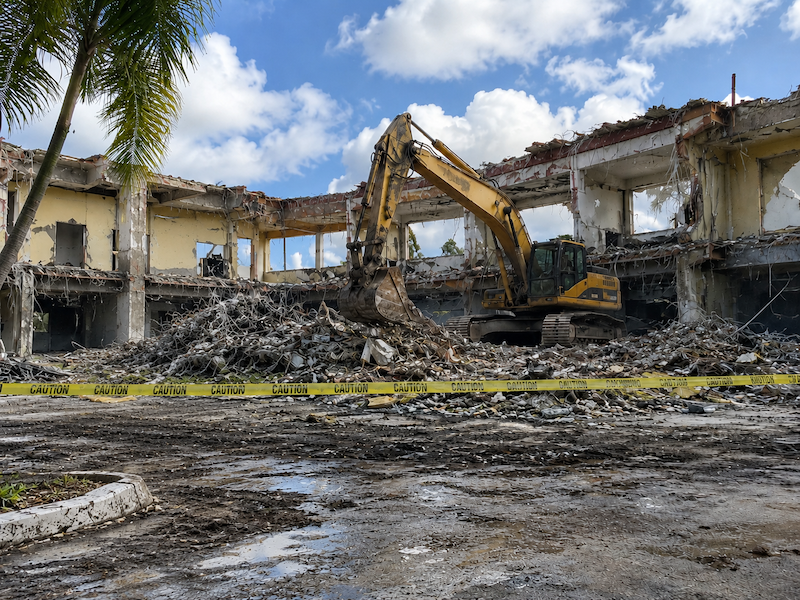
Quick Answer: In Florida, hiring a licensed abatement contractor before demolition is legally required whenever asbestos-containing materials are present or suspected. Both federal NESHAP regulations and Florida-specific rules apply, and skipping this step can result in stop-work orders, significant fines, and serious health liability.
Key Takeaways
- Florida demolition projects require a licensed asbestos abatement contractor before any structural work begins on buildings constructed before 1981.
- Both the EPA’s NESHAP regulations and Florida Department of Environmental Protection (FDEP) rules apply simultaneously, creating a dual compliance obligation.
- A licensed asbestos inspector and the abatement contractor must be separate entities under Florida law.
- Regulatory notification must be submitted at least 10 working days before abatement begins.
- Abatement costs in Florida typically range from $1,500 to $30,000 or more depending on project scope, material type, and building size.
- Non-compliance can trigger civil penalties, project shutdowns, and personal liability for general contractors and property owners.
Why Asbestos Abatement is Crucial Before Demolition in Florida
Asbestos was used extensively in commercial and industrial construction through the late 1970s. Insulation, floor tiles, roofing materials, pipe wrap, and fireproofing compounds all commonly contained asbestos fibers. When a structure is disturbed or demolished, those fibers become airborne and create serious health and legal exposure for everyone on and near the site.
Florida’s climate and construction history mean a large share of the commercial building stock still contains asbestos-containing materials (ACM). Before your crew touches a single wall, you need to understand what’s in the building and what the law requires you to do about it.
Health Risks Associated with Asbestos
Asbestos fibers are microscopic and invisible to the naked eye. Once inhaled, they lodge permanently in lung tissue and can cause:
- Mesothelioma: A rare and aggressive cancer of the lining of the lungs, abdomen, or heart with no cure.
- Asbestosis: Chronic scarring of lung tissue that progressively reduces breathing capacity.
- Lung cancer: Risk is significantly elevated in workers with prolonged asbestos exposure.
- Pleural disease: Thickening and calcification of the lung lining.
These diseases typically develop 10 to 40 years after initial exposure, which means workers may not show symptoms until decades after a demolition project. That long latency period is exactly why regulators treat asbestos exposure as a zero-tolerance issue on active job sites.
Legal Framework Governing Asbestos Abatement
Florida operates under a dual regulatory system for asbestos abatement. General contractors need to understand both layers before scheduling any demolition work.
- Federal NESHAP (National Emission Standards for Hazardous Air Pollutants): Administered by the EPA, NESHAP requires notification, proper removal, and approved disposal for all demolition and renovation projects involving regulated ACM. The EPA’s NESHAP guidance outlines the specific thresholds and notification requirements that apply nationally.
- Florida-specific regulations: The Florida Department of Environmental Protection (FDEP) enforces asbestos rules under Florida Statutes Chapter 469 and Florida Administrative Code Chapter 62-257. Licensing, training, and work practice standards are administered through the Florida Department of Business and Professional Regulation (DBPR).
- OSHA standards: 29 CFR 1926.1101 governs worker protection during asbestos removal on construction and demolition sites, including air monitoring, personal protective equipment, and containment requirements.
- Hillsborough County local oversight: The Environmental Protection Commission of Hillsborough County (EPCHC) administers its own asbestos notification and enforcement program. Projects in Hillsborough must file with the EPCHC in addition to meeting federal and state requirements.
Understanding environmental compliance for demolition in Florida is not optional. Both the EPA and FDEP can independently levy penalties, and local air quality districts may add another layer of oversight depending on the county.
Steps to Hire the Right Abatement Contractor Before Demolition
Not every contractor advertising asbestos services is qualified to handle commercial or industrial abatement in Florida. The selection process matters as much as the abatement work itself. A misstep here can invalidate your compliance documentation and expose your project to regulatory action.
Verifying Credentials and Licenses
Florida requires all asbestos abatement contractors to hold a specific license issued through DBPR. Here’s how to verify you’re hiring a qualified firm:
- Visit the Florida DBPR license verification portal and search for the contractor’s license number under the “Asbestos Contractor” category.
- Confirm the license is active and not under any disciplinary action.
- Verify that the on-site supervisor holds an individual Asbestos Supervisor license, separate from the company license.
- Ask for proof of liability insurance and workers’ compensation coverage specific to asbestos work.
- Request references from comparable commercial or industrial demolition projects in Florida.
If you’re qualifying a subcontractor for a larger bid, the demolition contractor prequalification process in Florida should include abatement credential verification as a standard checklist item.
Conducting an Asbestos Survey
Before abatement can begin, a licensed asbestos inspector must conduct a thorough survey of the building. This is not a task the abatement contractor can perform on their own structure. Florida law requires the inspection and abatement functions to be handled by separate entities to prevent conflicts of interest.
The survey process includes:
- Visual inspection of all accessible building materials
- Bulk sampling of suspected ACM by a licensed asbestos inspector or consultant
- Laboratory analysis of samples using polarized light microscopy (PLM)
- A written report identifying all ACM locations, quantities, and condition
The survey report becomes the foundation for your abatement scope of work, your regulatory notification, and your compliance documentation. Without it, your project has no legal basis to proceed.
Pro Tip: Request the asbestos survey report in digital format with GPS-tagged photo documentation. This makes regulatory submissions faster and gives you a defensible record if questions arise during or after the project.
Understanding the Costs Involved in Asbestos Abatement Before Demolition
Cost is one of the first questions that comes up when abatement enters the conversation. The honest answer is that it depends on several variables, but understanding the cost structure helps you build accurate project budgets and avoid surprises mid-schedule.
Itemizing Abatement Costs
Asbestos abatement costs in Florida typically range from $1,500 for small residential scopes to $30,000 or more for large commercial or industrial projects. The primary cost drivers include:
- Square footage of ACM: More material means more labor, more containment, and more disposal volume.
- Material type: Friable ACM (easily crumbled) requires more intensive removal procedures than non-friable materials.
- Location within the building: Confined spaces, high ceilings, and mechanical rooms increase labor time and safety requirements.
- Disposal fees: Florida requires ACM to be disposed of at approved landfills. Transport and tipping fees vary by county and material volume.
Hidden costs that general contractors often overlook include:
- Air monitoring during abatement (required for certain project types)
- Clearance testing before the containment area is reopened
- Third-party industrial hygienist oversight
- Decontamination unit setup and removal
- Permit fees for asbestos notification filings
For a broader picture of how abatement fits into your overall project budget, reviewing industrial demolition costs in Florida can help you set realistic expectations before you finalize your bid.
Financial Risks of Non-compliance
Skipping abatement is never a cost-saving move. The financial exposure from non-compliance far exceeds the cost of doing it right. Here’s what’s at stake:
- EPA penalties: Up to $70,117 per day per violation under NESHAP [CITATION NEEDED: current EPA civil penalty schedule]
- FDEP penalties: Florida can assess separate civil penalties under state law
- Stop-work orders: Your entire project shuts down until compliance is demonstrated
- Criminal liability: Knowing violations can result in criminal charges for individuals, not just companies
- Third-party lawsuits: Workers, neighboring property owners, and future occupants may have civil claims
Get Your Free Demolition Quote
Contact us today to get started with your demo project.
Ensuring Safety and Compliance During Demolition
Abatement doesn’t end when the last bag of ACM leaves the site. Compliance runs through the entire demolition sequence, and the coordination between your abatement contractor, your demo crew, and the regulatory authorities determines whether the project finishes clean or gets derailed.
Coordination with Regulatory Authorities
Florida requires advance notification to the FDEP before any asbestos abatement or demolition involving regulated ACM. Key notification requirements include:
- Timing: Notification must be submitted at least 10 working days before abatement begins. Emergency demolitions have a shorter window but still require notification.
- Content: The notification must include the project address, building description, ACM quantities and types, planned start and completion dates, contractor information, and disposal site details.
- Submission: Florida uses the FDEP’s online notification system. Paper submissions are also accepted in some districts.
- Updates: If project dates change, an amended notification must be filed. Failing to update is treated as a separate violation.
Your demolition permits by county in Florida may also trigger additional local requirements depending on the jurisdiction. Hillsborough, Pinellas, and Orange counties each have their own inspection and approval processes that run parallel to state notification.
Implementing Safety Protocols
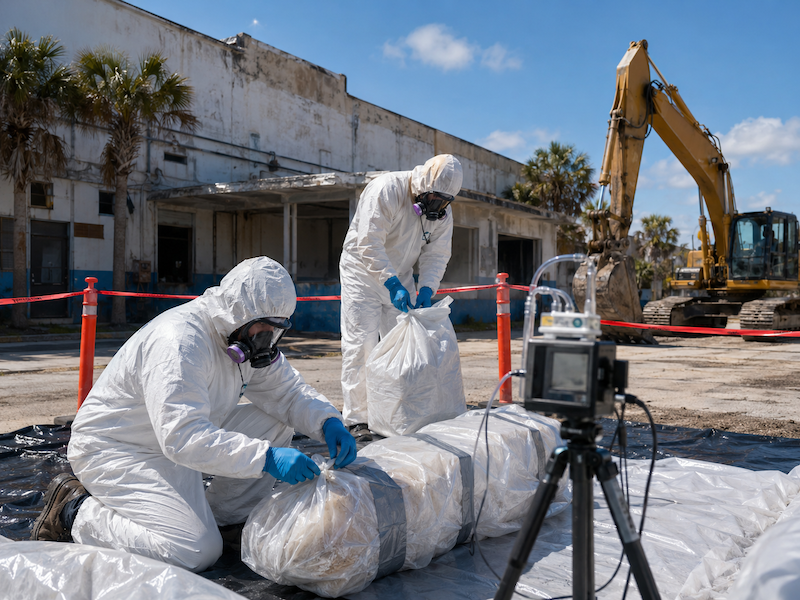 OSHA’s asbestos standard for construction (29 CFR 1926.1101) sets the minimum requirements for worker protection during abatement. Your abatement contractor is responsible for implementing these, but as the general contractor, you have a duty to verify compliance on your site.
Required safety measures include:
- Regulated area establishment with posted warning signs and restricted access
- Personal protective equipment (PPE) including half-face or full-face respirators with HEPA filters
- Negative pressure enclosures for Class I and Class II asbestos work
- Wet methods to suppress fiber release during removal
- Decontamination units for workers entering and exiting the regulated area
- Air monitoring to verify fiber concentrations remain below the permissible exposure limit (PEL)
Proper demolition waste management for ACM requires sealed, labeled, and wetted bags or containers. These must be transported to an approved disposal facility by a licensed waste hauler. Mixing ACM waste with general demolition debris is a serious violation.
Pro Tip: Keep a dedicated compliance binder on site throughout the abatement and demolition phases. Include the asbestos survey, FDEP notification confirmation, abatement contractor license, air monitoring results, and disposal manifests. This documentation protects you if a regulatory inspector shows up unannounced.
Lessons from Florida Demolition Projects
Real-world projects illustrate why following the abatement process precisely is worth the time and cost investment. The following scenarios reflect common patterns seen across Florida commercial demolition projects.
When Compliance Protects the Schedule
A general contractor managing the redevelopment of a 1960s-era warehouse in Tampa initiated the asbestos survey eight weeks before the planned demolition start date. The survey identified pipe insulation and floor tile ACM in two sections of the building. Because the GC had built abatement time into the schedule, the licensed contractor completed removal within the 10-working-day notification window. Clearance testing passed on the first attempt, and demolition started on time. The proactive approach added roughly $18,000 to the project budget but protected a $2.4 million construction contract from any delays.
When Skipping Abatement Becomes Expensive
A property owner in Central Florida contracted a demolition crew to tear down a 1970s commercial structure without ordering an asbestos survey. During demolition, a neighboring property owner contacted the FDEP. Inspectors arrived on site, identified visible ACM in the debris pile, and issued an immediate stop-work order. The project sat idle for three weeks while an emergency abatement contractor was mobilized, a retroactive notification was filed, and the contaminated debris was segregated and disposed of properly. Total cost of the compliance failure: more than $90,000 in fines, emergency abatement fees, and extended equipment rental.
These patterns repeat across Florida. The takeaway is straightforward: the abatement process is not a bureaucratic inconvenience. It is a critical path item that protects your crew, your schedule, and your professional reputation.
Pro Tip: When bidding a demolition project on a pre-1981 building, include a line item for asbestos survey and contingency abatement in every proposal. This protects your margin and sets accurate expectations with the owner before the contract is signed.
Bottom Line on Hiring an Abatement Contractor Before Demolition in Florida
- Start the asbestos survey early. Commission it as soon as a demolition project is awarded. Waiting until the last minute compresses your schedule and limits your contractor options.
- Verify every license before you sign a contract. Use the Florida DBPR portal to confirm the abatement contractor and supervisor are both currently licensed.
- File your FDEP notification on time. The 10-working-day requirement is non-negotiable. Build it into your project timeline from day one.
- Keep all compliance documentation on site. Survey reports, notifications, air monitoring results, and disposal manifests must be accessible throughout the project.
- Budget for abatement before you bid. Include survey costs and abatement contingency in every proposal involving a pre-1981 structure.
- Treat the abatement contractor as a critical subcontractor. Vet them with the same rigor you apply to structural and MEP subs. Their work directly affects your compliance status.
Plan Your Tear Down
Fast, reliable demolition services from licensed pros with decades of field experience.
Frequently Asked Questions
Do I need an asbestos inspection before demolishing a building in Florida?
Yes, a licensed asbestos inspector or consultant must conduct a building inspection before any abatement or demolition work begins on structures that may contain ACM. Florida law requires this inspection to be performed by an entity that is separate from the abatement contractor. The inspection report determines whether regulated ACM is present and defines the scope of required removal work.
How do I find a licensed asbestos abatement contractor in Florida?
Licensed asbestos abatement contractors in Florida can be verified through the Florida Department of Business and Professional Regulation (DBPR) online license search at myfloridalicense.com. Search under the “Asbestos Contractor” license category and confirm that both the company license and the individual supervisor license are active and in good standing before signing any contract.
What are the Florida regulations for asbestos removal before demolition?
Florida asbestos removal is governed by two parallel regulatory systems. At the federal level, the EPA’s NESHAP regulations require advance notification, proper removal, and approved disposal for all demolition projects involving regulated ACM. At the state level, Florida Administrative Code Chapter 62-257 and Florida Statutes Chapter 469 set licensing, work practice, and disposal requirements enforced by FDEP and DBPR. Both sets of rules apply simultaneously.
How much does asbestos abatement cost in Florida before demolition?
Asbestos abatement costs in Florida typically range from $1,500 for small scopes to $30,000 or more for large commercial or industrial projects. Cost variables include the type and quantity of ACM, the accessibility of affected areas, disposal fees, and whether air monitoring and clearance testing are required. Budget for these line items separately from the abatement labor and materials costs.
What happens if you demolish a building with asbestos without abatement in Florida?
Demolishing a building containing regulated ACM without proper abatement in Florida can result in an immediate stop-work order, EPA civil penalties of up to $70,117 per day per violation, separate FDEP penalties under state law, emergency remediation costs, and potential criminal charges for knowing violations. General contractors and property owners can both be held personally liable.
How long does asbestos abatement take before a demolition project?
Asbestos abatement timelines depend on the scope of work, but the regulatory minimum is 10 working days of advance notification to FDEP before abatement can begin. The actual removal work can take anywhere from a few days for minor scopes to several weeks for large commercial or industrial buildings. Factor in additional time for clearance testing and documentation before demolition crews can mobilize.